

NR 340-Exam 2 Study Guide-Critical Care Graded A+ 2025
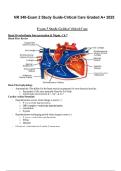
Basic Dysrhythmia Interpretation & Mgmt.-Ch 7 Blood Flow Review Basic Electrophysiology • Automaticity-The ability for the heart muscle to generate it's own electrical activity o Pacemaker Cells arise naturally from the SA Node o Electrolytes involved are K+, Na+, & Ca+ Cardiac Action Potentials • Depolarization-occurs when charge is more (+) o P wave=atrial depolarization o QRS complex=ventricular depolarization o contraction o Systole • Repolarization-recharging period when charge is more (-) o T wave=ventricular repolarization o filling o Diastole • Electrical + Mechanical=Cardiac Contraction • Action Potential Curve o See Below-Sodium, Potassium, & Calcium flow in & out of the cell at different times allowing for charge changes and contraction of heart muscle tissue. o 4 Phases ▪ Early Repolarization • sodium channels close ▪ Phase 2-Plateau Phase • potassium leaves cell ▪ Phase 3-Rapid Repolarization • calcium channels close • potassium returns into cell quickly ▪ Phase 4-Resting Phase (polarized state) • active transport through the Na-K pump begins restoring K to inside the cell & sodium to the outside of the cell • cell membranes become impermeable to sodium • Potassium may move in & out of the cell Intrinsic Rates of Conduction Pathway • SA Node o natural pacemaker o 60-100 bpm • AV Node o takes over as pacemaker if SA node can't do the job o 40-60 bpm • Purkinje Fibers o last resort to pace heart if both SA & AV nodes fail o 20-40 bpm Cardiac Monitoring • 12 lead ECG o only 10 electrodes used to monitor, but gives 12 overall electrical pictures ▪ 4 limb leads ▪ 6 trunk leads o shows change or damage to heart muscle ▪ ischemia, infarct, enlarged cardiac chambers, electrolyte imbalances or drug toxicity Calculating Heart Rate from a 6 Second Strip • Graph Paper o Vertical boxes measure voltage or amplitude o Horizontal boxes measure time (in seconds) ▪ 1 small box=0.04 seconds ▪ 1 large box=0.20 seconds ▪ 5 large boxes=1 second • a six-second strip will be 30 large boxes • To calculate rate on a 6 second strip, count R-to-R and multiply by 10 Cardiac Waveforms & Determining Rhythm • P Wave • atrial depolarization • 0.04-0.10 seconds in duration ▪ Are they present? ▪ are they regularly occurring? ▪ is there a P for each QRS? ▪ are the P waves smooth, rounded, & upright? ▪ do all P waves look similar? • QRS Complex • ventricular depolarization • 0.06-0.10 seconds in duration ▪ is the complex 0.12 seconds (wide)? • can indicate ventricular origin ▪ is the complex 0.12 seconds (narrow)? • most likely supraventricular in origin (SA/AV nodes) ▪ do the complexes have a similar appearance across the tracing? • QT Interval • 0.38-0.42 seconds • begins at the QRS Complex to the end of the T wave • varies with heart rate • Pathological Q waves • 0.04 seconds in width & more than 1/4 R wave amplitude • indication of MI or myocardial tissue death • ST Segment • Elevation ▪ myocardial injury or hyperkalemia • STEMI ▪ looks like a tombstone • Depression ▪ myocardial ischemia or digoxin use • T Wave • ventricular repolarization • follows QRS Complex • U Wave • can sometimes bee seen after the T wave • can be normal or indicate hypokalemia • PR Interval • 0.12-0.20 seconds in duration ▪ is the interval 0.20 seconds? ▪ is the interval 0.12 seconds? ▪ is the interval constant across the tracing? Cardiac Dysrhythmias • Normal Sinus • Rate 60-100 • Rhythm regular • P waves before QRS & upright • PR interval 0.12-0.20 seconds • QRS complexes 0.12 seconds & look alike • Sinus tachycardia • Causes ▪ stress, exercise, fever, anemia, hypoxemia, CHF, pain • Effects on body ▪ faster rate decreases CO • S&S ▪ pounding heart, dizziness, anxiety, weak pulses ▪ decreased BP, UO • Treatment ▪ treat underlying cause ▪ give O2 ▪ if CHF, give Digoxin • Rate 100-160 • Rhythm regular • P waves before QRS & upright • PR interval 0.12-0.20 seconds • QRS complexes 0.12 seconds & look alike • Sinus bradycardia • Causes ▪ athletes, acute spinal cord injury • Effects on body ▪ lower rate decreases CO • S&S ▪ dizziness, SOB, weak pulses • Treatment ▪ Atropine by IV bolus to increase heart rate • 0.5 mg q3-5 minutes for a total dose of no more than 3 mg • S/Es: dry mouth/eyes, blurry vision, decreased UO, further slowing of heart rate if 0.5 mg are given • Rate 60 • Rhythm regular • P waves before QRS & upright • PR interval 0.12-0.20 seconds • QRS complexes 0.12 seconds & look alike Atrial Rhythms • Causes o Stress response, electrolyte imbalances, hypoxia, atrial injury, Dig toxicity, hypothermia o hyperthyroidism, alcohol, pericarditis, drugs • Premature Atrial Contractions (PACs) • early beats initiated by the atria not the SA node resulting in an early P wave • P waves & PR intervals may vary and are not at a regular rhythm • normal QRS Complexes • Precursor to other atrial tachycardias • S&S ▪ palpitations, heart skipping or pausing • Supraventricular tachycardia (SVT) • Causes ▪ heart disease, use of digoxin • Effects on body ▪ rhythm can come & go ▪ decreases CO • S&S ▪ • Treatment ▪ O2, start an IV, vagal maneuvers/valsalva, carotid massage ▪ adenosine by rapid IV push to block AV node transmission & stop heart briefly • 6 mg rapid IV push initially, followed by a second bolus of 12 mg 2 minutes later if not convert back to NSR o all doses followed by flush of NS and raising of arm • monitor HR, BP, and rhythm pattern • Have crash cart and/or defibrillator present in room • S/Es: diaphoresis, facial flushing, lightheadedness, chest pain ▪ Beta Blockers (Metroprolol, Labetalol) • decreases HR & BP, cardioprotective effects for MI patients • slow IV push • continuous monitoring of BP, HR, & rhythm o do NOT give for HR less than 50 or with 2nd or 3rd* heart block • S/Es: bradycardia, hypotension, heart failure ▪ Calcium Channel Blocker (Diltiazem, Verapamil) • slows conduction through AV node & decreases HR • Diltiazem 15-20 mg slow IV push over at least 2 minutes with a repeat bolus of 20-25mg if needed can be given after 15 minutes o IV infusion rate of 5-15 mg/hr may be started & titrated to desired HR • Verapamil 2.5-5 mg slow IV push over at least 2 minutes; if no response, can give repeat boluses of 5-10 mg every 15-30 minutes for a total dosage of 20 mg • S/Es: hypotension, bradycardia, flushing, burning at injection site, CHF, heart block • Rate 150-250 • Rhythm regular • P waves usually not discernible, especially at high rates • PR interval usually not discernible • QRS complexes 0.12 seconds & look alike • Atrial fibrillation- • Causes: ▪ CHF, ischemic or rheumatic heart disease, pulmonary disease • Effects on Body ▪ decreases CO • S&S ▪ palpitations • Treatment ▪ Maze Procedure • permanently cures afib • series of incisions are cut into interior heart muscle to prevent conduction of ectopic stimuli ▪ Digoxin • slows conduction through the AV node, increases contraction resulting in a slower & stronger heartbeat with increased CO • initial dose is .25-.5 mg, followed by .25-.5 mg q4-6h until a therapeutic level has been reached o maintenance dose is 0.125-0.5 mg daily o administration of a single dose is over a minimum of 5 min o monitor electrolytes closely (Mg, K, Ca) and watch dig serum levels o S/Es: can cause AV block or other dysrhythmias ▪ signs of toxicity are ST segment sag, PR prolongation, and possible ventricular bigeminy • Rate: atrial 350-400, ventricular varies • Rhythm: irregularly irregular • P waves absent & replaced with F waves • PR interval not discernible • QRS complexes usually 0.12 seconds & look alike • Atrial Flutter-originates in the right atrium, AV node delayed signal • Causes ▪ History of CAD, HTN, COPD, RHF, hypothyroid ▪ MI, hypoxia, dig toxicity, CHF • Effects on body ▪ decreases CO • S&S ▪ fixed ratio of 3:1 (F:QRS) • Treatment ▪ Beta Blockers (Metroprolol, Labetalol) • decreases HR & BP, cardioprotective effects for MI patients • slow IV push • continuous monitoring of BP, HR, & rhythm o do NOT give for HR less than 50 or with 2nd or 3rd* heart block • S/Es: bradycardia, hypotension, heart failure ▪ Calcium Channel Blocker (Diltiazem, Verapamil) • slows conduction through AV node & decreases HR • Diltiazem 15-20 mg slow IV push over at least 2 minutes with a repeat bolus of 20-25mg if needed can be given after 15 minutes o IV infusion rate of 5-15 mg/hr may be started & titrated to desired HR • Verapamil 2.5-5 mg slow IV push over at least 2 minutes; if no response, can give repeat boluses of 5-10 mg every 15-30 minutes for a total dosage of 20 mg • S/Es: hypotension, bradycardia, flushing, burning at injection site, CHF, heart block • Rate: atrial 250-300, ventricular varies ▪ loss of atrial kick & decreased CO with ventricular rate 100 • Rhythm: atrial regular, ventricular can be regular or irregular • P waves absent & replaced with F waves (sawtooth) • PR interval not measurable • QRS complexes usually 0.12 seconds & look alike Ventricular Dysrhythmias • Causes o myocardial ischemia, injury & infarction; low potassium or magnesium o hypoxia; acid-base imbalance • Premature Ventricular Complexes (PVCs) ▪ can occur in 2s (couplets), multifocal (varied QRS shapes), or as bigeminy • Causes ▪ ischemia, infarct, dig toxicity, caffeine, tobacco & alcohol • Effect on Body ▪ can lead to V Fib & V Tach • Treatment ▪ Lidocaine: blocks sodium channels, decreasing cardiac automaticity & depolarization • initial dose is 1-1.5 mg/kg IV; can repeat 0.5-0.75 mg/kg IV given at 5-10 minute intervals up to a max dose of 3 mg/kg • maintenance infusion of 1-4 mg/min is hung if bolus was unable to terminate the dysrhythmia • S/Es: transient due to short duration; confusion, dizziness, numbness of tongue & lips, hallucinations & vomiting o Major: bradycardia, seizures, cardiac arrest, hypotension, respiratory depression & cardiovascular collapse • Rate: dependent on underlying rhythm & number of PVCs • Rhythm: occasionally irregular; regular if interpolated PVCs • P waves not associated with PVCs, P wave of underlying rhythm may be present • PR interval not present with PVCs • QRS complexes usually /=0.12 seconds & look wide and bizarre • Ventricular tachycardia • Causes ▪ 3+ PVCs in a row, MI, decreased potassium, dig toxicity • Impact on Body ▪ decreases CO, sweating, decreased BP, dizziness, syncope, weak & thready pulses • Treatment ▪ CPR if pulseless, intubation, defibrillation ▪ Amiodarone-prolongs duration of action potential, raising the threshold for SVT & vfib, and may prevent its occurrance • 150 mg IV (diluted in 100 ml of D5W) administered over 10 min & repeated as needed to a max dose of 2.2g in 24h. o if successful in converting back to NSR, maintain infusion at 1 mg/min over 6h, followed by 0.5 mg/min maintenance infusion over 18 hours • Use central line & use a glass bottle for infusions taking more than 2h since amio can leech chemicals from plastics • S/Es: hypotension, bradycardia, prolonged QT interval; may cause torsades de pointes o the long half life can allow S/Es to last long after drug is stopped • Rate: 100-250 • Rhythm: atrial rhythm not distinguishable, ventricular rhythm usually regular • P waves may be present or absent; not associated with QRS complexes • PR interval none • QRS complexes usually 0.12 seconds & look alike, bizarre morphology • Torsades de Pointes • Causes ▪ decreased magnesium, hypothermia • Treatment ▪ defibrillation ▪ magnesium sulfate-CNS & cardiac muscle relaxant; anticonvulsant & antidysrhythmic • immediate onset & lasts 30 min • 1-2g diluted in 10 ml D5W over 5-20 min slow IV push • S/Es: CNS & respiratory depression, hypotension, complete heart block, circulatory collapse, cardiac arrest ▪ Procainamide-prolongs cardiac action potential; slows conduction & works in 2-3 min • given IV infusion as a loading dose of 20 mg/min until dysrhythmia is suppressed, hypotension ensues, & the QRS widens by 50% or 17mg/kg of the drug has been given. o maintenance dose is started after suppression or max dose is reached at 1-4 mg/min • for the loading dose, 1g can be diluted into 50 ml D5W to yield 20 mg/ml administered via infusion pump at 1 ml/min • S/Es: blood dyscracias, hypotension, prolonged PR interval, widened QRS complex, long QT interval, & ventricular asystole. • Ventricular fibrillation • Causes ▪ acute MI, untreated v tach, hypothermia, R-on-T phenomenon (PVC on T wave), PVCs, electrolyte imbalances, electric shock • Impact on Body ▪ unresponsive, apneic, no palpable pulses or BP • Treatment ▪ defibrillation, CPR, ACLS protocol Coarse Fine • Rate: not discernible • Rhythm: not distinguishable, rapid & unorganized • P waves not before each QRS • PR interval none • QRS complexes none • Heart blocks • conduction blocked from atrium to ventricle • Causes ▪ CAD, MI, recent infection, dig toxicity • 1st degree AV block ▪ Rate: based on underlying rhythm ▪ Rhythm: usually regular ▪ P waves upright & before each QRS ▪ PR interval 0.20 seconds ▪ QRS complexes look alike & are 0.12 seconds
Document information
- Uploaded on
- November 5, 2025
- Number of pages
- 37
- Written in
- 2025/2026
- Type
- Exam (elaborations)
- Contains
- Questions & answers


