
?
D?
OVE
PR
_AP
K?
EE
MG
, ??
ED
OV
PR
_AP
K?
EE
MG
, ??
ED
OV
PR
_AP
K?
EE
MG
, MG
EE
K?
_AP
PR
OV
ED
??
D?
OVE
PR
_AP
K?
EE
MG
, ??
ED
OV
PR
_AP
K?
EE
MG
, ??
ED
OV
PR
_AP
K?
EE
MG
, MG
EE
K?
_AP
PR
OV
ED
??
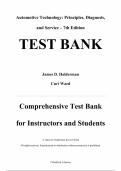
The Test Bank for Automotive Technology: Principles, Diagnosis, and Service, 7th Edition by James D. Halderman and Curt Ward (ISBN 9780137871797) is a fully aligned assessment resource built to match the textbook’s comprehensive chapter‑by‑chapter structure. Designed for instructors, it provides a wide range of question types—multiple choice, true/false, scenario‑based diagnosis items, and case‑study questions—that correspond to the textbook’s stated learning objectives and current ASE service area standards. The assessment material begins with Chapter 1: Automotive Background and Overview, then follows with Chapter 2: Careers in the Automotive Service Industry, Chapter 3: Starting a Career in the Automotive Industry, and Chapter 4: Working as a Professional Service Technician. It continues into the safety section with Chapter 5: Shop Safety, Chapter 6: Hazardous Materials, and Chapter 7: Health and Environmental Concerns. The next section covers tools and shop infrastructure through Chapter 8: Fasteners and Thread Repair, Chapter 9: Hand and Power Tools, Chapter 10: Vehicle Lifting and Hoisting, followed by measurement and scientific fundamentals in Chapter 11: Measuring, Math, and Charts and Chapter 12: Scientific Principles and Materials. The routine maintenance segment includes Chapter 13: Service Information, Work Orders, and Vehicle Identification and Chapter 14: Preventative Maintenance and Service Procedures. The engine repair section opens with Chapter 15: Gasoline Engine Operation, Parts, and Specifications, continuing through a full spectrum of engine chapters including Chapter 16: Diesel Engine Parts, Operation, and Aftertreatment, Chapter 17: Antifreeze and Coolant, Chapter 18: Cooling System Operation and Diagnosis, Chapter 19: Engine Oil and Filters, Chapter 20: Lubrication System Operation and Diagnosis, Chapter 21: Intake and Exhaust Systems, Chapter 22: Turbocharging and Supercharging, Chapter 23: Engine Condition Diagnosis, Chapter 24: In‑Vehicle Engine Service, Chapter 25: Engine Removal and Disassembly, Chapter 26: Engine Cleaning and Crack Detection, Chapter 27: Cylinder Head Inspection and Service, Chapter 28: Camshafts and Valve Trains, Chapter 29: Variable Valve Timing and Displacement Systems, Chapter 30: Pistons, Rings, and Connecting Rods, Chapter 31: Engine Blocks, Chapter 32: Crankshafts, Balance Shafts, and Bearings, Chapter 33: Gaskets and Sealants, Chapter 34: Engine Assembly and Testing, and Chapter 35: Engine Installation and Break‑In. The electrical systems section includes Chapter 36: Electrical Fundamentals, Chapter 37: Electrical Circuits and Ohm’s Law, Chapter 38: Series, Parallel, and Series‑Parallel Circuits, Chapter 39: Circuit Testers and Digital Meters, Chapter 40: Digital Storage Oscilloscopes, Chapter 41: Automotive Wiring and Wire Repair, Chapter 42: Wiring Schematics and Circuit Testing, Chapter 43: Capacitance and Capacitors, Chapter 44: Magnetism and Electromagnetism, Chapter 45: Electronic Fundamentals, Chapter 46: CAN and Network Communications, Chapter 47: Automotive 12‑Volt Batteries, Chapter 48: 12‑Volt Battery Testing and Service, Chapter 49: Starting System Parts and Operation, Chapter 50: Starting System Diagnosis and Service, Chapter 51: Charging System Parts and Operation, Chapter 52: Charging System Diagnosis and Service, Chapter 53: Lighting and Signaling Circuits, Chapter 54: Driver Information and Navigation Systems, Chapter 55: Security and Immobilizer Systems, Chapter 56: Airbag and Pretensioner Circuits, Chapter 57: Body Electrical Accessories, Chapter 58: Advanced Driver Assist Systems (ADAS), Chapter 59: Audio System Operation and Diagnosis. The HVAC segment is covered in Chapter 60: Heating and Air‑Conditioning Principles, Chapter 61: Air‑Conditioning Compressors and Service, Chapter 62: Air Management System, Chapter 63: Automatic Air‑Conditioning and Heat Pump Systems, Chapter 64: Refrigerants and Refrigerant Oils, Chapter 65: Refrigerant Recovery, Recycling, and Recharging, and Chapter 66: Air‑Conditioning System Diagnosis and Service. Engine performance and fuel/ emissions topics are included via Chapter 67: Gasoline, Alternative Fuels, and Diesel Fuels, Chapter 68: Ignition System Parts and Operation, Chapter 69: Ignition System Diagnosis and Service, Chapter 70: Computer Fundamentals, Chapter 71: Temperature and Throttle Position Sensors, Chapter 72: MAP and MAF Sensors, Chapter 73: Oxygen Sensors, Chapter 74: Fuel Pumps, Lines, and Filters, Chapter 75: Fuel‑Injection Parts and Operation, Chapter 76: Gasoline Direct‑Injection Systems, Chapter 77: Electronic Throttle Control System, Chapter 78: Fuel‑Injection System Diagnosis and Service, Chapter 79: Vehicle Emissions Standards and Testing, Chapter 80: Evaporative Emissions Control and EGR Systems, Chapter 81: Positive Crankcase Ventilation and Secondary Air‑Injection Systems, Chapter 82: Catalytic Converters, Chapter 83: Onboard Diagnosis, Chapter 84: Module Reprogramming, Chapter 85: Strategy‑Based Diagnosis. Electric and hybrid vehicle topics are addressed in Chapter 86: Hybrid and Electric Vehicle Safety, Chapter 87: Introduction to Electric and Hybrid Electric Vehicles, Chapter 88: Hybrid and Electric Vehicle Maintenance, Chapter 89: EV and HEV High‑Voltage Batteries, Chapter 90: EV and PHEV Charging, Chapter 91: Regenerative Brakes, and Chapter 92: Fuel Cells and Advanced Technologies. The brake system content continues in Chapter 93: Braking System Components and Performance Standards, Chapter 94: Braking Principles and Friction Materials, Chapter 95: Brake Hydraulic Systems, Chapter 96: Brake Fluid, Lines, and Bleeding, Chapter 97: Wheel Bearings and Service, Chapter 98: Drum Brakes, Chapter 99: Drum Brake Diagnosis and Service, Chapter 100: Disc Brakes, Chapter 101: Disc Brake Diagnosis and Service, Chapter 102: Parking Brake Operation, Diagnosis, and Service, Chapter 103: Machining Brake Drums and Rotors, Chapter 104: Power Brake Unit Operation, Diagnosis, and Service, Chapter 105: ABS Components and Operation, Chapter 106: ABS Diagnosis and Service, Chapter 107: Electronic Stability Control Systems. Steering and suspension topics are covered with Chapter 108: Tires and Wheels, Chapter 109: Tire‑Pressure Monitoring Systems, Chapter 110: Tire and Wheel Service, Chapter 111: Suspension System Components and Operation, Chapter 112: Front Suspension and Service, Chapter 113: Rear Suspension and Service, Chapter 114: Electronic Suspension Systems, Chapter 115: Steering Columns and Gears, Chapter 116: Steering Linkage and Service, Chapter 117: Hydraulic Power Steering Systems, Chapter 118: Electric Power Steering Systems, Chapter 119: Wheel Alignment Principles, and Chapter 120: Alignment Diagnosis and Service. The manual drivetrain coverage includes Chapter 121: Clutch Components, Operation, and Replacement, Chapter 122: Manual Transmissions/Transaxles, Chapter 123: Driveshafts and Half Shafts, Chapter 124: Driveshaft and Half Shafts Service, Chapter 125: Drive Axles and Differentials, Chapter 126: Four‑Wheel Drive and All‑Wheel Drive, and Chapter 127: Vibration and Noise Diagnosis and Correction. Automatic transmission content spans Chapter 128: Automatic Transmission/Transaxle Principles, Chapter 129: Continuously Variable and Dual‑Clutch Automatic Transmissions, Chapter 130: Hydraulic Components and Control Systems, Chapter 131: EV and HEV Transmissions, Chapter 132: Automatic Transmission/Transaxle Diagnosis and In‑Vehicle Service, and Chapter 133: Automatic Transmission/Transaxle Unit Repair. The specialty ASE certification segment includes Chapter 134: Parts Specialist (P2), Chapter 135: Service Consultant (C1), and Chapter 136: Exhaust Systems Specialist (X1).

Quality you can trust: written by students who passed their tests and reviewed by others who've used these notes.
No worries! You can instantly pick a different document that better fits what you're looking for.
No subscription, no commitments. Pay the way you're used to via credit card and download your PDF document instantly.

“Bought, downloaded, and aced it. It really can be that simple.”
