
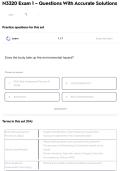
N3320 Exam 1 – Questions With Accurate Solutions
Save
Practice questions for this set
Learn 1 /7 Study with Learn
Does the body take up the environmental hazard?
Choose an answer
EPA's Risk Assessment Process (4
1 2 TOXICOKINETICS
steps)
3 Absorption 4 Risk Characterization
Don't know?
Terms in this set (154)
EPA's Risk Assessment Hazard Identification, Dose-Response Assessment,
Process (4 steps) Exposure Assessment, Risk Characterization
What health problems are caused by the pollutant?
The process of determining if a chemical hazard exists,
Hazard Identification causal
Review literature, Describe nature of hazard, Describe
circumstances, Discuss WOE
Dose-Response What are the health problems at different exposures?
Assessment (Toxicology
, How much of the pollutant are people exposed to
Exposure Assessment during a specific time period? How many people are
exposed?
What is the extra risk of health problems in the exposed
Risk Characterization
population?
What two things must be TOXICITY and EXPOSURE
present for risk to also be Risk = f(toxicity x exposure)
present?
T/F: Science determines False
how risks are managed and
how chemicals are
regulated.
PROBABILITY of consequences, can be good or bad,
UNOBSERVABLE
RISK the chance of harmful effects to human health or to
ecological systems resulting from exposure to an
environmental agent or stressor
Is water a health risk? It depends
1. The inherent TOXICITY of the chemical
What determines the level 2. How much contact (EXPOSURE) a person has with
of a risk that a chemical the contaminated environmental medium
entity has? (3 things) 3. How much of a chemical (CONCENTRATION) is
present in an environmental medium (e.g. soil, water, air)
RISK MANAGEMENT (& Policy) defines acceptable
How are acceptable risks incremental to risk to exposed population, based on risk
determined? assessments,
Typically defined as 1 in 1,000,000
Name 2 ways risks are Threshold and Nonthreshold
represented.
TOXICOKINETICS What the Body Does with the Hazard
TOCICODYNAMICS What the Hazard Does to the Body
Insurance (probability for loss of property, injury, death)
Stock Market (probability for loss of investment)
Application of Risk Natural Disaster/ Emergency Preparedness (earthquake,
Assessment flood, tornado, fire, disease)
Engineering (development of fail-safe systems, e.g.
spacecraft, nuclear power, bridges
, Relative Risk Allows us to compare risks
Any physical, chemical, biological entity that can induce
STRESSOR an adverse response, Has the potential,
Risks are induced by stressors, "HAZARD" or "AGENTS"
There is a "SAFE" LEVEL below which no adverse effects
are observed,
Risk is represented as a RATIO from 0 to infinity, where
THRESHOLD
"1" represents exposure at the threshold, values > 1
indicate exposures where adverse effects are expected,
values < 1 indicate exposures below the threshold
There is SOME RISK for adverse effects at any dose > 0,
NONTHRESHOLD Risk is represented as a PROBABILITY with value from 0
to 1
the process used to estimate the nature and probability
HUMAN HEALTH RISK of adverse health effects in human receptors who may
ASSESSMENT be exposed to chemicals in contaminated
environmental media, now or in the future
1. Sources of Environmental Agents
2. Environmental Agents
3. Environmental Matrices/Pathways
4. Distribution
EHS Model
5. Human and Animal Receivers' Exposures/Impacts
6. Personal/Group Responses
7. Societal Processes
8. Environmental Controls
1. Sources of Environmental Natural or Anthropogenic
Agents
2. Environmental Agents Physical, Chemical, Biological
3. Environmental Air, Water, Soil, Food, Surfaces
Matrices/Pathways
Movement through and/or storage in environmental
4. Distribution media, Agents changed in and/or eliminated from
environmental media, Vector? Vehicle?
5. Human and Animal Exposures (External or Internal), Transmissable?, Effects
Receivers'
Exposures/Impacts
Save
Practice questions for this set
Learn 1 /7 Study with Learn
Does the body take up the environmental hazard?
Choose an answer
EPA's Risk Assessment Process (4
1 2 TOXICOKINETICS
steps)
3 Absorption 4 Risk Characterization
Don't know?
Terms in this set (154)
EPA's Risk Assessment Hazard Identification, Dose-Response Assessment,
Process (4 steps) Exposure Assessment, Risk Characterization
What health problems are caused by the pollutant?
The process of determining if a chemical hazard exists,
Hazard Identification causal
Review literature, Describe nature of hazard, Describe
circumstances, Discuss WOE
Dose-Response What are the health problems at different exposures?
Assessment (Toxicology
, How much of the pollutant are people exposed to
Exposure Assessment during a specific time period? How many people are
exposed?
What is the extra risk of health problems in the exposed
Risk Characterization
population?
What two things must be TOXICITY and EXPOSURE
present for risk to also be Risk = f(toxicity x exposure)
present?
T/F: Science determines False
how risks are managed and
how chemicals are
regulated.
PROBABILITY of consequences, can be good or bad,
UNOBSERVABLE
RISK the chance of harmful effects to human health or to
ecological systems resulting from exposure to an
environmental agent or stressor
Is water a health risk? It depends
1. The inherent TOXICITY of the chemical
What determines the level 2. How much contact (EXPOSURE) a person has with
of a risk that a chemical the contaminated environmental medium
entity has? (3 things) 3. How much of a chemical (CONCENTRATION) is
present in an environmental medium (e.g. soil, water, air)
RISK MANAGEMENT (& Policy) defines acceptable
How are acceptable risks incremental to risk to exposed population, based on risk
determined? assessments,
Typically defined as 1 in 1,000,000
Name 2 ways risks are Threshold and Nonthreshold
represented.
TOXICOKINETICS What the Body Does with the Hazard
TOCICODYNAMICS What the Hazard Does to the Body
Insurance (probability for loss of property, injury, death)
Stock Market (probability for loss of investment)
Application of Risk Natural Disaster/ Emergency Preparedness (earthquake,
Assessment flood, tornado, fire, disease)
Engineering (development of fail-safe systems, e.g.
spacecraft, nuclear power, bridges
, Relative Risk Allows us to compare risks
Any physical, chemical, biological entity that can induce
STRESSOR an adverse response, Has the potential,
Risks are induced by stressors, "HAZARD" or "AGENTS"
There is a "SAFE" LEVEL below which no adverse effects
are observed,
Risk is represented as a RATIO from 0 to infinity, where
THRESHOLD
"1" represents exposure at the threshold, values > 1
indicate exposures where adverse effects are expected,
values < 1 indicate exposures below the threshold
There is SOME RISK for adverse effects at any dose > 0,
NONTHRESHOLD Risk is represented as a PROBABILITY with value from 0
to 1
the process used to estimate the nature and probability
HUMAN HEALTH RISK of adverse health effects in human receptors who may
ASSESSMENT be exposed to chemicals in contaminated
environmental media, now or in the future
1. Sources of Environmental Agents
2. Environmental Agents
3. Environmental Matrices/Pathways
4. Distribution
EHS Model
5. Human and Animal Receivers' Exposures/Impacts
6. Personal/Group Responses
7. Societal Processes
8. Environmental Controls
1. Sources of Environmental Natural or Anthropogenic
Agents
2. Environmental Agents Physical, Chemical, Biological
3. Environmental Air, Water, Soil, Food, Surfaces
Matrices/Pathways
Movement through and/or storage in environmental
4. Distribution media, Agents changed in and/or eliminated from
environmental media, Vector? Vehicle?
5. Human and Animal Exposures (External or Internal), Transmissable?, Effects
Receivers'
Exposures/Impacts


