
PSYCHOLOGY 3018 - FINAL YEAR
WEEK1
INTRODUCTION
Introduction
What is child and adolescent psychology?
South Africa has a Children’s Act 38 of 2005 which prioritises; Best
interest of the Child, children with disability and chronic illness, socio-
cultural and religious practises, access to court, and responsibility of
children. This is to promote the preservation and strengthening of
families.
Three interactive domains
o the environment (disease, nutrition, caregiving), the brain
(neuroscience) and the gene (epigenetics)
Socialization
o individuals standards, skills, motives, attitudes, and behaviours
change to conform to those regarded as desirable and appropriate
for his or her present and future role in society.
Agents;
o family, peers, school and media (interlinked)
Families have been recognized as an early pervasive and highly influential
context for socialisation.
Children are dependent on families for nurturance and support from an
early age, which accounts, in part, for their prominence as a socialization
agent
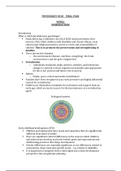
Ecological systems
Early childhood development (ECD)
Children and adolescents have needs and capacities that are significantly
different from those of adults.
there are significant cultural differences in the ways in which children
and adolescents develop, and in the beliefs, goals and expectations and
childrearing practices that shape development.
Gender differences are especially significant, as are differences related to
social status, class/caste and specific needs – e.g. related to disability.
It is important to integrate both a child rights and a child development
perspective into programme planning
, Children and adolescents also have the capacity to be resilient in the face
of adversity.
o Strengthening supportive networks may be the most effective way
of enabling children and their families to cope with adverse
circumstances,
Fundamentals
With children less than three (3) health
and nutritional needs to ensure survival
are often prioritized over stimulation to
ensure development.
- Whereas with children over three years, the emphasis is on play and
education and nutrition
Nutrition and health should be integrated into any centre or school where
early child development activities take place
First 1000 days/0-3 years
during this period that the brain is most plastic, grows fastest and is most
responsive to the outside world
Most of the brain’s neural pathways supporting communication,
understanding, social development and emotional well-being grow
rapidly in these first three years.
Pre-frontal cortex = part of the brain known as the social brain.
o activated when we are involved in controlling our emotions,
paying close attention to other people and their social signals,
thinking about feelings, and having empathy for others
o most basic instinctive ways of behaving
0-3 years: why love matters
Some of the first pathways to be established in babyhood are the
biochemical ones which are important for emotional well-being –stress
response and the soothing system.
The stress response
o a useful system which releases the hormone cortisol to generate
extra short term energy to cope with stresses and dangers of all
kinds.
o Once the objective has been achieved, and safety and social
equilibrium is restored, the cortisol is dispersed.
o But in early babyhood, the stress response is not yet fully
functional; babies are very vulnerable and easily stressed –
particularly by situations that feel unsafe, such as being separated
from their mother or a familiar person, or being physically hurt.
They are dependent on an adult to protect and calm them, to quickly
disperse their cortisol for them and to help them get back to a stable state.
If the adults taking care of them do not manage their states for them, they
can become flooded with cortisol without having any way of getting rid of
it.
, The brain volume of a child can be shaped by experience and evidence has
shown that a child who is severely neglected physically as well as
emotionally can have a dramatically reduced brain size.
Normal/ expected developmental trends
In a sequential manner, development forms in the following manner:
Gross Motor
o larger movements your baby makes with his arms, legs, feet, or his
entire body. So crawling, running, and jumping are gross motor
skills.
Fine Motor
o smaller actions. When your baby picks things up between his
finger and thumb, or wriggles their toes in the sand
Language
Psychosocial
Interventions
Provide direct learning experiences to
children and families, with
opportunities for children to initiate
their own learning and exploration of
their surroundings with age-
appropriate activities
Blend traditional child-rearing
practices and cultural beliefs with
evidence-based approaches
Provide parents and child care
workers with education and support; including systematic curricula and
training opportunities
Emergency feeding programmes
Supplementary Feeding Programmes (SFP) for undernourished
children where families usually attend fortnightly to collect rations to
supplement the child’s diet
Outreach Therapeutic Programmes (OTP) that support both acutely
and moderately malnourished children on an outpatient basis
National Integrated ECD Policy 2015, Dept. Social Development
Ensure universal availability of comprehensive age-, and stage-
appropriate quality early childhood development services through the
provision of a sufficient quantity of services in sufficiently close proximity
to children and their caregivers so as to ensure opportunities for equal
access;
Ensure equitable access to early childhood development services and
support for vulnerable young children and their caregivers
Empower and enable parents to lead and participate in the development
of their young children’s early development, growth and learning
to have access to quality early childhood development services to
support them when required;
, Ensure the alignment and harmonisation of sectoral policies, laws and
programmes across the different sectors responsible for early childhood
development services
Interventions: South Africa
Mentor Mothers
o Community Health Workers-led home visiting programme in the
Western and Eastern Cape, with the aim of improving child health
and nutrition outcomes. The programme is called Mentor Mothers
and it provides support and health education to at-risk pregnant
women in the communities where they live.
Champions for Children
o Grow Great Champions for children is an informal community of
practice that supports, empowers, and incentivises Community
Health Workers to provide evidence-based first 1000 days
interventions to mothers and children through virtual and face to-
face groups in communities.
Family Community Motivator (FCM) programme
o ELRU; The programme aims to provide education and support to
pregnant women and caregivers through home visiting and
parenting workshops
e National Development Plan (NDP) and the National ECD policy of 2015
o commit to ensuring that every child in South Africa has access to
the full range of ECD services by 2030
MATERNAL STRESS AND CHILD DEVELOPMENT
Maternal depression
Maternal depression
o expressed in combination with anxiety and/or somatic symptoms.
Perceptions
o risk factors in one’s exposure to depression said to include – poor
education, poor housing, low income, economic hardships, physical
and emotional abuse, inadequate support, poor relationships,
unwanted pregnancy, trauma at birth
a conceptual model
Strong link between maternal depression and child cognitive and socio-
emotional development.
Children of depressed parents are at an increased risk of developing
psychopathology; social unresponsiveness, low activity, negative emotion,
irritability and hypersensitivity.
Depression exerts adverse impact on child functioning through a strained
parent-child relationship.
leads to family disruption and marital or relational discord.
Depressed mothers are more likely to be critical, scold and nag, and be
physically abusive
WEEK1
INTRODUCTION
Introduction
What is child and adolescent psychology?
South Africa has a Children’s Act 38 of 2005 which prioritises; Best
interest of the Child, children with disability and chronic illness, socio-
cultural and religious practises, access to court, and responsibility of
children. This is to promote the preservation and strengthening of
families.
Three interactive domains
o the environment (disease, nutrition, caregiving), the brain
(neuroscience) and the gene (epigenetics)
Socialization
o individuals standards, skills, motives, attitudes, and behaviours
change to conform to those regarded as desirable and appropriate
for his or her present and future role in society.
Agents;
o family, peers, school and media (interlinked)
Families have been recognized as an early pervasive and highly influential
context for socialisation.
Children are dependent on families for nurturance and support from an
early age, which accounts, in part, for their prominence as a socialization
agent
Ecological systems
Early childhood development (ECD)
Children and adolescents have needs and capacities that are significantly
different from those of adults.
there are significant cultural differences in the ways in which children
and adolescents develop, and in the beliefs, goals and expectations and
childrearing practices that shape development.
Gender differences are especially significant, as are differences related to
social status, class/caste and specific needs – e.g. related to disability.
It is important to integrate both a child rights and a child development
perspective into programme planning
, Children and adolescents also have the capacity to be resilient in the face
of adversity.
o Strengthening supportive networks may be the most effective way
of enabling children and their families to cope with adverse
circumstances,
Fundamentals
With children less than three (3) health
and nutritional needs to ensure survival
are often prioritized over stimulation to
ensure development.
- Whereas with children over three years, the emphasis is on play and
education and nutrition
Nutrition and health should be integrated into any centre or school where
early child development activities take place
First 1000 days/0-3 years
during this period that the brain is most plastic, grows fastest and is most
responsive to the outside world
Most of the brain’s neural pathways supporting communication,
understanding, social development and emotional well-being grow
rapidly in these first three years.
Pre-frontal cortex = part of the brain known as the social brain.
o activated when we are involved in controlling our emotions,
paying close attention to other people and their social signals,
thinking about feelings, and having empathy for others
o most basic instinctive ways of behaving
0-3 years: why love matters
Some of the first pathways to be established in babyhood are the
biochemical ones which are important for emotional well-being –stress
response and the soothing system.
The stress response
o a useful system which releases the hormone cortisol to generate
extra short term energy to cope with stresses and dangers of all
kinds.
o Once the objective has been achieved, and safety and social
equilibrium is restored, the cortisol is dispersed.
o But in early babyhood, the stress response is not yet fully
functional; babies are very vulnerable and easily stressed –
particularly by situations that feel unsafe, such as being separated
from their mother or a familiar person, or being physically hurt.
They are dependent on an adult to protect and calm them, to quickly
disperse their cortisol for them and to help them get back to a stable state.
If the adults taking care of them do not manage their states for them, they
can become flooded with cortisol without having any way of getting rid of
it.
, The brain volume of a child can be shaped by experience and evidence has
shown that a child who is severely neglected physically as well as
emotionally can have a dramatically reduced brain size.
Normal/ expected developmental trends
In a sequential manner, development forms in the following manner:
Gross Motor
o larger movements your baby makes with his arms, legs, feet, or his
entire body. So crawling, running, and jumping are gross motor
skills.
Fine Motor
o smaller actions. When your baby picks things up between his
finger and thumb, or wriggles their toes in the sand
Language
Psychosocial
Interventions
Provide direct learning experiences to
children and families, with
opportunities for children to initiate
their own learning and exploration of
their surroundings with age-
appropriate activities
Blend traditional child-rearing
practices and cultural beliefs with
evidence-based approaches
Provide parents and child care
workers with education and support; including systematic curricula and
training opportunities
Emergency feeding programmes
Supplementary Feeding Programmes (SFP) for undernourished
children where families usually attend fortnightly to collect rations to
supplement the child’s diet
Outreach Therapeutic Programmes (OTP) that support both acutely
and moderately malnourished children on an outpatient basis
National Integrated ECD Policy 2015, Dept. Social Development
Ensure universal availability of comprehensive age-, and stage-
appropriate quality early childhood development services through the
provision of a sufficient quantity of services in sufficiently close proximity
to children and their caregivers so as to ensure opportunities for equal
access;
Ensure equitable access to early childhood development services and
support for vulnerable young children and their caregivers
Empower and enable parents to lead and participate in the development
of their young children’s early development, growth and learning
to have access to quality early childhood development services to
support them when required;
, Ensure the alignment and harmonisation of sectoral policies, laws and
programmes across the different sectors responsible for early childhood
development services
Interventions: South Africa
Mentor Mothers
o Community Health Workers-led home visiting programme in the
Western and Eastern Cape, with the aim of improving child health
and nutrition outcomes. The programme is called Mentor Mothers
and it provides support and health education to at-risk pregnant
women in the communities where they live.
Champions for Children
o Grow Great Champions for children is an informal community of
practice that supports, empowers, and incentivises Community
Health Workers to provide evidence-based first 1000 days
interventions to mothers and children through virtual and face to-
face groups in communities.
Family Community Motivator (FCM) programme
o ELRU; The programme aims to provide education and support to
pregnant women and caregivers through home visiting and
parenting workshops
e National Development Plan (NDP) and the National ECD policy of 2015
o commit to ensuring that every child in South Africa has access to
the full range of ECD services by 2030
MATERNAL STRESS AND CHILD DEVELOPMENT
Maternal depression
Maternal depression
o expressed in combination with anxiety and/or somatic symptoms.
Perceptions
o risk factors in one’s exposure to depression said to include – poor
education, poor housing, low income, economic hardships, physical
and emotional abuse, inadequate support, poor relationships,
unwanted pregnancy, trauma at birth
a conceptual model
Strong link between maternal depression and child cognitive and socio-
emotional development.
Children of depressed parents are at an increased risk of developing
psychopathology; social unresponsiveness, low activity, negative emotion,
irritability and hypersensitivity.
Depression exerts adverse impact on child functioning through a strained
parent-child relationship.
leads to family disruption and marital or relational discord.
Depressed mothers are more likely to be critical, scold and nag, and be
physically abusive


