

ACS Chemistry general Exam
_
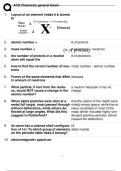
1. Layout of an element (mass # & atomic
#)
(# of protons + # of neutrons)
lVIass
Number
A
- El-ement
Atomic
Number----, Z
2. atomic number = # of protons
3. mass number = (# of# pr otons)+ neutrons
of protons
4. the number of protons in a neutral # of electrons
atom will equal the
5. how to find the correct number of neu- mass number - atomic number
trons
6. Forms of the same elements that differ isotopes
in amount of neutrons
7. What particle, if lost from the nucle- a neutron because it has no
us, would NOT cause a change in the charge
atomic number?
8. When alpha particles were shot at a that the atoms of the metal were
metal foil target, most passed through mostly empty space, while the nu-
without deflections, while others de- cleus consisted of most of the
flected at large angles. What did this mass which included highly con-
suggest to Rutherford? densed positive particles (which
caused the deflection).
9. An atom has a valence shell configura- IA
tion of 1s1. To which group of elements alkali metals
on the periodic table does it belong?
10. electromagnetic spectrum
, ACS Chemistry general Exam
11. The greater the wavelength of a pho- the lower its frequency
ton..?
12. The greater the frequency of a pho- the shorter its wavelength
ton...?
13. Light energy formula
14. What does C in the light energy formula
represent?
15. Give the ground-state electron config- 1s2 2s1
uration of an atom in the second period
16. Electrons configuration rule that Hund's rule
states electrons do not pair until they
have to. (put one electrons in each
electron domain then pair up)
17. An experimental phenomena associat- Paramagnetism
ed with atoms having unpaired elec-
, ACS Chemistry general Exam
trons - which states such substances
are attracted to magnetic fields
18. Which drop in energy level results in n=2 to n=1
the greatest emission of energy?
19. quantum numbers
20. What do the 4 quantum numbers stand n = energy level
for? l = (n-1)
ml -l to l
mn 1/2 or -1/2 (spin)
21. List the quantum numbers for the s, p, s 1,0,0
d, and f orbitals p 2, 1, -1-0-1
d 3, 2, -2--1-0-1-2
f 4, 3 -3--2--1-0-1-2-3
22. Py orbital
23. Which element is represented by X Chromium
24. What two subatomic particles have the protons and neutrons
most mass, but occupy very little of the
volume of an atom
25. Define Isoelectronic Having the same amount of elec-
trons
_
1. Layout of an element (mass # & atomic
#)
(# of protons + # of neutrons)
lVIass
Number
A
- El-ement
Atomic
Number----, Z
2. atomic number = # of protons
3. mass number = (# of# pr otons)+ neutrons
of protons
4. the number of protons in a neutral # of electrons
atom will equal the
5. how to find the correct number of neu- mass number - atomic number
trons
6. Forms of the same elements that differ isotopes
in amount of neutrons
7. What particle, if lost from the nucle- a neutron because it has no
us, would NOT cause a change in the charge
atomic number?
8. When alpha particles were shot at a that the atoms of the metal were
metal foil target, most passed through mostly empty space, while the nu-
without deflections, while others de- cleus consisted of most of the
flected at large angles. What did this mass which included highly con-
suggest to Rutherford? densed positive particles (which
caused the deflection).
9. An atom has a valence shell configura- IA
tion of 1s1. To which group of elements alkali metals
on the periodic table does it belong?
10. electromagnetic spectrum
, ACS Chemistry general Exam
11. The greater the wavelength of a pho- the lower its frequency
ton..?
12. The greater the frequency of a pho- the shorter its wavelength
ton...?
13. Light energy formula
14. What does C in the light energy formula
represent?
15. Give the ground-state electron config- 1s2 2s1
uration of an atom in the second period
16. Electrons configuration rule that Hund's rule
states electrons do not pair until they
have to. (put one electrons in each
electron domain then pair up)
17. An experimental phenomena associat- Paramagnetism
ed with atoms having unpaired elec-
, ACS Chemistry general Exam
trons - which states such substances
are attracted to magnetic fields
18. Which drop in energy level results in n=2 to n=1
the greatest emission of energy?
19. quantum numbers
20. What do the 4 quantum numbers stand n = energy level
for? l = (n-1)
ml -l to l
mn 1/2 or -1/2 (spin)
21. List the quantum numbers for the s, p, s 1,0,0
d, and f orbitals p 2, 1, -1-0-1
d 3, 2, -2--1-0-1-2
f 4, 3 -3--2--1-0-1-2-3
22. Py orbital
23. Which element is represented by X Chromium
24. What two subatomic particles have the protons and neutrons
most mass, but occupy very little of the
volume of an atom
25. Define Isoelectronic Having the same amount of elec-
trons



