

Carbohydrate Metabolism
Humans are hunter gatherers so if intake exceeds needs the excess is stored. This
stored energy is mobilised when food is scarce or there is a sudden need.
[this lecture deals with how body deals with excess carbohydrates]
Carbohydates are stored as glycogen which acts as a short term energy store. Fats
are a more long term storage device.
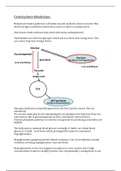
Glycogen synthesis is primarily important in the liver and the muscle (but not
exclusively)
We can also make glucose for maintaining the circulating levels of glucose from non-
carb sources, this is gluconeogenesis (in liver (and kidney when needed))
Pentose-phosphate pathway (not shown) is important for producing nucleotides and
NADPH
The body aims to maintain blood glucose (normally 4-5mM), our critical blood
glucose is 2.5mM – level below which prolonged life cannot be maintained
(hypoglycaemia)
Hypoglycaemia symptoms include: Muscle weakness , loss of coordination, mental
confusion, sweating, hypoglycaemic coma and death
Hyperglycaemia is also very dangerous as glucose is very reactive and at high
concentrations it starts to modify proteins (non-enzymatically), causing them to not
, function properly. This can may lead to cataracts or modify lipoproteins important in
atherosclerosis.
It can also lead to a hyperosmolar coma.
Our body is good at maintaining blood glucose over a range of activities -> rest,
exercise, blood glucose stays relatively same level.
This is because brain cells use glucose and RBC’s only use glucose. Fats are regulated
more loosely so may vary much more.
How the body deals with:
Excess blood glucose = Glycogen synthesis, pentose phosphate pathway (fatty acid
synthesis, spoken about in another lecture)
Lack of blood glucose = Glycogen breakdown (glycogenolysis), gluconeogenesis
Summary-
G6P is a key intermediate molecule
Glycogen
Glycogen is a branched polymer of D-glucose, the majority of it is alpha 1-4 linked,
but there are branches off it which are alpha 1-6 linked.
An important part of glycogen is the protein glycogenin which acts as a primer, it
allows the initiation of synthesis of glycogen.
Humans are hunter gatherers so if intake exceeds needs the excess is stored. This
stored energy is mobilised when food is scarce or there is a sudden need.
[this lecture deals with how body deals with excess carbohydrates]
Carbohydates are stored as glycogen which acts as a short term energy store. Fats
are a more long term storage device.
Glycogen synthesis is primarily important in the liver and the muscle (but not
exclusively)
We can also make glucose for maintaining the circulating levels of glucose from non-
carb sources, this is gluconeogenesis (in liver (and kidney when needed))
Pentose-phosphate pathway (not shown) is important for producing nucleotides and
NADPH
The body aims to maintain blood glucose (normally 4-5mM), our critical blood
glucose is 2.5mM – level below which prolonged life cannot be maintained
(hypoglycaemia)
Hypoglycaemia symptoms include: Muscle weakness , loss of coordination, mental
confusion, sweating, hypoglycaemic coma and death
Hyperglycaemia is also very dangerous as glucose is very reactive and at high
concentrations it starts to modify proteins (non-enzymatically), causing them to not
, function properly. This can may lead to cataracts or modify lipoproteins important in
atherosclerosis.
It can also lead to a hyperosmolar coma.
Our body is good at maintaining blood glucose over a range of activities -> rest,
exercise, blood glucose stays relatively same level.
This is because brain cells use glucose and RBC’s only use glucose. Fats are regulated
more loosely so may vary much more.
How the body deals with:
Excess blood glucose = Glycogen synthesis, pentose phosphate pathway (fatty acid
synthesis, spoken about in another lecture)
Lack of blood glucose = Glycogen breakdown (glycogenolysis), gluconeogenesis
Summary-
G6P is a key intermediate molecule
Glycogen
Glycogen is a branched polymer of D-glucose, the majority of it is alpha 1-4 linked,
but there are branches off it which are alpha 1-6 linked.
An important part of glycogen is the protein glycogenin which acts as a primer, it
allows the initiation of synthesis of glycogen.


