

Clotting and Anti-Clotting Agents
The older drugs are more non-specific, whereas new ones are more targeted.
The older drugs:
Aspirin
Aspirin inhibits cyclo-oxygenase which generates thromboxane A2 (and
prostaglandins). Thromboxane A2 promotes aggregation by triggering reactions that
lead to platelet aggregation. So by inhibiting cyclo-oxygenase it leads to a reduction
in thromboxane synthesis in platelets.
Heparin and Anti-Thrombin
Anti-thrombin is a protein made by the body which acts as a “suicidal” protease
inhibitor. It becomes irreversibly bound to a protease in the process of inhibiting it
so both proteins are taken out of action.
Anti-thrombin inhibits several other proteases (not just thrombin), with varying
efficacy. The biggest inhibition is thrombin and FVIIa.
You can give anti-thrombin to patients but instead we just tend to activate the
antithrombin already in the body. Heparin mimics the endogenous molecule heparan
which binds anti-thrombin on the surface of endothelial cells. This gives another way
of preventing inappropriate coagulation.
, Low molecular weight heparin (shorter chain) that when combined with
antithrombin forms a complex that is more selective at inhibiting FXa.
Warfarin
In the coagulation cascade there are various protease coagulation factors that
require a negatively-charged lipid surface and Ca2+ to work more efficiently. These
coagulation factors have a domain in their structure which contains several
carboxyglutamate (GLA) residues.
These GLA residues are added AFTER the protein has been synthesised by an enzyme
that requires vitamin K to work (it acts as a cofactor in the reaction).
Warfarin interferes with the recycling of “used” vitamin K in the cell, this
effectively causes its depletion (as can no longer be recycled). This means the
clotting factors are released into the blood without the GLA domains! The GLA
domains are needed for the interaction of the protease with phospholipids on
platelets.
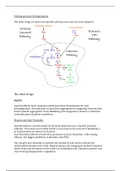
This prevents all the amplification steps in the cascade where these proteases are
present (in the diagram we’re using, all the blue bits).
A deficiency in dietary vitamin K will have the same effect and administering excess
vitamin K is an antidote to Warfarin.
The older drugs are more non-specific, whereas new ones are more targeted.
The older drugs:
Aspirin
Aspirin inhibits cyclo-oxygenase which generates thromboxane A2 (and
prostaglandins). Thromboxane A2 promotes aggregation by triggering reactions that
lead to platelet aggregation. So by inhibiting cyclo-oxygenase it leads to a reduction
in thromboxane synthesis in platelets.
Heparin and Anti-Thrombin
Anti-thrombin is a protein made by the body which acts as a “suicidal” protease
inhibitor. It becomes irreversibly bound to a protease in the process of inhibiting it
so both proteins are taken out of action.
Anti-thrombin inhibits several other proteases (not just thrombin), with varying
efficacy. The biggest inhibition is thrombin and FVIIa.
You can give anti-thrombin to patients but instead we just tend to activate the
antithrombin already in the body. Heparin mimics the endogenous molecule heparan
which binds anti-thrombin on the surface of endothelial cells. This gives another way
of preventing inappropriate coagulation.
, Low molecular weight heparin (shorter chain) that when combined with
antithrombin forms a complex that is more selective at inhibiting FXa.
Warfarin
In the coagulation cascade there are various protease coagulation factors that
require a negatively-charged lipid surface and Ca2+ to work more efficiently. These
coagulation factors have a domain in their structure which contains several
carboxyglutamate (GLA) residues.
These GLA residues are added AFTER the protein has been synthesised by an enzyme
that requires vitamin K to work (it acts as a cofactor in the reaction).
Warfarin interferes with the recycling of “used” vitamin K in the cell, this
effectively causes its depletion (as can no longer be recycled). This means the
clotting factors are released into the blood without the GLA domains! The GLA
domains are needed for the interaction of the protease with phospholipids on
platelets.
This prevents all the amplification steps in the cascade where these proteases are
present (in the diagram we’re using, all the blue bits).
A deficiency in dietary vitamin K will have the same effect and administering excess
vitamin K is an antidote to Warfarin.


