

Bile, Gallbladder and Gallstones
The gross anatomy of the biliary system (gallbladder, hepatic cystic
and common ducts, sphincter of the Oddi) and the relationship
between the entry of the pancreatic and bile ducts into duodenum
The digestive functions of the major constituents of bile
The interaction between gallbladder motility and the opening of the
sphincter of Oddi
The control of gallbladder motility (In particular the role of the vagus
and PZ-CCK)
The composition of hepatic and gallbladder bile in terms of bile acids,
bilirubin, bicarbonate and cholesterol concentrations
The major constituent of small gallstones and factors leading to
gallstone formation
The possible clinical consequences of gallstones
How and where bile acids are synthesised and the difference between
primary and secondary bile acids
The main functions of bile acids
The metabolism of bile acids in the different parts of the enterohepatic
circulation
What is meant by the 'enterohepatic circulation'?
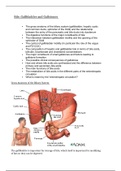
Gross Anatomy of the Biliary System
The gallbladder is important for storage of bile, which itself is important for modifying
of fats so they can be digested.
, The biliary tree can be seen within the liver. The components being held in the gall
bladder has been synthesised in the liver.
Physiology and Functions of the Gallbladder
The gallbladder stores and concentrates bile, it is concentrated because of active Na +
transport from the gallbladder and H2O follows.
The gallbladder is important due to how common gallstones are and cholecystectomy.
The bile becomes more acidic as Na+ is exchanged for H+, but [Na+] increases as more Cl-
and HCO3- are lost. Note that by acidic we are talking about it relative to the bile that
would have been in the hepatic duct, the gall bladder bile is around pH 7.
Pancreatic juice contains bile salts, bile pigments and dissolved substances in alkaline
electrolytes.
The secretions from the gallbladder and pancreas come together and go into the
duodenum, it is important as they have to neutralise the acidic chyme from the stomach,
especially the HCO3- is important.
Bile Formation
Substances that are secreted into the bile (across the bile canalicular membrane)
include:
-> Bile acids
-> Phosphatidylcholine (phospholipid)
->Conjugated bilirubin
->Cholesterol
-> Xenobiotics
There are specific transporters to ferry the above substances into the bile. Substances
such as water, glucose, Ca2+, GSH (glutathione), amino acids and urea enter the bile by
diffusion.
Deviation from the correct ratio of substances, bile acids: phosphatidylcholine:
cholesterol in the canalicular bile (usually held in a ratio of 10:3:1) can lead to
cholesterol gallstones (as cholesterol precipitates out).
Bile that is formed in the liver (from bile acids) moves through larger ductules and
ducts and as they go through their composition is modified (by movement of Na + and
H+).
Water may be added by specific tight junctions within the ductules, which are lined by a
cell type called cholangiocytes (which have tight junctions).
The ductules scavenge (remove) glucose, AA, GSH is hydrolysed, this is because too
much glucose etc. could result in bacteria.
The ductules also secrete IgA for mucosal protection and HCO 3- in response to secretin
in the postprandial period (after a meal).
The gross anatomy of the biliary system (gallbladder, hepatic cystic
and common ducts, sphincter of the Oddi) and the relationship
between the entry of the pancreatic and bile ducts into duodenum
The digestive functions of the major constituents of bile
The interaction between gallbladder motility and the opening of the
sphincter of Oddi
The control of gallbladder motility (In particular the role of the vagus
and PZ-CCK)
The composition of hepatic and gallbladder bile in terms of bile acids,
bilirubin, bicarbonate and cholesterol concentrations
The major constituent of small gallstones and factors leading to
gallstone formation
The possible clinical consequences of gallstones
How and where bile acids are synthesised and the difference between
primary and secondary bile acids
The main functions of bile acids
The metabolism of bile acids in the different parts of the enterohepatic
circulation
What is meant by the 'enterohepatic circulation'?
Gross Anatomy of the Biliary System
The gallbladder is important for storage of bile, which itself is important for modifying
of fats so they can be digested.
, The biliary tree can be seen within the liver. The components being held in the gall
bladder has been synthesised in the liver.
Physiology and Functions of the Gallbladder
The gallbladder stores and concentrates bile, it is concentrated because of active Na +
transport from the gallbladder and H2O follows.
The gallbladder is important due to how common gallstones are and cholecystectomy.
The bile becomes more acidic as Na+ is exchanged for H+, but [Na+] increases as more Cl-
and HCO3- are lost. Note that by acidic we are talking about it relative to the bile that
would have been in the hepatic duct, the gall bladder bile is around pH 7.
Pancreatic juice contains bile salts, bile pigments and dissolved substances in alkaline
electrolytes.
The secretions from the gallbladder and pancreas come together and go into the
duodenum, it is important as they have to neutralise the acidic chyme from the stomach,
especially the HCO3- is important.
Bile Formation
Substances that are secreted into the bile (across the bile canalicular membrane)
include:
-> Bile acids
-> Phosphatidylcholine (phospholipid)
->Conjugated bilirubin
->Cholesterol
-> Xenobiotics
There are specific transporters to ferry the above substances into the bile. Substances
such as water, glucose, Ca2+, GSH (glutathione), amino acids and urea enter the bile by
diffusion.
Deviation from the correct ratio of substances, bile acids: phosphatidylcholine:
cholesterol in the canalicular bile (usually held in a ratio of 10:3:1) can lead to
cholesterol gallstones (as cholesterol precipitates out).
Bile that is formed in the liver (from bile acids) moves through larger ductules and
ducts and as they go through their composition is modified (by movement of Na + and
H+).
Water may be added by specific tight junctions within the ductules, which are lined by a
cell type called cholangiocytes (which have tight junctions).
The ductules scavenge (remove) glucose, AA, GSH is hydrolysed, this is because too
much glucose etc. could result in bacteria.
The ductules also secrete IgA for mucosal protection and HCO 3- in response to secretin
in the postprandial period (after a meal).


