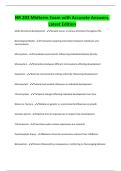
NR 203 Midterm Exam with Accurate Answers.
Latest Edition
Multi-directional development - ✔✔Growth occurs in various directions throughout life.
Bioecological Model - ✔✔Framework analyzing interactions between individuals and
environments.
Microsystem - ✔✔Immediate environments influencing individual behavior directly.
Mesosystem - ✔✔Interactions between different microsystems affecting development.
Exosystem - ✔✔External environmental settings indirectly influencing development.
Macrosystem - ✔✔Cultural and societal influences on individual development.
Chronosystem - ✔✔Temporal changes affecting individual development over time.
Nature vs. Nurture - ✔✔Debate on genetic vs. environmental influences on growth.
Sensitive period - ✔✔Optimal time for experiences to impact brain development.
Critical period - ✔✔Fixed times when certain experiences are essential.
Psychoanalytic theory - ✔✔Behavior driven by unconscious motives from childhood.
Behaviorism - ✔✔Actions influenced by consequences, reinforcing or discouraging behavior.
, Cognitive theory - ✔✔Thoughts and expectations shape actions and beliefs.
Social learning theory - ✔✔Learning through observing and imitating others' behaviors.
Maslow's Hierarchy of Needs - ✔✔Model prioritizing human motivations from basic to
complex.
SIDS - ✔✔Sudden infant death syndrome; unexplained infant death.
Vocabulary explosion - ✔✔Rapid increase in children's vocabulary acquisition.
Overregulization - ✔✔Incorrectly applying grammatical rules to all words.
Secure attachment - ✔✔Healthy emotional bond characterized by trust and safety.
Insecure attachment - ✔✔Struggles with intimacy and trust in relationships.
Prenatal development stages - ✔✔Three trimesters spanning 36-40 weeks of pregnancy.
Teratogen - ✔✔Agent causing abnormalities during fetal development.
Fetal Alcohol Syndrome (FAS) - ✔✔Disorder caused by alcohol exposure during pregnancy.
Stages of labor - ✔✔Four phases from contractions to recovery post-birth.
Effacement - ✔✔Thinning of the cervix during labor.
Latest Edition
Multi-directional development - ✔✔Growth occurs in various directions throughout life.
Bioecological Model - ✔✔Framework analyzing interactions between individuals and
environments.
Microsystem - ✔✔Immediate environments influencing individual behavior directly.
Mesosystem - ✔✔Interactions between different microsystems affecting development.
Exosystem - ✔✔External environmental settings indirectly influencing development.
Macrosystem - ✔✔Cultural and societal influences on individual development.
Chronosystem - ✔✔Temporal changes affecting individual development over time.
Nature vs. Nurture - ✔✔Debate on genetic vs. environmental influences on growth.
Sensitive period - ✔✔Optimal time for experiences to impact brain development.
Critical period - ✔✔Fixed times when certain experiences are essential.
Psychoanalytic theory - ✔✔Behavior driven by unconscious motives from childhood.
Behaviorism - ✔✔Actions influenced by consequences, reinforcing or discouraging behavior.
, Cognitive theory - ✔✔Thoughts and expectations shape actions and beliefs.
Social learning theory - ✔✔Learning through observing and imitating others' behaviors.
Maslow's Hierarchy of Needs - ✔✔Model prioritizing human motivations from basic to
complex.
SIDS - ✔✔Sudden infant death syndrome; unexplained infant death.
Vocabulary explosion - ✔✔Rapid increase in children's vocabulary acquisition.
Overregulization - ✔✔Incorrectly applying grammatical rules to all words.
Secure attachment - ✔✔Healthy emotional bond characterized by trust and safety.
Insecure attachment - ✔✔Struggles with intimacy and trust in relationships.
Prenatal development stages - ✔✔Three trimesters spanning 36-40 weeks of pregnancy.
Teratogen - ✔✔Agent causing abnormalities during fetal development.
Fetal Alcohol Syndrome (FAS) - ✔✔Disorder caused by alcohol exposure during pregnancy.
Stages of labor - ✔✔Four phases from contractions to recovery post-birth.
Effacement - ✔✔Thinning of the cervix during labor.