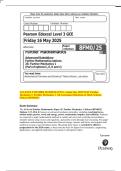
AS LEVEL FURTHER MATHEMATICS: Actual May 2025 PAST Further
Mechanics 1: Further Mechanics 1. All Assessment Questions & Mark Scheme
[Edexcel 8FM0/25]
Exam Summary
The AS Level Further Mathematics Paper 25: Further Mechanics 1 (Edexcel 8FM0/25,
Options C, E, H & J) focuses on advanced mechanics principles, including resolving forces,
motion under gravity, work and energy, power, momentum, impulse, and collisions. Students
are expected to apply mathematical methods to model and solve real-world physical problems,
interpret motion using vectors and equations, and justify results through clear reasoning. The paper
emphasizes understanding the connections between energy, motion, and forces, and requires both
analytical accuracy and conceptual clarity. Mastering these topics is essential for effective
preparation for the 2026 exams, as they form the basis for higher-level mechanics, engineering
applications, and applied mathematics reasoning in subsequent studies.
Turn over
,1. A car of mass 1000 kg moves along a straight horizontal road at a constant
speed U ms1 . The engine of the car is working at a rate of 20 kW.
DO NOT WRITE IN THIS AREA
The total resistance to the motion of the car is modelled as a constant force of
magnitude 1600 N.
Using the model,
(a) find the value of U.
(3)
Later on, the car moves down a straight road which is inclined to the horizontal at an
1
angle α, where sin α =
49
The total resistance to the motion of the car is again modelled as a constant
force of magnitude 1600 N.
At the instant when the engine of the car is working at a rate of 20 kW and the speed of
the car is 8 m s−1, the acceleration of the car is a m s−2
Using the model,
DO NOT WRITE IN THIS AREA
(b) find the value of a.
(4)
(c) State one improvement to the model that would make it more realistic.
(1)
DO NOT WRITE IN THIS AREA
2
■■■■
, 2. A particle Q of mass 3m is at rest on a smooth horizontal plane. A particle P of mass m
is moving along the plane when it collides directly with Q.
DO NOT WRITE IN THIS AREA
The speed of P immediately before the collision is u.
The direction of motion of P is reversed by the collision.
The coefficient of restitution between P and Q is e.
(a) u(3e 1)
Show that the speed of P immediately after the collision is
4 (6)
(b) State the full range of possible values of e.
(1)
1
Given that e =
2
(c) find, in terms of m and u, the magnitude of the impulse exerted by P on Q in the
collision.
(3)
DO NOT WRITE IN THIS AREA
DO NOT WRITE IN THIS AREA
6
■■■■
Mechanics 1: Further Mechanics 1. All Assessment Questions & Mark Scheme
[Edexcel 8FM0/25]
Exam Summary
The AS Level Further Mathematics Paper 25: Further Mechanics 1 (Edexcel 8FM0/25,
Options C, E, H & J) focuses on advanced mechanics principles, including resolving forces,
motion under gravity, work and energy, power, momentum, impulse, and collisions. Students
are expected to apply mathematical methods to model and solve real-world physical problems,
interpret motion using vectors and equations, and justify results through clear reasoning. The paper
emphasizes understanding the connections between energy, motion, and forces, and requires both
analytical accuracy and conceptual clarity. Mastering these topics is essential for effective
preparation for the 2026 exams, as they form the basis for higher-level mechanics, engineering
applications, and applied mathematics reasoning in subsequent studies.
Turn over
,1. A car of mass 1000 kg moves along a straight horizontal road at a constant
speed U ms1 . The engine of the car is working at a rate of 20 kW.
DO NOT WRITE IN THIS AREA
The total resistance to the motion of the car is modelled as a constant force of
magnitude 1600 N.
Using the model,
(a) find the value of U.
(3)
Later on, the car moves down a straight road which is inclined to the horizontal at an
1
angle α, where sin α =
49
The total resistance to the motion of the car is again modelled as a constant
force of magnitude 1600 N.
At the instant when the engine of the car is working at a rate of 20 kW and the speed of
the car is 8 m s−1, the acceleration of the car is a m s−2
Using the model,
DO NOT WRITE IN THIS AREA
(b) find the value of a.
(4)
(c) State one improvement to the model that would make it more realistic.
(1)
DO NOT WRITE IN THIS AREA
2
■■■■
, 2. A particle Q of mass 3m is at rest on a smooth horizontal plane. A particle P of mass m
is moving along the plane when it collides directly with Q.
DO NOT WRITE IN THIS AREA
The speed of P immediately before the collision is u.
The direction of motion of P is reversed by the collision.
The coefficient of restitution between P and Q is e.
(a) u(3e 1)
Show that the speed of P immediately after the collision is
4 (6)
(b) State the full range of possible values of e.
(1)
1
Given that e =
2
(c) find, in terms of m and u, the magnitude of the impulse exerted by P on Q in the
collision.
(3)
DO NOT WRITE IN THIS AREA
DO NOT WRITE IN THIS AREA
6
■■■■