NR 302 HEALTH ASSESSMENT EVOLVE QUESTIONS EXAM #1 REVIEW
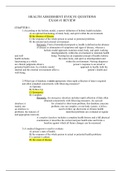
HEALTH ASSESSMENT EVOLVE QUESTIONS EXAM #1 REVIEW CHAPTER 1: 1) According to the holistic model, a narrow definition of holistic health includes: A) an optimal functioning of mind, body, and spirit within the environment. B) the absence of disease C) the response of the whole person to actual or potential problems D) the internal and external environment. Rationale: From a biomedical perspective, health is defined as the absence of disease or elimination of symptoms and signs of disease, whereas a holistic model approach examines mind, body, and spirit working interdependently within the environment to maintain health and well- being. Nursing has an expanded concept of health; holistic health includes the mind, body, and spirit as interdependent and functioning as a whole within the environment. Nursing diagnoses are clinical judgments about a person’s response to an actual or potential health state. In a holistic model approach to health, both the internal and the external environment affect a patient’s health and well-being. 2) What type of database is most appropriate when rapid collection of data is required and often compiled concurrently with lifesaving measures? A) Episodic B) Follow-Up C) Emergency D) Complete Rationale: An emergency database includes rapid collection of data often obtained concurrently with lifesaving measures. An episodic database is for a limited or short-term problem; this database concerns mainly one problem, one cue complex, or one body system. A follow-up database is used to follow up short-term or chronic health problems; the statuses of identified problems are evaluated at regular and appropriate intervals. A complete database includes a complete health history and a full physical examination; it describes the current and past health state and forms a baseline against which all future changes can be measured. 3) A medical diagnosis is used to evaluate: A) person’s state of health. B) the response of the whole person to actual or potential health problems C) a person’s culture D) the cause of disease Rationale: Medical diagnoses are used to evaluate the cause or etiology of disease. Nursing diagnoses are clinical judgments about a person’s response to an actual or potential health state. Nursing diagnoses are used to evaluate the response of the whole person to actual or potential health problems. 4) An example of subjective data is: A) decreased ROM B) crepitation in the left knee joint C) left knee has been swollen and hot for 3 days D) arthritis Rationale: Subjective data is what the patient says about himself or herself during history taking. Objective data is what the health professional observes by inspecting, percussing, palpating, and auscultating during the physical examination. Range of motion is assessed by inspection 5) What type of database is most appropriate for an individual who is admitted to a long- term care facility? A) Episodic B) Follow-Up C) Emergency D) Complete Rationale: Same as question #2 6) Which of the following is an example of objective data? A) Alert and orientated B) Dizziness C) An earache D) A sore throat 7) An example of objective data is: A) a complaint of left knee pain B) crepitation in the left knee joint C) left knee has been swollen and hot for the past 3 days. D) a report of impaired mobility from left knee pain as evidenced by an inability to walk, swelling, and pain on passive range of motion Rationale: Crepitation is assessed by palpation 8) A patient admitted to the hospital with asthma has the following problems identified based on an admission health history and physical assessment. Which problem is a first- level priority? A) Ineffective self-health management B) Risk for infection C) Impaired gas exchange D) Readiness for enhanced spiritual well-being Rationale: First-level priority problems are problems that are emergent, life-threatening, and immediate. Impaired gas exchange is an emergent and immediate problem. CHAPTER 2: 1) Each culture has its own healers who usually: A) speak at least 2 languages B) own and operate specialty community clinics C) cost less than traditional or biomedical providers D) recommend fold practices that are dangerous 2) While evaluating the health history, the nurse determines that the patient subscribes to the hot/cold theory of health. Which of the following would most likely describe this patient’s view of wellness? A) Good is hot B) Evil is hot C) The humors must be balanced D) The phlegm will be replaced with dryness Rationale: The hot/cold theory of health is based on humoral theory; the treatment of disease is based on the balance of the humors. Beverages, foods, herbs, medicines, and diseases are classified as hot or cold according to their perceived effects on the body, not their physical characteristics. The four humors of the body include the blood, phlegm, black bile, and yellow bile; the humors regulate basic bodily functions and are described in terms of temperature, dryness, and moisture 3) On the basis of median age: A) Non-Hispanic white population tends to be younger B) the Hispanic population tends to be older C) the Asian population tends to be younger D) minorities tend to be older than non-Hispanic white populations Rationale: The Asian population is younger with a median age of 36 years. The non-Hispanic, single-race white population is older than the population as a whole; the respective median age is 40.2 years. The Hispanic population is much younger, with a median age of 27.7 years. Minorities tend to be younger than non-Hispanic white populations. 4) What is the yin/yang theory of health? A) Health exists when all aspects of the person are in perfect balance. B) Health exists when physical, psychological, spiritual, and social needs are met. C) Health exists in the absence of
Document information
- Uploaded on
- January 17, 2021
- Number of pages
- 13
- Written in
- 2020/2021
- Type
- Exam (elaborations)
- Contains
- Questions & answers