

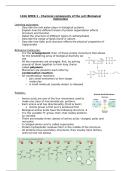
116A WEEK 2 - Chemical components of the cell (Biological
molecules)
Learning outcomes:
- Describe the role water plays in biological systems
- Explain how the different levels of protein organisation effects
structure and function.
- Detail the structure of different types of carbohydrates
- Describe the range of lipids found in nature.
- Describe how fatty acid structure effects the physical properties of
triglycerides
Biological molecules:
- It is the arrangement, then, of these simple monomers that allows
for the bewildering array of biological diversity we
see
- All the monomers are arranged, first, by joining
several of them together to form long chains
called polymers.
- Monomers are joined to each other by
condensation reaction.
- All condensation reactions:
○ Join small monomers to form larger
molecules
○ A small molecule (usually water) is released
Proteins:
- Amino acids are one of the four monomers used to
make one class of macromolecule: proteins.
- Each amino acid has directionality (front & back)
o Amine group is first as it’s produced first
- Biological amino acids have the following structure
- It is the variable ‘R’ group, then, that makes proteins
so variable.
- There are broadly three classes of amino acids: charged, polar and
non-polar
- A charged amino acid is called super-polar
- Protein hydrophobic residues form in the middle of the structure
- All proteins have secondary structures, they usually have tertiary
ones too but not always
, Joining amino acids together:
- Amino acids join together by condensation reactions
- One amino joins to one carboxyl
- Water is lost
- The bond formed is called a peptide bond
The 4 levels of protein structure:
- Primary: sequence of amino acids
- Secondary: simple motifs
- Tertiary: the overall structure of an individual polypeptide (including
prosthetic groups)
- Quaternary: an arrangement of more than one polypeptide
Primary structure:
- This is the sequence of amino acids
- The primary structure is held together by peptide bonds
○ These bonds are strong and covalent
- This sequence is given from the amino end to the
carboxyl end
- Although the primary sequence is simple, it gives rise to
all the higher order structures
molecules)
Learning outcomes:
- Describe the role water plays in biological systems
- Explain how the different levels of protein organisation effects
structure and function.
- Detail the structure of different types of carbohydrates
- Describe the range of lipids found in nature.
- Describe how fatty acid structure effects the physical properties of
triglycerides
Biological molecules:
- It is the arrangement, then, of these simple monomers that allows
for the bewildering array of biological diversity we
see
- All the monomers are arranged, first, by joining
several of them together to form long chains
called polymers.
- Monomers are joined to each other by
condensation reaction.
- All condensation reactions:
○ Join small monomers to form larger
molecules
○ A small molecule (usually water) is released
Proteins:
- Amino acids are one of the four monomers used to
make one class of macromolecule: proteins.
- Each amino acid has directionality (front & back)
o Amine group is first as it’s produced first
- Biological amino acids have the following structure
- It is the variable ‘R’ group, then, that makes proteins
so variable.
- There are broadly three classes of amino acids: charged, polar and
non-polar
- A charged amino acid is called super-polar
- Protein hydrophobic residues form in the middle of the structure
- All proteins have secondary structures, they usually have tertiary
ones too but not always
, Joining amino acids together:
- Amino acids join together by condensation reactions
- One amino joins to one carboxyl
- Water is lost
- The bond formed is called a peptide bond
The 4 levels of protein structure:
- Primary: sequence of amino acids
- Secondary: simple motifs
- Tertiary: the overall structure of an individual polypeptide (including
prosthetic groups)
- Quaternary: an arrangement of more than one polypeptide
Primary structure:
- This is the sequence of amino acids
- The primary structure is held together by peptide bonds
○ These bonds are strong and covalent
- This sequence is given from the amino end to the
carboxyl end
- Although the primary sequence is simple, it gives rise to
all the higher order structures


