Law of Evidence
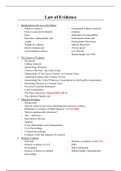
1. Introduction to the Law of Evidence
- What is evidence? - Testimonial evidence and real
- Facts in issue and Collateral evidence
Facts - Allocation of responsibility
- Relevance, admissibility and - Exclusionary Rules and
weight Exclusionary Discretions
- Weight of evidence - Judicial Discretion
- Direct evidence and - ‘Free(r) proof’
circumstantial evidence - Law Reform
- Human Rights Act 1998
2. The Course of Evidence
- Disclosure
- Calling witnesses
- Questioning Witnesses
- Course of the trial – the order of play
- Submissions of ‘No Case to Answer’ in Criminal Cases
- Adducing Evidence after Closure of Case
- Questioning One’s Own Witnesses: Examination-in-chief and Re-examination
- Refreshing Memory in Criminal Cases
- Previous Consistent Statements
- Cross-Examination
- The Rule in Browne v Dunn (1893) 6 R 67
- The collateral-finality rule
3. Character Evidence
- Background
- Specific statutory provisions admitting bad character evidence
- Definition of evidence of ‘Bad Character’ in CJA 2003
- What is reprehensible behaviour?
- The 7 ‘Gateways’
- Directions to the jury
- Appeals
- Cross-admissibility and Contamination
- Civil Proceedings
- Criminal proceedings
- Evidence of the bad character of a non-D
4. Hearsay Evidence
- Rationale - Statutory exceptions in the CJA
- Hearsay evidence in Civil 2003
Proceedings - Other Safeguards
- Hearsay evidence in criminal - Human Rights Considerations
proceedings
, Introduction to the Law of Evidence
What is evidence?
Evidence = the information with which the matters requiring proof in a trial are
proved
- The info the court hears to make a decision.
- It’s on the basis of this evidence that the jury will have to reach a verdict.
Law of evidence = the law governing the process by which the matters requiring
proof in a trial are proved
- What can be heard and what can’t
- Admissible – allowed to be heard and taken into account when making the
decision.
Procedural law rather than substantive law
- Not the actual law, rather about how the law is enforced, not rights and
obligations – it’s the procedure about how the parties bring the case and what
they are allowed to do in court.
Facts in issue and Collateral Facts:
Trials are concerned with ascertaining/determining/finding facts
Disputed facts need to be resolved – each party will present evidence to support
their side, the jury will have to decide what happen after hearing the information
and then, having been instructed on the law by the judge, they will have to decide
the verdict.
All evidence in a case must be relevant to either a fact in issue or a collateral
fact.
Fact in issue (factum probandum) - a fact that must be proved by a party to
succeed in the action = an essential fact
- Must look at the question in the perspective of the party bring the action,
what do they absolutely have to show to prove their side.
- Depends on the substantive law.
- The question effectively is ‘What are the elements of the action?’ – EG:
murder – in order to succeded the prosecution must prove that:
1. D caused the V’s death
2. Had the MR
These are the facts in issue.
- Defence would not be a fact in issue because if a defence wouldn’t be
brought up, they could still prove guilt.
- A fact that is not a fact in issue but is relevant to a fact in issue is known as a
relevant fact (factum probans)
Collateral fact – a fact of which proof may be permitted but which doesn’t
constitute a fact in issue or a relevant fact.
- EG: collateral fact is the credibility of a witness (‘credit’) – whether they can
be believed or not.
1. Introduction to the Law of Evidence
- What is evidence? - Testimonial evidence and real
- Facts in issue and Collateral evidence
Facts - Allocation of responsibility
- Relevance, admissibility and - Exclusionary Rules and
weight Exclusionary Discretions
- Weight of evidence - Judicial Discretion
- Direct evidence and - ‘Free(r) proof’
circumstantial evidence - Law Reform
- Human Rights Act 1998
2. The Course of Evidence
- Disclosure
- Calling witnesses
- Questioning Witnesses
- Course of the trial – the order of play
- Submissions of ‘No Case to Answer’ in Criminal Cases
- Adducing Evidence after Closure of Case
- Questioning One’s Own Witnesses: Examination-in-chief and Re-examination
- Refreshing Memory in Criminal Cases
- Previous Consistent Statements
- Cross-Examination
- The Rule in Browne v Dunn (1893) 6 R 67
- The collateral-finality rule
3. Character Evidence
- Background
- Specific statutory provisions admitting bad character evidence
- Definition of evidence of ‘Bad Character’ in CJA 2003
- What is reprehensible behaviour?
- The 7 ‘Gateways’
- Directions to the jury
- Appeals
- Cross-admissibility and Contamination
- Civil Proceedings
- Criminal proceedings
- Evidence of the bad character of a non-D
4. Hearsay Evidence
- Rationale - Statutory exceptions in the CJA
- Hearsay evidence in Civil 2003
Proceedings - Other Safeguards
- Hearsay evidence in criminal - Human Rights Considerations
proceedings
, Introduction to the Law of Evidence
What is evidence?
Evidence = the information with which the matters requiring proof in a trial are
proved
- The info the court hears to make a decision.
- It’s on the basis of this evidence that the jury will have to reach a verdict.
Law of evidence = the law governing the process by which the matters requiring
proof in a trial are proved
- What can be heard and what can’t
- Admissible – allowed to be heard and taken into account when making the
decision.
Procedural law rather than substantive law
- Not the actual law, rather about how the law is enforced, not rights and
obligations – it’s the procedure about how the parties bring the case and what
they are allowed to do in court.
Facts in issue and Collateral Facts:
Trials are concerned with ascertaining/determining/finding facts
Disputed facts need to be resolved – each party will present evidence to support
their side, the jury will have to decide what happen after hearing the information
and then, having been instructed on the law by the judge, they will have to decide
the verdict.
All evidence in a case must be relevant to either a fact in issue or a collateral
fact.
Fact in issue (factum probandum) - a fact that must be proved by a party to
succeed in the action = an essential fact
- Must look at the question in the perspective of the party bring the action,
what do they absolutely have to show to prove their side.
- Depends on the substantive law.
- The question effectively is ‘What are the elements of the action?’ – EG:
murder – in order to succeded the prosecution must prove that:
1. D caused the V’s death
2. Had the MR
These are the facts in issue.
- Defence would not be a fact in issue because if a defence wouldn’t be
brought up, they could still prove guilt.
- A fact that is not a fact in issue but is relevant to a fact in issue is known as a
relevant fact (factum probans)
Collateral fact – a fact of which proof may be permitted but which doesn’t
constitute a fact in issue or a relevant fact.
- EG: collateral fact is the credibility of a witness (‘credit’) – whether they can
be believed or not.