
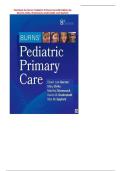
Test Bank for Burns' Pediatric Primary Care 8th Edition by Dawn Lee Garzon, Mary Dirks, Martha Driessnack, Karen G. Duderstadt, and Nan M. Gaylord
This document is a complete test bank designed for Burns' Pediatric Primary Care (8th Edition) by Garzon, Dirks, Driessnack, Duderstadt, and Gaylord. It contains a wide range of multiple-choice questions and answers covering all major chapters and topics in pediatric primary care, including growth and development, health promotion, clinical conditions, and evidence-based care. Ideal for exam preparation, quizzes, and in-depth content review for nursing and advanced practice students. Test Bank for Burns' Pediatric Primary Care 8th Edition by Dawn Lee Garzon, Mary Dirks, Martha Driessnack, Karen G. Duderstadt, and Nan M. Gaylord Chapter 1: Health Conditions of Kidren: Global and National Perspectives 1. Which global region has the highest infant mortality rate? A. Indonesia B. Southern Asia C. Sub-Saharan Africa: CORRECT ANSWER D. Syria 2. A primary care pediatric nurse recognizes that the most effective strategy for significantly reducing global child mortality from pneumonia and diarrhea is: A. Antibiotics B. Proper nutrition C. Vaccinations: CORRECT ANSWER D. Water purification 3. Which statement accurately describes the health status of children in the United States? A. Globalization has minimal influence on child health indicators in the U.S. B. Obesity rates among children aged 2 to 5 have recently shown a notable decline. CORRECT ANSWER C. The poverty rate among households is lower compared to other developed countries. D. Children who attend preschool or daycare experience higher rates of food insecurity. 4. A primary care pediatric nurse understands that a significant child health consequence linked to global climate change is: A. Cost of living B. Education C. Nutrition: CORRECT ANSWER D. Pollution 5. When providing well-child care during an infant’s first year, a primary care pediatric nurse follows the latest American Academy of Pediatrics guidelines by: A. Prioritizing illness prevention and nutrition over developmental monitoring. B. Adhering to the recommendations outlined in the Bright Futures publication. C. Scheduling well-baby checkups to align with key developmental milestones. CORRECT ANSWER D. Conducting visits at 2, 4, 6, and 12 months to administer necessary immunizations. 6. A primary care pediatric nurse recognizes that one of the key global child health concerns that can be effectively addressed with early intervention is: A. Asthma B. Malnutrition: CORRECT ANSWER C. Learning disabilities D. Seasonal allergies 7. According to global health research, which factor has the greatest impact on reducing child mortality rates worldwide? A. Increased healthcare spending B. Access to clean drinking water C. Maternal education: CORRECT ANSWER D. Urbanization 8. Which of the following statements about childhood immunization programs is accurate? A. They have successfully eradicated all vaccine-preventable diseases. B. They only benefit children in low-income countries. C. They have significantly reduced deaths from infectious diseases worldwide. CORRECT ANSWER D. They are no longer a public health priority in developed nations. 9. What is one of the leading causes of preventable childhood deaths worldwide? A. Cancer B. Road traffic accidents C. Diarrheal diseases: CORRECT ANSWER D. Congenital disorders 10. A pediatric nurse understands that the most effective way to prevent mother-to-child transmission of HIV is: A. Avoiding breastfeeding B. Antiretroviral therapy for the mother and baby: CORRECT ANSWER C. Providing iron supplements during pregnancy D. Encouraging early weaning Chapter 2. Unique Issues in Pediatrics 1. A practicing nurse is explaining the concept of a therapeutic milieu to a new nurse. The best explanation would be: 1. The environment where the child is receiving care. 2. Group therapy. 3. Interactions between the patient and staff. 4. All of the above – CORRECT ANSWER 2. A 16-year-old male has been admitted for inpatient psychiatric treatment after receiving an emergency referral from the police. He has expressed thoughts of suicide, stating that “life sucks.” The nursing staff should place him: 1. With peers. 2. In a location where he can be observed one-on-one. – CORRECT ANSWER 3. With a roommate who has similar concerns. 4. Near an exit door. 3. Scientific research has linked learning disabilities in children to: 1. Poor nutrition. 2. Environmental factors. 3. Genetics. – CORRECT ANSWER 4. Watching more than four hours of television daily. 4. A mental health nurse assesses a child and determines that they have behavioral challenges. When explaining this to a teacher, the most accurate description is: 1. The child may display physical outbursts. 2. The child may be violent toward others. 3. The child may show defiance or have tantrums. – CORRECT ANSWER 4. The child will require specialized learning interventions. 5. A child who had not experienced enuresis for four years has suddenly resumed bed-wetting over the past week. A likely cause of this regression is: 1. Hallucinations. 2. Behavioral difficulties. 3. Delusions. 4. Stress. – CORRECT ANSWER 6. An 18-year-old male calls a crisis hotline for assistance. The crisis nurse understands that intervention may involve all of the following except: 1. Discussing the caller’s daily routine. – CORRECT ANSWER 2. Recognizing that the individual may be experiencing an emotional release. 3. Showing empathy. 4. Avoiding emotional detachment. 7. An 8-year-old boy with a history of hallucinations and aggressive behavior has been placed in seclusion for harming others. The nurse should remove him from the seclusion room when: 1. He begins crying and asking to be released. 2. He promises to behave. 3. He starts headbutting the window. – CORRECT ANSWER 4. He complains that his parents will sue the hospital. 8. A child exhibiting the MacDonald Triad would display: 1. Bed-wetting, aggression, and pyromania. 2. Animal cruelty, persistent enuresis, and fire-setting. – CORRECT ANSWER 3. Playing with other children, laughing, and engaging with adults. 4. Watching television, playing with fire, and seeking adult attention. 9. A teenager diagnosed with borderline personality disorder should receive discharge planning that includes: 1. Having a consistent caregiver. 2. Monitoring of media exposure, such as the Internet and video games. 3. Support from family and friends. – CORRECT ANSWER 4. Seeking medical attention only when feeling well. 10. A nurse is teaching a mother ways to assist her child with executive functioning difficulties. Effective strategies include: 1. Placing visual cues on the bathroom mirror to guide the child’s morning routine. – CORRECT ANSWER 2. Allowing the child to choose their meals. 3. Encouraging the child to ask for help when needed. 4. Reminding the child to be kind to others. 11. Ellie, a 9-year-old girl, was adopted at age 4 after experiencing severe neglect from her birth family. Her adoptive parents report that she is frequently angry, manipulative with teachers, and avoids positive attention. The nurse should: 1. Educate the family on reducing environmental triggers for anger. 2. Recognize that Ellie may have attachment issues and encourage the family’s active involvement. – CORRECT ANSWER 3. Support the family in deciding whether Ellie should remain in the home. 4. Recommend inpatient therapy to address manipulative behavior. 12. An infant may display symptoms of depression by: 1. Smiling at strangers. 2. Forming attachments to individuals outside the immediate family. 3. Crying more frequently than other infants. 4. Looking away when an adult attempts to engage them in play. – CORRECT ANSWER 13. A father reports that his adolescent daughter, who previously had good grades, has recently become withdrawn, spending time alone and avoiding conversations. The mental health nurse should: 1. Recognize this as a normal stage of adolescence. 2. Conduct a mental health screening to assess for depression. – CORRECT ANSWER 3. Try to get the teenager to explain why she dislikes her father. 4. Wait for the adolescent to open up on her own. 14. A teenager should be screened for depression during: 1. Every physician visit. – CORRECT ANSWER 2. Only one visit. 3. Monthly checkups. 4. Twice a year. 15. When using the SAD FACES depression screening tool, it is essential to assess: 1. Loss of interest in activities (anhedonia). 2. Suicidal thoughts. 3. Sleep patterns. 4. All of the above. – CORRECT ANSWER 16. A school nurse is educating teachers about bullycide. The primary reason for this training is to: 1. Raise awareness that bullying occurs. 2. Help teachers recognize students who are at risk. 3. Educate teachers on how bullying can lead to suicide. – CORRECT ANSWER 4. Address the role teachers may play in bullying. 17. A student with bipolar disorder is sent to the school nurse after a teacher observes her speaking rapidly and claiming to be "God." The nurse assesses the student and determines: 1. She is likely experiencing a manic episode and requires professional treatment. – CORRECT ANSWER 2. She has slept too much and is now hyperactive. 3. She forgot to take her medication. 4. She needs food and rest before returning to class. Chapter 3.Geneticsand Kid Health
Document information
- Uploaded on
- October 26, 2025
- Number of pages
- 135
- Written in
- 2025/2026
- Type
- Exam (elaborations)
- Contains
- Questions & answers


