Intro to Stats Summer 2024 Name___________________________
At Home Test 3
For this test, please feel free to use 1) your notes, 2) the book, 3) my videos, and 4) the internet.
What's not allowed: 1) Submitting work that isn't your own. 2) Working on the test with others.
All work and ideas must be your own.
You can print this document and do your work here, or copy the problems onto your own paper and submit your
work that way.
Note: For each problem that involves a hypothesis test, clearly write the null and alternate hypotheses, include your
P-value (round to three significant figures), state what you conclude about the hypothesis, and write a concluding
sentence. Do not use the test-statistic/critical value method. Have a good test!
9 points each
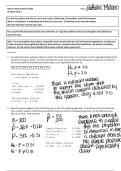
1. An experiment gives subjects a generic version of a brand-name drug. The amounts of active ingredient delivered by
the generic drug are below. Test the claim that the mean amount delivered by the generic drug is not 7.5 (which is
the amount delivered by the brand-name drug.) Use a significance level of .01.
6.4 7.4 6.1 7.0 7.1 6.9 7.7
2. Recent research suggests 31% of Americans are in favor of outlawing cigarettes. You decide to test this claim and
ask a random sample of 200 Americans whether they are in favor of outlawing cigarettes. Of the 200 Americans,
26% are in favor. Test the claim.
, 3. While evaluating a new curriculum option, a sample of 243 students rated their math textbook on a scale from one
to seven. The average rating was 4.63, and the standard deviation was 0.82.
a) Construct a 95% confidence interval for the mean score, and write it in interval form.
b) Write a sentence that explains the interval from part a), using the numbers from part a).
c) Write the confidence interval in “point estimate + margin of error” form.
4. When surveying 617 music teachers, 503 said early childhood education has a positive effect on musical ability.
a) Calculate a 90% confidence interval for the true proportion of music teachers who believe that early education
has a positive effect.
b) Write a sentence that explains the interval from part a), using the numbers from part a).
At Home Test 3
For this test, please feel free to use 1) your notes, 2) the book, 3) my videos, and 4) the internet.
What's not allowed: 1) Submitting work that isn't your own. 2) Working on the test with others.
All work and ideas must be your own.
You can print this document and do your work here, or copy the problems onto your own paper and submit your
work that way.
Note: For each problem that involves a hypothesis test, clearly write the null and alternate hypotheses, include your
P-value (round to three significant figures), state what you conclude about the hypothesis, and write a concluding
sentence. Do not use the test-statistic/critical value method. Have a good test!
9 points each
1. An experiment gives subjects a generic version of a brand-name drug. The amounts of active ingredient delivered by
the generic drug are below. Test the claim that the mean amount delivered by the generic drug is not 7.5 (which is
the amount delivered by the brand-name drug.) Use a significance level of .01.
6.4 7.4 6.1 7.0 7.1 6.9 7.7
2. Recent research suggests 31% of Americans are in favor of outlawing cigarettes. You decide to test this claim and
ask a random sample of 200 Americans whether they are in favor of outlawing cigarettes. Of the 200 Americans,
26% are in favor. Test the claim.
, 3. While evaluating a new curriculum option, a sample of 243 students rated their math textbook on a scale from one
to seven. The average rating was 4.63, and the standard deviation was 0.82.
a) Construct a 95% confidence interval for the mean score, and write it in interval form.
b) Write a sentence that explains the interval from part a), using the numbers from part a).
c) Write the confidence interval in “point estimate + margin of error” form.
4. When surveying 617 music teachers, 503 said early childhood education has a positive effect on musical ability.
a) Calculate a 90% confidence interval for the true proportion of music teachers who believe that early education
has a positive effect.
b) Write a sentence that explains the interval from part a), using the numbers from part a).