

KNS 475: Exam 1 Question and answers verified
to pass 2025/2026
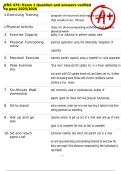
1.Exercising Training program of recurrent and regular physical work
that results in inc. fitness
2.Physical Activity refers to all encompassing activities that involve
physical work
3. Exercise Capacity ability if an individual to perform aerobic work
4. Physical Functioning practical application using the whole-body integration of
exercise
capacity
5. Maximal Exercise maximal aerobic capacity using a treadmill or cycle ergometer
6. Peak Exercise "true max" measured O2 uptake inc. in a linear relationship to
phys-
ical work until O2 uptake levels ott and does not inc. further
with increasing work (those with chronic conditions cannot
achieve a true max)
7. Six-Minute Walk test commonly used in cardiovascular studies of
pharmaceuticals
agents (good for those with low physical functioning)
8. Sit to stand many versions; main one is to see how long it takes to rise from
sitting position to standing
9. Get up and go requires person to get up out of a chair walk and go sit back
down
(goal is to complete the test as fast as possible)
10. Sit and reach functional mobility test which the patient sits in a chair
against a wall
w/ one leg extending and bending forward to see how far
they can reach (the distance measured by the individual is
recorded)
,11. Describe how we use EVS? - We calculate the average days per week someone
engages in
moderate to vigorous PA (on a scale of 0-7 days)
- from the days recorded we calculate how many minutes were
they engaged (10-60 or >60)
, KNS 475: Exam 1
Study online at https://quizlet.com/_cty0l6
MVPA calculated [days * minutes]
12. What is the best way to cal- - Talk test via ventilatory symptomatology
culate moderate to -RPE [rate of perceived exertion]; on a scale from 1-10 & on
vigor- ous intensity? another 6-20 which is based on how high the HR is
(athletes & highly active individuals)
13. What is an exercise -150 min/week of MVPA (lower limit) OR light intensity
pre- scription for -Muscular/flexibility training 2 days a week (chair sit and
adults with chronic reach, sit to stand, arm curls)
disease?
FITT (frequency, intensity, time & type)
Frequency - how many days a week [aerobic 4 to 5 &
strength 2 to 3] Intensity - How hard [ aerobic can still talk
& strength can do some before the rest period]
Time - How long? [aerobic 150 mins per week & strength
minimal amount]
Type - What kind? [aerobic BEST is walking & strength training
lifting weights or any resistance training ALSO interval
training]
14. What are the barriers
to exercise? lack of time, physical limitations, feeling of being
bored/unenjoyable
15. Hypertension the force of blood through the vessels and is high
16. What is Dyslipidemia? -Abnormally elevated cholesterol or fats (lipids) in the blood
How does cholesterol
play a part in it? -High cholesterol has no s/s (only way to know if it is
checked)
-Cholesterol is important in all of the body
-Cholesterol is synthesized & metabolized in the liver and
transported to the rest of the body
to pass 2025/2026
1.Exercising Training program of recurrent and regular physical work
that results in inc. fitness
2.Physical Activity refers to all encompassing activities that involve
physical work
3. Exercise Capacity ability if an individual to perform aerobic work
4. Physical Functioning practical application using the whole-body integration of
exercise
capacity
5. Maximal Exercise maximal aerobic capacity using a treadmill or cycle ergometer
6. Peak Exercise "true max" measured O2 uptake inc. in a linear relationship to
phys-
ical work until O2 uptake levels ott and does not inc. further
with increasing work (those with chronic conditions cannot
achieve a true max)
7. Six-Minute Walk test commonly used in cardiovascular studies of
pharmaceuticals
agents (good for those with low physical functioning)
8. Sit to stand many versions; main one is to see how long it takes to rise from
sitting position to standing
9. Get up and go requires person to get up out of a chair walk and go sit back
down
(goal is to complete the test as fast as possible)
10. Sit and reach functional mobility test which the patient sits in a chair
against a wall
w/ one leg extending and bending forward to see how far
they can reach (the distance measured by the individual is
recorded)
,11. Describe how we use EVS? - We calculate the average days per week someone
engages in
moderate to vigorous PA (on a scale of 0-7 days)
- from the days recorded we calculate how many minutes were
they engaged (10-60 or >60)
, KNS 475: Exam 1
Study online at https://quizlet.com/_cty0l6
MVPA calculated [days * minutes]
12. What is the best way to cal- - Talk test via ventilatory symptomatology
culate moderate to -RPE [rate of perceived exertion]; on a scale from 1-10 & on
vigor- ous intensity? another 6-20 which is based on how high the HR is
(athletes & highly active individuals)
13. What is an exercise -150 min/week of MVPA (lower limit) OR light intensity
pre- scription for -Muscular/flexibility training 2 days a week (chair sit and
adults with chronic reach, sit to stand, arm curls)
disease?
FITT (frequency, intensity, time & type)
Frequency - how many days a week [aerobic 4 to 5 &
strength 2 to 3] Intensity - How hard [ aerobic can still talk
& strength can do some before the rest period]
Time - How long? [aerobic 150 mins per week & strength
minimal amount]
Type - What kind? [aerobic BEST is walking & strength training
lifting weights or any resistance training ALSO interval
training]
14. What are the barriers
to exercise? lack of time, physical limitations, feeling of being
bored/unenjoyable
15. Hypertension the force of blood through the vessels and is high
16. What is Dyslipidemia? -Abnormally elevated cholesterol or fats (lipids) in the blood
How does cholesterol
play a part in it? -High cholesterol has no s/s (only way to know if it is
checked)
-Cholesterol is important in all of the body
-Cholesterol is synthesized & metabolized in the liver and
transported to the rest of the body


