

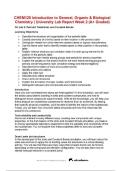
CHEM120 Introduction to General, Organic & Biological Chemistry | University Lab Report Week 2 (A+ Graded)
This document is the Week 2 lab report for CHEM120: Introduction to General, Organic & Biological Chemistry. It presents a complete and well-structured overview of the second practical session, including procedures, observations, data analysis, and conclusions. Graded with an A+, this report demonstrates excellent scientific reasoning and is ideal for students seeking a high-quality example. CHEM120 Introduction to General, Organic & Biological Chemistry | University Lab Report Week 2 (A+ Graded) OL Lab 2: Periodic Table/Ionic and Covalent Bonds Learning Objectives ● Describe the structure and organization of the periodic table ● Classify elements of a family based on their location in the periodic table ● Distinguish metals from other element classes based on typical characteristics ● Use the flame color test to identify metals based on their position in the periodic table ● Explain valence electrons and oxidation state of a main group element to its position in the periodic table ● Describe the main trends among groups and periods for atomic properties ● Explain the causes on the atomic level for the main trends among groups and periods concerning atomic radii, ionization energy and electronegativity ● Describe the formation of ionic and covalent bonds ● Identify anions and cations ● Apply the octet rule ● Describe ionic lattice structure ● Draw Lewis dot structures ● Explain the formation of single, double, and triple bonds ● Distinguish between ionic compounds and covalent compounds Introduction Have you ever wondered how atoms are held together? In this simulation, you will learn the basics about atomic bonding in ionic and covalent compounds, and how to distinguish those compounds experimentally. With all this knowledge, you will help your friend analyze two mysterious substances he received from an alchemist. By testing their specific physical properties, you’ll be able to identify the nature of the substances. Finally, you will learn how ions form lattice structures and how this influences the property of a compound. Test solubility and conductivity Atoms can interact in many different ways, creating new compounds with unique properties. In the first mission of the Ionic and Covalent Bonds simulation, your task is to choose appropriate laboratory equipment to test the solubility and conductivity of the two substances. You will explore how these properties differ in ionic and covalent compounds. Draw Lewis dot structures In the second part of the Ionic and Covalent Bonds simulation, you will learn about the octet rule and how to apply this to building Lewis dot structures in a virtual drawing activity. You will see that there are many ways that covalent bonds can be formed, depending on the compound and electron configuration. You will also learn how to identify lone pair electron in a covalent bond. Determine melting points In the last mission, your task is to determine the melting point of the two substances by using a melting point apparatus. You will explore how your results are connected to the ability of ions to form a lattice structure. Part 1: Complete Labster lab Periodic Table of Elements: Get the table organized in time! (about 40 mins) Complete all activities and answer all questions within the lab and then complete the questions below: 1. For each of the following elements, give another element in the same family (2 points) a. F Cl (Chlorine) b. Mg Ba (Barium) c. C Si (Silicon) d. S Se (Selenium) 2. In your own words, describe the term electronegativity Electronegativity describes the amount or strength that an element has, in terms of attracting other electrons, from other atoms. How likely the element is to form electron bonds. 3. In your own words, describe the term ionization energy Ionization energy is the amount of effort, in terms of energy that is required at minimum to remove an electron from an atom by another element. Part 2: Complete Labster Lab Ionic and Covalent Bonds (about 40 mins) Complete all activities and answer all questions within the lab and then complete the questions below: 1. Purpose: Describe in complete sentences and in your own words, the purpose of this experiment. The purpose was to identify the chemical make-up of the unknown headache medicine the alchemist created. The use of understanding chemical bonding was prevalent and helped us get to the bottom of what the headache medicine actually was. The real purpose was going over and understanding chemical bonds: ionic, covalent, and metallic. 2. Observations: Record three observations from the simulation. I. The “medication” turned out to be grape sugar, and table salt. II. Covalent bonds have lower melting points than ionic bonds because of the ionic bonds being tightly compact crystal lattice structures. III. Covalent bonds are formed by sharing an electron ideal for both elements to complete their octet rule. Ionic bonds are made when one element takes an electron from another element for its own octet rule. 3. In your own words, explain the term Ionic bond Ionic bonds are stronger bonds formed by oppositely charged ions. These bonds are tightly packed and have higher melting points as well. This bonding is often a result of an electron shell needing an electron, and filling that need by bonding with, and removing the valence electron of another element/ion. 4. In your own words, explain the term Covalent bond Covalent bonds are weaker bonds, formed by sharing electrons so that incomplete valence shells can have complete octet rules, some of the time at least. These bonds are weaker bonds that are not in a lattice structure and are more loosely connected, with lower melting points. 5. For each of the below, predict the expected ion each could become by giving the charges (2 points) a. O (2-) b. Li (1+) c. Mg (2+) d. N (3-)
Document information
- Uploaded on
- October 22, 2025
- Number of pages
- 5
- Written in
- 2025/2026
- Type
- Exam (elaborations)
- Contains
- Questions & answers


