

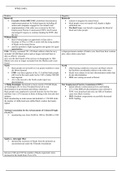
WWII/1940’s
Positive Negative
Roosevelt Roosevelt
Executive Order 8802 1941- prohibited discriminatory refused to integrate the armed forces
employment practices by Federal agencies including all black people were not treated well, despite a higher
unions and companies engaged in war-related work enlistment rate
implementation of the order was overseen by the Fair The Red Cross- was forced to segregate the blood of
Employment Practice Commission (FEPC) and Truman black and white people.
encouraged Congress to continue funding the FEPC after
the war
William Hastie
black Federal judge was appointed civilian aide to
Secretary of War, in 1940, to assist with the rising number
of blacks in the armed forces
used his position to fight segregation and agitate for equal
opportunities
1944- US army contained 701, 678 black soldiers while the navy a disproportionate number of blacks were fired from their wartime
included 165,000 black sailors and no longer restricted them to jobs, when whites came back
duty as officers’ stewards
navy was the first branch of the services to desegregate in 1946
Blacks were also no longer excluded from the Marines and Coast
Guard
North North
black people moved north in even greater numbers to meet often housing conditions were poor and black schools
the labour demand had facilities considerably inferior to the white ones
1940- over three-quarters of the 13.5 million black people blacks were subject to de facto discrimination rather than
still lived in the rural south, but by 1945 a further 500 000 de jure discrimination
had migrated 1943- race rioting occurred in Detroit
AA’s who moved to the North could expect less
discrimination
A Philip Randolph- threatened to lead a march of 50 000 blacks Fair Employment Practice Commission (FEPC)
on Washington DC to force President Roosevelt to end lacked effective enforcement powers and funding
discrimination in government and defence industries 2/3’s of the 8000 job discrimination cases referred to
black people were employed in aircraft factories for the first time FEPC were dismissed and only one-fifth of Southern
and there was a 25% increase in those working in the iron and steel cases were black victories.
industry 1943- Southern congressmen successfully decreased
black membership in trade unions had doubled to 1 250 000 while FEPC funding
the number of skilled and semi-skilled black workers had nearly
tripled.
National Association for the Advancement of Coloured People
(NAACP)
membership rose from 50,000 in 1940 to 500,000 in 1944
Smith vs. Allwright 1944
declared the exclusion of blacks from the primaries as
unconstitutional under the Fifteenth Amendment
between 1940 and 1947 the number of blacks registered voters
increased in the South from 3% to 12%.
Positive Negative
Roosevelt Roosevelt
Executive Order 8802 1941- prohibited discriminatory refused to integrate the armed forces
employment practices by Federal agencies including all black people were not treated well, despite a higher
unions and companies engaged in war-related work enlistment rate
implementation of the order was overseen by the Fair The Red Cross- was forced to segregate the blood of
Employment Practice Commission (FEPC) and Truman black and white people.
encouraged Congress to continue funding the FEPC after
the war
William Hastie
black Federal judge was appointed civilian aide to
Secretary of War, in 1940, to assist with the rising number
of blacks in the armed forces
used his position to fight segregation and agitate for equal
opportunities
1944- US army contained 701, 678 black soldiers while the navy a disproportionate number of blacks were fired from their wartime
included 165,000 black sailors and no longer restricted them to jobs, when whites came back
duty as officers’ stewards
navy was the first branch of the services to desegregate in 1946
Blacks were also no longer excluded from the Marines and Coast
Guard
North North
black people moved north in even greater numbers to meet often housing conditions were poor and black schools
the labour demand had facilities considerably inferior to the white ones
1940- over three-quarters of the 13.5 million black people blacks were subject to de facto discrimination rather than
still lived in the rural south, but by 1945 a further 500 000 de jure discrimination
had migrated 1943- race rioting occurred in Detroit
AA’s who moved to the North could expect less
discrimination
A Philip Randolph- threatened to lead a march of 50 000 blacks Fair Employment Practice Commission (FEPC)
on Washington DC to force President Roosevelt to end lacked effective enforcement powers and funding
discrimination in government and defence industries 2/3’s of the 8000 job discrimination cases referred to
black people were employed in aircraft factories for the first time FEPC were dismissed and only one-fifth of Southern
and there was a 25% increase in those working in the iron and steel cases were black victories.
industry 1943- Southern congressmen successfully decreased
black membership in trade unions had doubled to 1 250 000 while FEPC funding
the number of skilled and semi-skilled black workers had nearly
tripled.
National Association for the Advancement of Coloured People
(NAACP)
membership rose from 50,000 in 1940 to 500,000 in 1944
Smith vs. Allwright 1944
declared the exclusion of blacks from the primaries as
unconstitutional under the Fifteenth Amendment
between 1940 and 1947 the number of blacks registered voters
increased in the South from 3% to 12%.


