Biology 102 Chapter 9 - DNA Structure
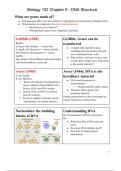
What are genes made of?
● Chromosomes follow the same patterns of segregation and assortment as Mendel's traits.
● Chromosomes are composed of nucleic acids and protein
○ But what are genes made of?
○ Old hypothesis: genes were comprised of proteins.
Griffith (1928) Griffith: Genes can be
Results: transferred
Living S cells (deadly) → mouse dies
● Living R cells (harmless) took
Living R cells (harmless) → mouse healthy
something from the dead S cells and
Heat-killed S cells (harmless) → mouse
were transformed into s cells
healthy
● What did the s cells give to the r cells
The mixture of heat-killed S cells and living R
to make them change into s cells (what
cells (both harmless) mouse die
is the genetic material?)
Avery (1944) Avery (1944): DNA is the
S cell: Deadly hereditary material
R cell: Harmless
● DNA must be present for
1. Remove the lipids and carbohydrates
transformation.
from a solution of heat-killed S cells.
○ Protein and RNA didn’t matter
Protein, RNA, and DNA remain.
● Therefore, DNA must be the
2. Protein, DNA, or RNA is removed
hereditary material.
from the solution.
Further experiments by other researchers on
3. R cells are added so that they can be
various organisms confirmed this.
“transformed” into deadly bacteria.
Nucleotides: the building Understanding DNA
blocks of DNA So, the monomers of DNA were known,
but…
● What form does a DNA molecule
have?
● How does DNA replicate itself?
● How does it contain genetic
information?
1
, Biology 102 Chapter 9 - DNA Structure
Chargaff’s rules
In 1950, Erwin Chargaff studied the DNA of different organisms; the amounts of the different
nitrogenous bases (Adenine, Cytosine, Guanine, Thymine)
Two findings became known as Chargaffʼs rules Example: If he measured 20% A, what
1. The base composition of DNA varies would he measure for all the others?
among species. 20% T
2. In any species, the number of A and T 30% C
bases is equal, and the number of G and C 30% G
bases is equal.
DNA structure
“Watson and Crick” with Rosalind Franklin
● Franklin: X-ray crystallography pattern = evidence of double helix shape.
● Watson and Crick: Saw Franklin’s X-ray pattern, and played with atomic models.
● Why does A=T? And C=G?
● DNA double helix model (1953)
The DNA polymer “strand”
2
What are genes made of?
● Chromosomes follow the same patterns of segregation and assortment as Mendel's traits.
● Chromosomes are composed of nucleic acids and protein
○ But what are genes made of?
○ Old hypothesis: genes were comprised of proteins.
Griffith (1928) Griffith: Genes can be
Results: transferred
Living S cells (deadly) → mouse dies
● Living R cells (harmless) took
Living R cells (harmless) → mouse healthy
something from the dead S cells and
Heat-killed S cells (harmless) → mouse
were transformed into s cells
healthy
● What did the s cells give to the r cells
The mixture of heat-killed S cells and living R
to make them change into s cells (what
cells (both harmless) mouse die
is the genetic material?)
Avery (1944) Avery (1944): DNA is the
S cell: Deadly hereditary material
R cell: Harmless
● DNA must be present for
1. Remove the lipids and carbohydrates
transformation.
from a solution of heat-killed S cells.
○ Protein and RNA didn’t matter
Protein, RNA, and DNA remain.
● Therefore, DNA must be the
2. Protein, DNA, or RNA is removed
hereditary material.
from the solution.
Further experiments by other researchers on
3. R cells are added so that they can be
various organisms confirmed this.
“transformed” into deadly bacteria.
Nucleotides: the building Understanding DNA
blocks of DNA So, the monomers of DNA were known,
but…
● What form does a DNA molecule
have?
● How does DNA replicate itself?
● How does it contain genetic
information?
1
, Biology 102 Chapter 9 - DNA Structure
Chargaff’s rules
In 1950, Erwin Chargaff studied the DNA of different organisms; the amounts of the different
nitrogenous bases (Adenine, Cytosine, Guanine, Thymine)
Two findings became known as Chargaffʼs rules Example: If he measured 20% A, what
1. The base composition of DNA varies would he measure for all the others?
among species. 20% T
2. In any species, the number of A and T 30% C
bases is equal, and the number of G and C 30% G
bases is equal.
DNA structure
“Watson and Crick” with Rosalind Franklin
● Franklin: X-ray crystallography pattern = evidence of double helix shape.
● Watson and Crick: Saw Franklin’s X-ray pattern, and played with atomic models.
● Why does A=T? And C=G?
● DNA double helix model (1953)
The DNA polymer “strand”
2