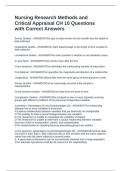
Nursing Research Methods and
Critical Appraisal CH 10 Questions
with Correct Answers
Survey Studies - ANSWERSThis type is better known for the breadth than the depth of
data collected.
longitudinal studies - ANSWERSA major disadvantage is the length of time needed for
data collection
correlational studies - ANSWERSThe main question is whether or not variables covary
ex post facto - ANSWERSThese words mean after the fact.
Cross-sectional - ANSWERSThis eliminates the confounding variable of mayuration.
Correlational - ANSWERSThis quantifies the magnitude and direction of a relationship
Longitudinal - ANSWERSCollects data from the same group at several points in time.
Survey Studies - ANSWERSCan be surprisingly accurate if the sample is
representative.
Cross-sectional studies - ANSWERSUse data from one point in time.
Comparative Studies - ANSWERSThis is based on two or more naturally occurring
groups with different conditions of the presumed independent variable
Correlation -Advantages (A) and Disadvantages (D) - ANSWERSThe relationship
between two or more variables is examined.
A-Explores relationships between variables that are inherently not manipulable
D-The inability to draw a causal linkage between two variables
D-The researcher is unable to manipulate the variables of interest
D-The researcher is unable tp determine a causal relationship between variables
because of lack of manipulation, control, and randomization
D-No randomization in sampling because preexisting groups are studied.
Cross-sectional -Advantages (A) and Disadvantages (D) - ANSWERSExamines data
one point in time: that is, data collected only on one occasion with the same subjects,
rather than with the same subjects at several points.
A- A great deal of information can be economically obtained from a large population.
D-An alternate hypothesis could be the reason for the relationships.
, D-The information tends to be superficial
Ex post facto - Advantages (A) and Disadvantages (D) - ANSWERSThe dependent
variable has already been affected by the independent variable, and the investigator
attempts to link present events that occurred in the past.
A-Offers a higher level of control than a correlational study.
D-The inability to draw a causal linkage between two variables
D-An alternate hypothesis could be the reason for the relationships.
D-The researcher is unable to manipulate the variables of interest
D-The researcher is unable tp determine a causal relationship between variables
because of lack of manipulation, control, and randomization
D-The information tends to be superficial
D-No randomization in sampling because preexisting groups are studied.
7D-
longitudinal (A) and Disadvantages (D)advantages - ANSWERSExplore differences and
relationships among variables. Collect data from the same group at different points in
time(AKA-repeated measures study).
A-Ability to assess changes in the variables of interest over times.
A-Less time consuming, less expensive and thus more manageable for the researcher.
D-An alternate hypothesis could be the reason for the relationships.
D-Internal validity threats such as testing and mortality are present
D- Subject loss to follow-up and attrition may lead to unintended sample bias that
affects external validity and generalizability of findings.
Prospective (A) and Disadvantages (D)advantages and disadvantages - ANSWERSA-
Ability to assess changes in the variables of interest over times.
A-Stronger than retrospective studies because of the degree of control on extraneous
variables
D-The researcher is unable to manipulate the variables of interest
D-The researcher is unable tp determine a causal relationship between variables
because of lack of manipulation, control, and randomization
D-No randomization in sampling because preexisting groups are studied.
D-Internal validity threats such as testing and mortality are present
Retrospective Advantages (A) and Disadvantages (D) - ANSWERSA-Offers a higher
level of control than a correlational study.
D-The inability to draw a causal linkage between two variables
D-An alternate hypothesis could be the reason for the relationships.
D-The researcher is unable to manipulate the variables of interest
D-The researcher is unable tp determine a causal relationship between variables
because of lack of manipulation, control, and randomization
D-The information tends to be superficial
D-No randomization in sampling because preexisting groups are studied.
Critical Appraisal CH 10 Questions
with Correct Answers
Survey Studies - ANSWERSThis type is better known for the breadth than the depth of
data collected.
longitudinal studies - ANSWERSA major disadvantage is the length of time needed for
data collection
correlational studies - ANSWERSThe main question is whether or not variables covary
ex post facto - ANSWERSThese words mean after the fact.
Cross-sectional - ANSWERSThis eliminates the confounding variable of mayuration.
Correlational - ANSWERSThis quantifies the magnitude and direction of a relationship
Longitudinal - ANSWERSCollects data from the same group at several points in time.
Survey Studies - ANSWERSCan be surprisingly accurate if the sample is
representative.
Cross-sectional studies - ANSWERSUse data from one point in time.
Comparative Studies - ANSWERSThis is based on two or more naturally occurring
groups with different conditions of the presumed independent variable
Correlation -Advantages (A) and Disadvantages (D) - ANSWERSThe relationship
between two or more variables is examined.
A-Explores relationships between variables that are inherently not manipulable
D-The inability to draw a causal linkage between two variables
D-The researcher is unable to manipulate the variables of interest
D-The researcher is unable tp determine a causal relationship between variables
because of lack of manipulation, control, and randomization
D-No randomization in sampling because preexisting groups are studied.
Cross-sectional -Advantages (A) and Disadvantages (D) - ANSWERSExamines data
one point in time: that is, data collected only on one occasion with the same subjects,
rather than with the same subjects at several points.
A- A great deal of information can be economically obtained from a large population.
D-An alternate hypothesis could be the reason for the relationships.
, D-The information tends to be superficial
Ex post facto - Advantages (A) and Disadvantages (D) - ANSWERSThe dependent
variable has already been affected by the independent variable, and the investigator
attempts to link present events that occurred in the past.
A-Offers a higher level of control than a correlational study.
D-The inability to draw a causal linkage between two variables
D-An alternate hypothesis could be the reason for the relationships.
D-The researcher is unable to manipulate the variables of interest
D-The researcher is unable tp determine a causal relationship between variables
because of lack of manipulation, control, and randomization
D-The information tends to be superficial
D-No randomization in sampling because preexisting groups are studied.
7D-
longitudinal (A) and Disadvantages (D)advantages - ANSWERSExplore differences and
relationships among variables. Collect data from the same group at different points in
time(AKA-repeated measures study).
A-Ability to assess changes in the variables of interest over times.
A-Less time consuming, less expensive and thus more manageable for the researcher.
D-An alternate hypothesis could be the reason for the relationships.
D-Internal validity threats such as testing and mortality are present
D- Subject loss to follow-up and attrition may lead to unintended sample bias that
affects external validity and generalizability of findings.
Prospective (A) and Disadvantages (D)advantages and disadvantages - ANSWERSA-
Ability to assess changes in the variables of interest over times.
A-Stronger than retrospective studies because of the degree of control on extraneous
variables
D-The researcher is unable to manipulate the variables of interest
D-The researcher is unable tp determine a causal relationship between variables
because of lack of manipulation, control, and randomization
D-No randomization in sampling because preexisting groups are studied.
D-Internal validity threats such as testing and mortality are present
Retrospective Advantages (A) and Disadvantages (D) - ANSWERSA-Offers a higher
level of control than a correlational study.
D-The inability to draw a causal linkage between two variables
D-An alternate hypothesis could be the reason for the relationships.
D-The researcher is unable to manipulate the variables of interest
D-The researcher is unable tp determine a causal relationship between variables
because of lack of manipulation, control, and randomization
D-The information tends to be superficial
D-No randomization in sampling because preexisting groups are studied.