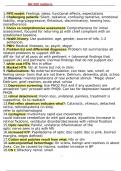
Saunders Comprehensive Review for the NCLEX-PN®
Examination
9th Edition
• Author(s)Linda Anne Silvestri; Angela Silvestri
ANATOMY AND PHYSIOLOGY TEST BANK
1 — Cardiovascular: Cardiac Output & Preload
A 68-year-old client with chronic heart failure arrives with
sudden weight gain, jugular venous distention, and crackles in
the lungs. Which physiological change best explains the client’s
pulmonary congestion?
A. Increased heart rate causing decreased diastolic filling time
B. Decreased left ventricular ejection fraction leading to
increased left ventricular end-diastolic volume (preload)
C. Decreased systemic vascular resistance lowering afterload
D. Increased oncotic pressure from elevated plasma proteins
Answer: B
Rationale (correct — B):
Left ventricular systolic dysfunction (reduced ejection fraction)
causes blood to remain in the left ventricle after systole,
increasing left ventricular end-diastolic volume (preload).
Elevated pressure in the left ventricle is transmitted backward
,to the left atrium and pulmonary veins, increasing pulmonary
capillary hydrostatic pressure and causing pulmonary edema
and crackles.
Why the others are incorrect:
A. Increased heart rate can reduce diastolic filling time, but it
alone does not explain fluid backing into the lungs — congestive
signs link to decreased forward output.
C. Decreased systemic vascular resistance lowers afterload
(which would often improve forward output), so it would be
less likely to cause pulmonary congestion.
D. Increased oncotic pressure would pull fluid into the
vasculature and reduce edema — the clinical picture shows
increased hydrostatic pressure, not oncotic causes.
2 — Respiratory: V/Q Matching
Which physiological phenomenon best explains hypoxemia
when a client has an airway plugged by mucus in one bronchus
while the remainder of the lung is ventilated normally?
A. Increased physiologic dead space
B. Right-to-left shunt effect (low V/Q) in the affected lung region
C. Decreased diffusion capacity due to alveolar membrane
thickening
D. Increased oxygen affinity of hemoglobin
Answer: B
,Rationale (correct — B):
When an airway is obstructed, perfusion to that region
continues but ventilation is absent — this produces a very low
ventilation/perfusion ratio (V/Q ≈ 0), functionally acting like a
right-to-left shunt. Blood leaves the pulmonary circulation
without being oxygenated, causing hypoxemia that is often
poorly responsive to low-flow oxygen.
Why the others are incorrect:
A. Physiologic dead space is ventilation without perfusion (high
V/Q); the scenario has perfusion without ventilation (low V/Q).
C. Diffusion impairment (e.g., fibrosis) causes hypoxemia but is
a global alveolar membrane problem, not acute obstruction of a
single bronchus.
D. Increased oxygen affinity would cause decreased oxygen
unloading to tissues, not immediate arterial hypoxemia from
intrapulmonary shunting.
3 — Renal: Glomerular Filtration & Proteinuria
A client with glomerular basement membrane damage is noted
to have proteinuria. Which explanation correctly relates
structure to the clinical finding?
A. Increased pore size of the basement membrane allows
albumin to be filtered into the urine
B. Enhanced reabsorption by proximal tubule causes overflow
proteinuria
C. Increased hydrostatic pressure in Bowman's capsule prevents
, filtration of proteins
D. Increased proximal tubule secretion of proteins
Answer: A
Rationale (correct — A):
The glomerular filtration barrier normally restricts large
proteins like albumin. Damage to the basement membrane or
podocytes increases its permeability (effectively larger or
dysfunctional filtration slits), allowing albumin and other
plasma proteins to pass into the filtrate, resulting in proteinuria.
Why the others are incorrect:
B. Proximal tubule reabsorption reduces filtered protein in
normal physiology; overflow proteinuria arises from excessive
plasma protein (e.g., myoglobin) that overwhelms reabsorption,
not enhanced reabsorption.
C. Increased hydrostatic pressure in Bowman's space would
reduce filtration overall but not selectively cause proteinuria.
D. Proximal tubular secretion of proteins is not a normal
mechanism causing proteinuria.
4 — Endocrine: Thyroid Hormone & Metabolism
A client presents with heat intolerance, weight loss despite
increased appetite, and fine tremor. Lab shows elevated T3/T4
and suppressed TSH. Which physiologic action of thyroid
hormone explains the weight loss?
A. Reduced basal metabolic rate through decreased
Examination
9th Edition
• Author(s)Linda Anne Silvestri; Angela Silvestri
ANATOMY AND PHYSIOLOGY TEST BANK
1 — Cardiovascular: Cardiac Output & Preload
A 68-year-old client with chronic heart failure arrives with
sudden weight gain, jugular venous distention, and crackles in
the lungs. Which physiological change best explains the client’s
pulmonary congestion?
A. Increased heart rate causing decreased diastolic filling time
B. Decreased left ventricular ejection fraction leading to
increased left ventricular end-diastolic volume (preload)
C. Decreased systemic vascular resistance lowering afterload
D. Increased oncotic pressure from elevated plasma proteins
Answer: B
Rationale (correct — B):
Left ventricular systolic dysfunction (reduced ejection fraction)
causes blood to remain in the left ventricle after systole,
increasing left ventricular end-diastolic volume (preload).
Elevated pressure in the left ventricle is transmitted backward
,to the left atrium and pulmonary veins, increasing pulmonary
capillary hydrostatic pressure and causing pulmonary edema
and crackles.
Why the others are incorrect:
A. Increased heart rate can reduce diastolic filling time, but it
alone does not explain fluid backing into the lungs — congestive
signs link to decreased forward output.
C. Decreased systemic vascular resistance lowers afterload
(which would often improve forward output), so it would be
less likely to cause pulmonary congestion.
D. Increased oncotic pressure would pull fluid into the
vasculature and reduce edema — the clinical picture shows
increased hydrostatic pressure, not oncotic causes.
2 — Respiratory: V/Q Matching
Which physiological phenomenon best explains hypoxemia
when a client has an airway plugged by mucus in one bronchus
while the remainder of the lung is ventilated normally?
A. Increased physiologic dead space
B. Right-to-left shunt effect (low V/Q) in the affected lung region
C. Decreased diffusion capacity due to alveolar membrane
thickening
D. Increased oxygen affinity of hemoglobin
Answer: B
,Rationale (correct — B):
When an airway is obstructed, perfusion to that region
continues but ventilation is absent — this produces a very low
ventilation/perfusion ratio (V/Q ≈ 0), functionally acting like a
right-to-left shunt. Blood leaves the pulmonary circulation
without being oxygenated, causing hypoxemia that is often
poorly responsive to low-flow oxygen.
Why the others are incorrect:
A. Physiologic dead space is ventilation without perfusion (high
V/Q); the scenario has perfusion without ventilation (low V/Q).
C. Diffusion impairment (e.g., fibrosis) causes hypoxemia but is
a global alveolar membrane problem, not acute obstruction of a
single bronchus.
D. Increased oxygen affinity would cause decreased oxygen
unloading to tissues, not immediate arterial hypoxemia from
intrapulmonary shunting.
3 — Renal: Glomerular Filtration & Proteinuria
A client with glomerular basement membrane damage is noted
to have proteinuria. Which explanation correctly relates
structure to the clinical finding?
A. Increased pore size of the basement membrane allows
albumin to be filtered into the urine
B. Enhanced reabsorption by proximal tubule causes overflow
proteinuria
C. Increased hydrostatic pressure in Bowman's capsule prevents
, filtration of proteins
D. Increased proximal tubule secretion of proteins
Answer: A
Rationale (correct — A):
The glomerular filtration barrier normally restricts large
proteins like albumin. Damage to the basement membrane or
podocytes increases its permeability (effectively larger or
dysfunctional filtration slits), allowing albumin and other
plasma proteins to pass into the filtrate, resulting in proteinuria.
Why the others are incorrect:
B. Proximal tubule reabsorption reduces filtered protein in
normal physiology; overflow proteinuria arises from excessive
plasma protein (e.g., myoglobin) that overwhelms reabsorption,
not enhanced reabsorption.
C. Increased hydrostatic pressure in Bowman's space would
reduce filtration overall but not selectively cause proteinuria.
D. Proximal tubular secretion of proteins is not a normal
mechanism causing proteinuria.
4 — Endocrine: Thyroid Hormone & Metabolism
A client presents with heat intolerance, weight loss despite
increased appetite, and fine tremor. Lab shows elevated T3/T4
and suppressed TSH. Which physiologic action of thyroid
hormone explains the weight loss?
A. Reduced basal metabolic rate through decreased