
PHOTOSYNTHESIS Key Terms
3.5 ENERGY TRANSFERS IN AND BETWEEN ORGANISMS Thylakoid membrane
Grana/granum
Chloroplasts MISSESTRUCH 2021 Pigment
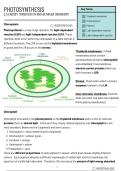
Photosynthesis is a two-stage reaction: the light-dependent Light dependent reaction
reaction (LDR) and light-independent reaction (LIR). These Light independent reaction
reactions both occur within the chloroplast of a plant cell but in
different locations. The LDR occurs on the thylakoid membranes
or grana and the LIR occurs in the stroma.
Thylakoid membranes: Folded
membranes which contain
photosynthetic proteins (chlorophyll)
and embedded, transmembrane
electron carrier proteins which are
both involved in LDR.
Stroma: Fluid centre which contains
enzymes involved in the LIR.
Inner and outer membrane: Controls
what can enter and leave the organelle
(think plasma membranes).
Chlorophyll
Chlorophyll is located in the photosystems on the thylakoid membrane and is a mix of coloured
proteins that can absorb light. There are 5 key closely related pigments, but chlorophyll a is the
most abundant. Below are the 5 pigments and their colours:
1. Chlorophyll a = blue/ green (found in all plants)
2. Chlorophyll b = yellow/ green
3. Carotene = orange
4. Xanthophyll = yellow
5. Phaeophytin = grey
There are different proportions of each pigment in leaves, which gives leaves slightly different
colours. Each pigment absorbs a different wavelength of visible light and this maximises the
spectrum of visible light absorbed. Therefore, this increases the amount of light energy absorbed.
1
MISSESTRUCH 2021
,PHOTOSYNTHESIS Key Terms
3.5 ENERGY TRANSFERS IN AND BETWEEN ORGANISMS Pigment
Wavelength of light
Chlorophyll MISSESTRUCH 2021 Photoionisation
Each pigment can absorb a different range of wavelengths of Photolysis
light within the visible light spectrum. 500- 550nm is poorly Chemiosmosis
absorbed by all pigments, so wavelengths within this range are
reflected which is why leaves look green.
The advantage of having multiple
pigments is that a wider range of
wavelengths of light is absorbed.
Therefore, more light energy is
absorbed for the LDR (more
photoionisation of chlorophyll).
Light-dependent reaction (LDR)
This is the first stage of photosynthesis, which requires light and it occurs on the thylakoid
membranes or grana. The purpose of this stage is to use light energy and water to create ATP
and reduced NADP which can then be used in the light-independent stage. This occurs in three key
stages:
1. Photoionisation of chlorophyll
2. Photolysis
3. Chemiosmosis
2
MISSESTRUCH 2021
,PHOTOSYNTHESIS Key Terms
3.5 ENERGY TRANSFERS IN AND BETWEEN ORGANISMS Photolysis
Photoionisation
Photolysis MISSESTRUCH 2021 Energy level
ATP synthase
Photo (light) Lysis (splitting)
Chemiosmosis
Light energy is absorbed by chlorophyll and splits water into
oxygen, H+ and e-.
H2O --> ½ O2 + 2e- + 2H+
The H+ is picked up by NADP to form reduced NADP and is used in the LIR.
The e- are passed along a chain of electron carrier proteins.
The oxygen is either used for respiration or diffuses out of the leaf through the stomata.
Photoionisation of chlorophyll
Light energy is absorbed by the chlorophyll which
results in electrons becoming excited so they can move
up an energy level to leave the chlorophyll. Therefore,
chlorophyll has been ionised by light. Some of the
energy from the released electrons is used to make ATP
and reduced NADP in chemiosmosis.
Chemiosmosis
The electrons that gained energy and left the chlorophyll move along a series of electron-carrier
proteins embedded within the thylakoid membrane. As they move along, they release energy
and some of the energy from electrons is used to pump the protons from photolysis across the
chloroplast membranes. This creates an electrochemical gradient. Therefore, the protons pass
back across the membranes through the enzyme ATP synthase down their concentration
gradient, which results in the production of ATP. The protons combine with the co-enzyme NADP
to become reduced NADP. As the protons move down their concentration gradient, this is known
as chemiosmosis.
3
MISSESTRUCH 2021
,PHOTOSYNTHESIS Key Terms
3.5 ENERGY TRANSFERS IN AND BETWEEN ORGANISMS Chlorophyll
Electrons
Chemiosmosis MISSESTRUCH 2021 Electrochemical gradient
Calvin cycle
The diagram below summarises the process.
Rubisco
Step 4: The protons combine with the co-enzyme NADP
Step 2: As they move along they release energy
to become reduced NADP. As the protons move down
and some of the energy from electrons is used
their concentration gradient, this is known as
to pump the protons across chloroplast
chemiosmosis.
membranes.
Step 1: The
electrons that
gained energy
and left the
chlorophyll move
along a series of
electron- carrier Step 3: An electrochemical
proteins gradient is created. The
embedded within protons pass through the
the thylakoid enzyme ATP synthase,
membrane. which results in the
production of ATP.
The light-independent reaction (LIR)
The light-independent reaction, also known as the Calvin cycle, uses carbon dioxide, reduced
NADP and ATP to form a hexose sugar. The ATP is hydrolysed to provide energy for this reaction
and the reduced NADP donates the hydrogen to reduce GP in the cycle.
The Calvin cycle occurs in the stroma, and this fluid contains the enzyme rubisco which catalyses
this reaction. This stage is temperature sensitive due to the fact it involves an enzyme.
4
MISSESTRUCH 2021
, PHOTOSYNTHESIS Key Terms
3.5 ENERGY TRANSFERS IN AND BETWEEN ORGANISMS RuBP
GP
The light-independent reaction (LIR) MISSESTRUCH 2021 TP
Carbon dioxide reacts with ribulose bisphosphate (RuBP) to Rubisco
form two molecules of glycerate 3-phosphate (GP) which is a Organic substances
3-carbon compound. This reaction is catalysed by the enzyme
rubisco.
GP is reduced to triose phosphate (TP)
using energy from ATP and by accepting a
H from reduced NADP.
Some of the carbon from TP leaves the
cycle each turn to be converted into useful
organic substances.
The rest of the molecule is used to
regenerate RuBP, with the energy released
from the hydrolysis of ATP.
Whilst glucose is the product, this
monosaccharide can join to form
disaccharides such as sucrose, and
polysaccharides such as cellulose and
starch. It can also be converted into
glycerol and therefore combine with fatty
acids to make lipids for the plant.
Limiting factors
Any factor that reduces that rate of photosynthesis is called a limiting factor. These could be
temperature, carbon dioxide concentration or light intensity.
For maximum photosynthesis, and therefore plant growth, common agriculture practices
incorporate techniques to remove limiting factors.
5
MISSESTRUCH 2021


