
Mosquito and Aquatic Training Guide –
Questions With Appropriate Solutions
Save
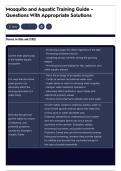
Terms in this set (132)
- Producing oxygen for other organisms in the lake
- Preventing shoreline erosion
List the roles plants play
- Lessening excess nutrients during the growing
in the healthy aquatic
season
ecosystem
- Providing food and habitat for fish, waterfowl, and
other aquatic animals
- Harm the ecology of an aquatic ecosystem
List ways that excessive - Curtail or prevent recreational water uses
plant growth can - Impart tastes or odors to drinking water supplies
adversely affect the - Hamper water treatment operations
ecology and uses of a - Adversely affect aesthetics, resort trade, and
water body. waterfront property values
- Produce toxins that harm animals who drink water
Growth habits: rooted in relatively shallow water so
most of their growth extends above the water line,
or they grow in water-saturated soils.
Describe the general
Dispersal: spread by an underground root system
growth habits of, means
and new emergent plants can occur almost
of dispersal, and
anywhere in the network. Examples: cattails,
potential problems
arrowhead, bulrushes, and purple loosestrife.
caused by: Emergent
Problems: Dense and can limit recreational boating,
Aquatic Plants
fishing and swimming, however they provide habitat
for wildlife and shouldn't be controlled except in
the case of purple loosestrife.
, Growth habits: rooted plants with all of their growth
occurring below the water line (i.e. pondweeds)
Dispersal:
Pondweeds - extensive root systems and runners,
new growth sprouts from roots, runners and seeds;
some have floating leaves and some submerged
leaves that are attached to center stem in alternate
arrangement.
Whorled leaves - 3 or more leaves attached at one
point on the main stem i.e. coontail, water milfoil,
and elodea are most common.
Problems:
Describe the general
Pondweeds - not usually a nuisance except for curly
growth habits of, means
leaf pondweed and sago pondweed. Many
of dispersal, and
pondweeds are good habitat for wildlife and if
potential problems
removed can cause aggressive nuisance plants to
caused by: Submergent
infest the area.
Aquatic Plants
Whorled leaves - if uprooted they break free, drift
with wind and clutter shoreline; must hand rake to
remove them. Cutting plants without raking can
produce nuisance situation. Motorboats can
aggravate situation and cause nuisance infestation.
Third type of submergent plant: water celery, tape
grass, and eelgrass. Grows in clear water to a depth
of 15ft. has long, green, ribbon-like leaves extending
from the base of the plant. Should be left alone
because it's a food source for waterfowl.
, Growth habits: plants whose leaves float on the
water surface (i.e. water lilies)
Dispersal: Free-floating- wind; Rooted- wind
Describe the general
growth habits of, means
Problems:
of dispersal, and
Free-floating - i.e lesser duckweed; form green
potential problems
blanket up to 2" thick on water surface; difficult to
caused by: Free-floating
control in large bodies of water.
and rooted floating-
Rooted - examples: water lilies, spatterdock,
leaved aquatic plants
American lotus, and watershield. These plants
provide valuable cover for fish and are rarely a
problem
Growth habits: can be found floating or attached to
submerged surfaces in lakes, ponds, and streams.
Multiply rapidly through summertime.
Dispersal:
Free-floating - multiply rapidly suspended in the
water
Filamentous - anchor to a submerged surface to
Describe the general multiply
growth habits of, means Rooted - i.e. Chara and Nitella; attached to the
of dispersal, and bottom
potential problems
caused by: Free-floating, Problems:
filamentous, and "rooted" Free-floating - bacteria that decompose dead algae
algae. often use up the dissolved oxygen in the water and
produce fish kills. As they die, the algae also may
release into the water extremely toxic compounds
that make the water unsafe to drink.
Filamentous - they may break loose and float as a
mass over an entire body of water.
Rooted - sometimes difficult to control, and is often
best to leave alone
Questions With Appropriate Solutions
Save
Terms in this set (132)
- Producing oxygen for other organisms in the lake
- Preventing shoreline erosion
List the roles plants play
- Lessening excess nutrients during the growing
in the healthy aquatic
season
ecosystem
- Providing food and habitat for fish, waterfowl, and
other aquatic animals
- Harm the ecology of an aquatic ecosystem
List ways that excessive - Curtail or prevent recreational water uses
plant growth can - Impart tastes or odors to drinking water supplies
adversely affect the - Hamper water treatment operations
ecology and uses of a - Adversely affect aesthetics, resort trade, and
water body. waterfront property values
- Produce toxins that harm animals who drink water
Growth habits: rooted in relatively shallow water so
most of their growth extends above the water line,
or they grow in water-saturated soils.
Describe the general
Dispersal: spread by an underground root system
growth habits of, means
and new emergent plants can occur almost
of dispersal, and
anywhere in the network. Examples: cattails,
potential problems
arrowhead, bulrushes, and purple loosestrife.
caused by: Emergent
Problems: Dense and can limit recreational boating,
Aquatic Plants
fishing and swimming, however they provide habitat
for wildlife and shouldn't be controlled except in
the case of purple loosestrife.
, Growth habits: rooted plants with all of their growth
occurring below the water line (i.e. pondweeds)
Dispersal:
Pondweeds - extensive root systems and runners,
new growth sprouts from roots, runners and seeds;
some have floating leaves and some submerged
leaves that are attached to center stem in alternate
arrangement.
Whorled leaves - 3 or more leaves attached at one
point on the main stem i.e. coontail, water milfoil,
and elodea are most common.
Problems:
Describe the general
Pondweeds - not usually a nuisance except for curly
growth habits of, means
leaf pondweed and sago pondweed. Many
of dispersal, and
pondweeds are good habitat for wildlife and if
potential problems
removed can cause aggressive nuisance plants to
caused by: Submergent
infest the area.
Aquatic Plants
Whorled leaves - if uprooted they break free, drift
with wind and clutter shoreline; must hand rake to
remove them. Cutting plants without raking can
produce nuisance situation. Motorboats can
aggravate situation and cause nuisance infestation.
Third type of submergent plant: water celery, tape
grass, and eelgrass. Grows in clear water to a depth
of 15ft. has long, green, ribbon-like leaves extending
from the base of the plant. Should be left alone
because it's a food source for waterfowl.
, Growth habits: plants whose leaves float on the
water surface (i.e. water lilies)
Dispersal: Free-floating- wind; Rooted- wind
Describe the general
growth habits of, means
Problems:
of dispersal, and
Free-floating - i.e lesser duckweed; form green
potential problems
blanket up to 2" thick on water surface; difficult to
caused by: Free-floating
control in large bodies of water.
and rooted floating-
Rooted - examples: water lilies, spatterdock,
leaved aquatic plants
American lotus, and watershield. These plants
provide valuable cover for fish and are rarely a
problem
Growth habits: can be found floating or attached to
submerged surfaces in lakes, ponds, and streams.
Multiply rapidly through summertime.
Dispersal:
Free-floating - multiply rapidly suspended in the
water
Filamentous - anchor to a submerged surface to
Describe the general multiply
growth habits of, means Rooted - i.e. Chara and Nitella; attached to the
of dispersal, and bottom
potential problems
caused by: Free-floating, Problems:
filamentous, and "rooted" Free-floating - bacteria that decompose dead algae
algae. often use up the dissolved oxygen in the water and
produce fish kills. As they die, the algae also may
release into the water extremely toxic compounds
that make the water unsafe to drink.
Filamentous - they may break loose and float as a
mass over an entire body of water.
Rooted - sometimes difficult to control, and is often
best to leave alone


