

06 - Plant transport
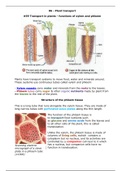
#59 Transport in plants - functions of xylem and phloem
Plants have transport systems to move food, water and minerals around.
These systems use continuous tubes called xylem and phloem:
- Xylem vessels carry water and minerals from the roots to the leaves.
- Phloem tubes carry sugar & other organic nutrients made by plant from
the leaves to the rest of the plant.
Structure of the phloem tissue
This is a long tube that runs alongside the xylem tissue. They are made of
long narrow tubes with perforated sieve plates along the thin length.
The function of the phloem tissue is
to transport food nutrients such
as glucose and amino acids from the leaves and
to all other cells of the plant, this is called
translocation.
Unlike the xylem, the phloem tissue is made of
columns of living cells, swhich contains a
cytoplasm but no nucleus, and its activities are
controlled by a companion cell next to it which
Scanning electron has a nucleus, but companion cells have no
micrograph of a sieve function in translocation.
plate in a phloem tube
(x1300)
,Structure of the xylem tissue
Xylem vessels consist of dead cells.
They have a thick, strengthened
cellulose cell wall with a hollow
lumen. The end walls of the cells have
disappeared, so a long, open tube is
formed. The walls of the xylem vessel
contains holes called pits which water
enters through.
The xylem vessel is specialised
to transport water and dissolved minerals from
the root up to all the other parts of the plant, and
also to helps supporting the stem and
strengthening it.
Scanning electron
micrograph
of xylem vessels (x1800)
, Additional resource: xtremepapers.com
acceleratedstudynotes.com
Related post: Cell functions
#59 Transport in plants - functions of xylem and phloem
Plants have transport systems to move food, water and minerals around.
These systems use continuous tubes called xylem and phloem:
- Xylem vessels carry water and minerals from the roots to the leaves.
- Phloem tubes carry sugar & other organic nutrients made by plant from
the leaves to the rest of the plant.
Structure of the phloem tissue
This is a long tube that runs alongside the xylem tissue. They are made of
long narrow tubes with perforated sieve plates along the thin length.
The function of the phloem tissue is
to transport food nutrients such
as glucose and amino acids from the leaves and
to all other cells of the plant, this is called
translocation.
Unlike the xylem, the phloem tissue is made of
columns of living cells, swhich contains a
cytoplasm but no nucleus, and its activities are
controlled by a companion cell next to it which
Scanning electron has a nucleus, but companion cells have no
micrograph of a sieve function in translocation.
plate in a phloem tube
(x1300)
,Structure of the xylem tissue
Xylem vessels consist of dead cells.
They have a thick, strengthened
cellulose cell wall with a hollow
lumen. The end walls of the cells have
disappeared, so a long, open tube is
formed. The walls of the xylem vessel
contains holes called pits which water
enters through.
The xylem vessel is specialised
to transport water and dissolved minerals from
the root up to all the other parts of the plant, and
also to helps supporting the stem and
strengthening it.
Scanning electron
micrograph
of xylem vessels (x1800)
, Additional resource: xtremepapers.com
acceleratedstudynotes.com
Related post: Cell functions


