

09 Coordination and response
#86 The human nervous system
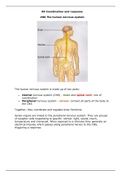
The human nervous system is made up of two parts:
Central nervous system (CNS) - brain and spinal cord: role of
coordination
Peripheral nervous system - nerves: connect all parts of the body to
the CNS.
Together, they coordinate and regulate body functions.
Sense organs are linked to the peripheral nervous system. They are groups
of receptor cells responding to specific stimuli: light, sound, touch,
temperature and chemicals. When exposed to a stimulus they generate an
electrical impulse which passes along peripheral nerves to the CNS,
triggering a response.
,Peripheral nerves contain sensory and motor neurones (nerve cells).
transmit nerve impules
Motor neurone sense organs à CNS
CNS à effectors
Sensory neurone (muscles or glands)
Motor and sensory neurones are covered with a myelin sheath, which
insulates the neurone to make transmission of the impulse more efficient.
The cytoplasm (mainly axon and dendron) is elongated to transmit the
impulse for long distances.
Structure Sensory neurone Motor neurone
Cell body Near end of neurone, in a At start of neurone,
ganglion (swelling) just indise the grey matter
outside the spinal cord of the spinal cord
Dendrites Present at end of neurone Attached to cell body
Axon Very short Very long
Dendron Very long None
Fun fact: The human nervous system runs on electrical impulses that
travel close to the speed of light.
Sample question and answer
Question Figure above shows a type of neurone. Name this type of
neurone and state a reason for your choice. [ 2 marks]
Answer Name: motor neurone.
Reason: It has a cell body, the cell body is at the and of the cell.
Video: The Human Nervous System
Video: The Spinal Cord
Video: Human Body Nervous System
, #87 Simple reflex arc
A reflex action is an automatic response to a stimulus.
A reflex arc describes the pathway of an electrical impulse in response
to a stimulus.
Relay neurones are found in the spinal cord, connecting sensosy neurones
to motor neurones.
#86 The human nervous system
The human nervous system is made up of two parts:
Central nervous system (CNS) - brain and spinal cord: role of
coordination
Peripheral nervous system - nerves: connect all parts of the body to
the CNS.
Together, they coordinate and regulate body functions.
Sense organs are linked to the peripheral nervous system. They are groups
of receptor cells responding to specific stimuli: light, sound, touch,
temperature and chemicals. When exposed to a stimulus they generate an
electrical impulse which passes along peripheral nerves to the CNS,
triggering a response.
,Peripheral nerves contain sensory and motor neurones (nerve cells).
transmit nerve impules
Motor neurone sense organs à CNS
CNS à effectors
Sensory neurone (muscles or glands)
Motor and sensory neurones are covered with a myelin sheath, which
insulates the neurone to make transmission of the impulse more efficient.
The cytoplasm (mainly axon and dendron) is elongated to transmit the
impulse for long distances.
Structure Sensory neurone Motor neurone
Cell body Near end of neurone, in a At start of neurone,
ganglion (swelling) just indise the grey matter
outside the spinal cord of the spinal cord
Dendrites Present at end of neurone Attached to cell body
Axon Very short Very long
Dendron Very long None
Fun fact: The human nervous system runs on electrical impulses that
travel close to the speed of light.
Sample question and answer
Question Figure above shows a type of neurone. Name this type of
neurone and state a reason for your choice. [ 2 marks]
Answer Name: motor neurone.
Reason: It has a cell body, the cell body is at the and of the cell.
Video: The Human Nervous System
Video: The Spinal Cord
Video: Human Body Nervous System
, #87 Simple reflex arc
A reflex action is an automatic response to a stimulus.
A reflex arc describes the pathway of an electrical impulse in response
to a stimulus.
Relay neurones are found in the spinal cord, connecting sensosy neurones
to motor neurones.


