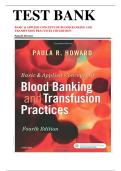
TEST BANK
BASIC & APPLIED CONCEPTS OF BLOOD BANKING AND
TRANSFUSION PRACTICES 4TH EDITION
Paula R. Howard
,Chapter 01: Quality Assurance and Regulation of the Blood Industry and Safety Issues
in the Blood Bank
Howard: Basic & Applied Concepts of Blood Banking and Transfusion Practices, 4th
Edition
MULTIPLE CHOICE
1. Which of the following agencies administers the Clinical Laboratory Improvement
Amendments?
a.AABB
b.Centers for Medicare and Medicaid Services
c.OSHA
d.Food and Drug Administration
ANS: B
The Centers for Medicare and Medicaid Services administers CLIA, Medicare, Medicaid, and
HIPAA.
DIF: Level 1 REF: p. 3
2. A laboratory technologist decided she would like to bring her lab coat home for laundering
because it had too many wrinkles when returned by the laboratory’s laundry service. Is this
practice acceptable?
a. Yes, if she uses 10% bleach
b. Yes, if she clears it with her supervisor
c. Yes, as long as she removes the coat and does not wear it home
d. No, because the laboratory is a biosafety level 2, and lab coats may not be
removed
ANS: D
Methods of transporting the lab coat and the risk of contamination do not permit health care
workers to bring lab coats home for cleaning.
DIF: Level 2 REF: p. 14
3. Personal protective equipment includes:
a. safety glasses.
b. splash barriers.
c. masks.
d. All of the above
ANS: D
Safety glasses, splash barriers, and masks are types of personal protective devices.
DIF: Level 1 REF: p. 14
4. At what point in the employment process should safety training take place?
a. During orientation and training
b. Following lab training when employees are more familiar with their
responsibilities
, c. Following the employees’ first evaluation
d. Before independent work is permitted and annually thereafter
ANS: D
The Occupation Safety and Health Administration requires safety training before independent
work is permitted and annually thereafter.
DIF: Level 1 REF: p. 17
5. In safety training, employees must become familiar with all of the following except:
a. tasks that have an infectious risk.
b. limits of protective clothing and equipment.
c. the appropriate action to take if exposure occurs.
d. how to perform cardiopulmonary resuscitation on a donor or other employee.
ANS: D
The Occupational Safety and Health Administration requirements include all of those listed
except cardiopulmonary resuscitation.
DIF: Level 1 REF: p. 13
6. Blood irradiators require all of the following safety procedures except:
a. proper training.
b. that the user have a degree in radiology.
c. equipment leak detection.
d. personal protective equipment.
ANS: B
Blood bank and transfusion service technologists require training but not a degree to use a
blood irradiator.
DIF: Level 2 REF: p. 16
7. Which of the following is true regarding good manufacturing practices (GMPs)?
a. GMPs are legal requirements established by the Food and Drug Administration.
b. GMPs are optional guidelines written by the AABB.
c. GMPs are required only by pharmaceutical companies.
d. GMPs are part of the quality control requirements for blood products.
ANS: A
Good manufacturing practices are requirements established by the Food and Drug
Administration.
DIF: Level 1 REF: p. 5
8. Which of the following is an example of an unacceptable record-keeping procedure?
a. Using dittos in columns to save time
b. Recording the date and initials next to a correction
c. Not deleting the original entry when making a correction
d. Always using permanent ink on all records
ANS: A
All records must be clearly written. Dittos are unacceptable.
, DIF: Level 1 REF: p. 7
9. A ftechnologist fin ftraining fnoticed fthat fthe fperson ftraining fher fhad fnot frecorded fthe fresults
fof fa ftest. fTo fbe fhelpful, fshe fcarefully frecorded fthe fresults fshe fsaw fat fa flater ftime, fusing
fthe ftechnologist’s finitials. fIs fthis fan facceptable fprocedure?
a. Yes; fall fresults fmust fbe frecorded fregardless fof fwho fdid fthe ftest.
b. No; fshe fshould fhave fbrought fthe ferror fto fthe ftechnologist’s fattention.
c. Yes; fbecause fshe fused fthe fother ftechnologist’s finitials.
d. Yes; fas flong fas fshe frecords fthe fresult fin fpencil.
ANS: f B
This fis fan fexample fof fpoor frecord fkeeping; fresults fmust fbe frecorded fwhen fthe ftest fis
fperformed fand fby fthe fperson fdoing fthe ftest.
DIF: Level f3 REF: f f p. f8
10. Unacceptable fquality fcontrol fresults ffor fthe fantiglobulin ftest fperformed fin ftest ftubes
fmay fbe fnoticed fif:
a. preventive fmaintenance fhas fnot fbeen fperformed fon fthe fcell fwasher.
b. the ftechnologist fperforming fthe ftest fwas fnever ftrained.
c. the freagents fused fwere fimproperly fstored.
d. All fof fthe fabove
ANS: f D
Training, fequipment fmaintenance, fand freagent fquality fcan faffect fquality fcontrol.
DIF: Level f2 REF: f f p. f5
11. All fof fthe ffollowing fare ftrue fregarding fcompetency ftesting fexcept:
a. it fmust fbe fperformed ffollowing ftraining.
b. it fmust fbe fperformed fon fan fannual fbasis.
c. it fis frequired fonly fif fthe ftechnologist fhas fno fexperience.
d. retraining fis frequired fif fthere fis fa ffailure fin fcompetency ftesting.
ANS: f C
All femployees fmust fhave fcompetency ftesting ffollowing ftraining fand fannually fthereafter. fIf
fthere fis fa ffailure fin fcompetency ftesting, fretraining fis frequired.
DIF: Level f2 REF: f f p. f10
12. Which fof fthe ffollowing forganizations fare finvolved fin fthe fregulation fof fblood fbanks?
a. The fJoint fCommission
b. AABB
c. College fof fAmerican fPathologists
d. Food fand fDrug fAdministration
ANS: f D
The fFood fand fDrug fAdministration fregulates fblood fbanks, fwhereas fthe fother forganizations
fare finvolved fin faccreditation.
DIF: Level f1 REF: f f p. f2
BASIC & APPLIED CONCEPTS OF BLOOD BANKING AND
TRANSFUSION PRACTICES 4TH EDITION
Paula R. Howard
,Chapter 01: Quality Assurance and Regulation of the Blood Industry and Safety Issues
in the Blood Bank
Howard: Basic & Applied Concepts of Blood Banking and Transfusion Practices, 4th
Edition
MULTIPLE CHOICE
1. Which of the following agencies administers the Clinical Laboratory Improvement
Amendments?
a.AABB
b.Centers for Medicare and Medicaid Services
c.OSHA
d.Food and Drug Administration
ANS: B
The Centers for Medicare and Medicaid Services administers CLIA, Medicare, Medicaid, and
HIPAA.
DIF: Level 1 REF: p. 3
2. A laboratory technologist decided she would like to bring her lab coat home for laundering
because it had too many wrinkles when returned by the laboratory’s laundry service. Is this
practice acceptable?
a. Yes, if she uses 10% bleach
b. Yes, if she clears it with her supervisor
c. Yes, as long as she removes the coat and does not wear it home
d. No, because the laboratory is a biosafety level 2, and lab coats may not be
removed
ANS: D
Methods of transporting the lab coat and the risk of contamination do not permit health care
workers to bring lab coats home for cleaning.
DIF: Level 2 REF: p. 14
3. Personal protective equipment includes:
a. safety glasses.
b. splash barriers.
c. masks.
d. All of the above
ANS: D
Safety glasses, splash barriers, and masks are types of personal protective devices.
DIF: Level 1 REF: p. 14
4. At what point in the employment process should safety training take place?
a. During orientation and training
b. Following lab training when employees are more familiar with their
responsibilities
, c. Following the employees’ first evaluation
d. Before independent work is permitted and annually thereafter
ANS: D
The Occupation Safety and Health Administration requires safety training before independent
work is permitted and annually thereafter.
DIF: Level 1 REF: p. 17
5. In safety training, employees must become familiar with all of the following except:
a. tasks that have an infectious risk.
b. limits of protective clothing and equipment.
c. the appropriate action to take if exposure occurs.
d. how to perform cardiopulmonary resuscitation on a donor or other employee.
ANS: D
The Occupational Safety and Health Administration requirements include all of those listed
except cardiopulmonary resuscitation.
DIF: Level 1 REF: p. 13
6. Blood irradiators require all of the following safety procedures except:
a. proper training.
b. that the user have a degree in radiology.
c. equipment leak detection.
d. personal protective equipment.
ANS: B
Blood bank and transfusion service technologists require training but not a degree to use a
blood irradiator.
DIF: Level 2 REF: p. 16
7. Which of the following is true regarding good manufacturing practices (GMPs)?
a. GMPs are legal requirements established by the Food and Drug Administration.
b. GMPs are optional guidelines written by the AABB.
c. GMPs are required only by pharmaceutical companies.
d. GMPs are part of the quality control requirements for blood products.
ANS: A
Good manufacturing practices are requirements established by the Food and Drug
Administration.
DIF: Level 1 REF: p. 5
8. Which of the following is an example of an unacceptable record-keeping procedure?
a. Using dittos in columns to save time
b. Recording the date and initials next to a correction
c. Not deleting the original entry when making a correction
d. Always using permanent ink on all records
ANS: A
All records must be clearly written. Dittos are unacceptable.
, DIF: Level 1 REF: p. 7
9. A ftechnologist fin ftraining fnoticed fthat fthe fperson ftraining fher fhad fnot frecorded fthe fresults
fof fa ftest. fTo fbe fhelpful, fshe fcarefully frecorded fthe fresults fshe fsaw fat fa flater ftime, fusing
fthe ftechnologist’s finitials. fIs fthis fan facceptable fprocedure?
a. Yes; fall fresults fmust fbe frecorded fregardless fof fwho fdid fthe ftest.
b. No; fshe fshould fhave fbrought fthe ferror fto fthe ftechnologist’s fattention.
c. Yes; fbecause fshe fused fthe fother ftechnologist’s finitials.
d. Yes; fas flong fas fshe frecords fthe fresult fin fpencil.
ANS: f B
This fis fan fexample fof fpoor frecord fkeeping; fresults fmust fbe frecorded fwhen fthe ftest fis
fperformed fand fby fthe fperson fdoing fthe ftest.
DIF: Level f3 REF: f f p. f8
10. Unacceptable fquality fcontrol fresults ffor fthe fantiglobulin ftest fperformed fin ftest ftubes
fmay fbe fnoticed fif:
a. preventive fmaintenance fhas fnot fbeen fperformed fon fthe fcell fwasher.
b. the ftechnologist fperforming fthe ftest fwas fnever ftrained.
c. the freagents fused fwere fimproperly fstored.
d. All fof fthe fabove
ANS: f D
Training, fequipment fmaintenance, fand freagent fquality fcan faffect fquality fcontrol.
DIF: Level f2 REF: f f p. f5
11. All fof fthe ffollowing fare ftrue fregarding fcompetency ftesting fexcept:
a. it fmust fbe fperformed ffollowing ftraining.
b. it fmust fbe fperformed fon fan fannual fbasis.
c. it fis frequired fonly fif fthe ftechnologist fhas fno fexperience.
d. retraining fis frequired fif fthere fis fa ffailure fin fcompetency ftesting.
ANS: f C
All femployees fmust fhave fcompetency ftesting ffollowing ftraining fand fannually fthereafter. fIf
fthere fis fa ffailure fin fcompetency ftesting, fretraining fis frequired.
DIF: Level f2 REF: f f p. f10
12. Which fof fthe ffollowing forganizations fare finvolved fin fthe fregulation fof fblood fbanks?
a. The fJoint fCommission
b. AABB
c. College fof fAmerican fPathologists
d. Food fand fDrug fAdministration
ANS: f D
The fFood fand fDrug fAdministration fregulates fblood fbanks, fwhereas fthe fother forganizations
fare finvolved fin faccreditation.
DIF: Level f1 REF: f f p. f2