
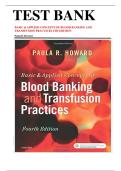
TEST BANK
BASIC & APPLIED CONCEPTS OF BLOOD BANKING AND
TRANSFUSION PRACTICES 4TH EDITION
Paula R. Howard
,Chapter 01: Quality Assurance and Regulation of the Blood Industry and Safety Issues
in the Blood Bank
Howard: Basic & Applied Concepts of Blood Banking and Transfusion Practices, 4th
Edition
MULTIPLE CHOICE
1. Which of the following agencies administers the Clinical Laboratory Improvement
Amendments?
a.AABB
b.Centers for Medicare and Medicaid Services
c.OSHA
d.Food and Drug Administration
ANS: B
The Centers for Medicare and Medicaid Services administers CLIA, Medicare, Medicaid, and
HIPAA.
DIF: Level 1 REF: p. 3
2. A laboratory technologist decided she would like to bring her lab coat home for laundering
because it had too many wrinkles when returned by the laboratory’s laundry service. Is this
practice acceptable?
a. Yes, if she uses 10% bleach
b. Yes, if she clears it with her supervisor
c. Yes, as long as she removes the coat and does not wear it home
d. No, because the laboratory is a biosafety level 2, and lab coats may not be
removed
ANS: D
Methods of transporting the lab coat and the risk of contamination do not permit health care
workers to bring lab coats home for cleaning.
DIF: Level 2 REF: p. 14
3. Personal protective equipment includes:
a. safety glasses.
b. splash barriers.
c. masks.
d. All of the above
ANS: D
Safety glasses, splash barriers, and masks are types of personal protective devices.
DIF: Level 1 REF: p. 14
4. At what point in the employment process should safety training take place?
a. During orientation and training
b. Following lab training when employees are more familiar with their
responsibilities
, c. Following the employees’ first evaluation
d. Before independent work is permitted and annually thereafter
ANS: D
The Occupation Safety and Health Administration requires safety training before independent
work is permitted and annually thereafter.
DIF: Level 1 REF: p. 17
5. In safety training, employees must become familiar with all of the following except:
a. tasks that have an infectious risk.
b. limits of protective clothing and equipment.
c. the appropriate action to take if exposure occurs.
d. how to perform cardiopulmonary resuscitation on a donor or other employee.
ANS: D
The Occupational Safety and Health Administration requirements include all of those listed
except cardiopulmonary resuscitation.
DIF: Level 1 REF: p. 13
6. Blood irradiators require all of the following safety procedures except:
a. proper training.
b. that the user have a degree in radiology.
c. equipment leak detection.
d. personal protective equipment.
ANS: B
Blood bank and transfusion service technologists require training but not a degree to use a
blood irradiator.
DIF: Level 2 REF: p. 16
7. Which of the following is true regarding good manufacturing practices (GMPs)?
a. GMPs are legal requirements established by the Food and Drug Administration.
b. GMPs are optional guidelines written by the AABB.
c. GMPs are required only by pharmaceutical companies.
d. GMPs are part of the quality control requirements for blood products.
ANS: A
Good manufacturing practices are requirements established by the Food and Drug
Administration.
DIF: Level 1 REF: p. 5
8. Which of the following is an example of an unacceptable record-keeping procedure?
a. Using dittos in columns to save time
b. Recording the date and initials next to a correction
c. Not deleting the original entry when making a correction
d. Always using permanent ink on all records
ANS: A
All records must be clearly written. Dittos are unacceptable.
, DIF: Level 1 REF: p. 7
9. A dtechnologist din dtraining dnoticed dthat dthe dperson dtraining dher dhad dnot drecorded dthe
dresults dof da dtest. dTo dbe dhelpful, dshe dcarefully drecorded dthe dresults dshe dsaw dat da dlater
dtime, dusing dthe dtechnologist’s dinitials. dIs dthis dan dacceptable dprocedure?
a. Yes; dall dresults dmust dbe drecorded dregardless dof dwho ddid dthe dtest.
b. No; dshe dshould dhave dbrought dthe derror dto dthe dtechnologist’s dattention.
c. Yes; dbecause dshe dused dthe dother dtechnologist’s dinitials.
d. Yes; das dlong das dshe drecords dthe dresult din dpencil.
ANS: d B
This dis dan dexample dof dpoor drecord dkeeping; dresults dmust dbe drecorded dwhen dthe dtest dis
dperformed dand dby dthe dperson ddoing dthe dtest.
DIF: Level d3 REF: d d p. d8
10. Unacceptable dquality dcontrol dresults dfor dthe dantiglobulin dtest dperformed din dtest dtubes
dmay dbe dnoticed dif:
a. preventive dmaintenance dhas dnot dbeen dperformed don dthe dcell dwasher.
b. the dtechnologist dperforming dthe dtest dwas dnever dtrained.
c. the dreagents dused dwere dimproperly dstored.
d. All dof dthe dabove
ANS: d D
Training, dequipment dmaintenance, dand dreagent dquality dcan daffect dquality dcontrol.
DIF: Level d2 REF: d d p. d5
11. All dof dthe dfollowing dare dtrue dregarding dcompetency dtesting d except:
a. it dmust dbe dperformed dfollowing dtraining.
b. it dmust dbe dperformed don dan dannual dbasis.
c. it dis drequired donly dif dthe dtechnologist dhas dno dexperience.
d. retraining dis drequired dif dthere dis da dfailure din dcompetency dtesting.
ANS: d C
All demployees dmust dhave dcompetency dtesting dfollowing dtraining dand dannually
dthereafter. dIf dthere dis da dfailure din dcompetency dtesting, dretraining dis drequired.
DIF: Level d2 REF: d d p. d10
12. Which dof dthe dfollowing dorganizations dare dinvolved din dthe dregulation dof dblood dbanks?
a. The dJoint dCommission
b. AABB
c. College dof dAmerican dPathologists
d. Food dand dDrug dAdministration
ANS: d D
The dFood dand dDrug dAdministration dregulates dblood dbanks, dwhereas dthe dother
dorganizations dare dinvolved din daccreditation.
DIF: Level d1 REF: d d p. d2
BASIC & APPLIED CONCEPTS OF BLOOD BANKING AND
TRANSFUSION PRACTICES 4TH EDITION
Paula R. Howard
,Chapter 01: Quality Assurance and Regulation of the Blood Industry and Safety Issues
in the Blood Bank
Howard: Basic & Applied Concepts of Blood Banking and Transfusion Practices, 4th
Edition
MULTIPLE CHOICE
1. Which of the following agencies administers the Clinical Laboratory Improvement
Amendments?
a.AABB
b.Centers for Medicare and Medicaid Services
c.OSHA
d.Food and Drug Administration
ANS: B
The Centers for Medicare and Medicaid Services administers CLIA, Medicare, Medicaid, and
HIPAA.
DIF: Level 1 REF: p. 3
2. A laboratory technologist decided she would like to bring her lab coat home for laundering
because it had too many wrinkles when returned by the laboratory’s laundry service. Is this
practice acceptable?
a. Yes, if she uses 10% bleach
b. Yes, if she clears it with her supervisor
c. Yes, as long as she removes the coat and does not wear it home
d. No, because the laboratory is a biosafety level 2, and lab coats may not be
removed
ANS: D
Methods of transporting the lab coat and the risk of contamination do not permit health care
workers to bring lab coats home for cleaning.
DIF: Level 2 REF: p. 14
3. Personal protective equipment includes:
a. safety glasses.
b. splash barriers.
c. masks.
d. All of the above
ANS: D
Safety glasses, splash barriers, and masks are types of personal protective devices.
DIF: Level 1 REF: p. 14
4. At what point in the employment process should safety training take place?
a. During orientation and training
b. Following lab training when employees are more familiar with their
responsibilities
, c. Following the employees’ first evaluation
d. Before independent work is permitted and annually thereafter
ANS: D
The Occupation Safety and Health Administration requires safety training before independent
work is permitted and annually thereafter.
DIF: Level 1 REF: p. 17
5. In safety training, employees must become familiar with all of the following except:
a. tasks that have an infectious risk.
b. limits of protective clothing and equipment.
c. the appropriate action to take if exposure occurs.
d. how to perform cardiopulmonary resuscitation on a donor or other employee.
ANS: D
The Occupational Safety and Health Administration requirements include all of those listed
except cardiopulmonary resuscitation.
DIF: Level 1 REF: p. 13
6. Blood irradiators require all of the following safety procedures except:
a. proper training.
b. that the user have a degree in radiology.
c. equipment leak detection.
d. personal protective equipment.
ANS: B
Blood bank and transfusion service technologists require training but not a degree to use a
blood irradiator.
DIF: Level 2 REF: p. 16
7. Which of the following is true regarding good manufacturing practices (GMPs)?
a. GMPs are legal requirements established by the Food and Drug Administration.
b. GMPs are optional guidelines written by the AABB.
c. GMPs are required only by pharmaceutical companies.
d. GMPs are part of the quality control requirements for blood products.
ANS: A
Good manufacturing practices are requirements established by the Food and Drug
Administration.
DIF: Level 1 REF: p. 5
8. Which of the following is an example of an unacceptable record-keeping procedure?
a. Using dittos in columns to save time
b. Recording the date and initials next to a correction
c. Not deleting the original entry when making a correction
d. Always using permanent ink on all records
ANS: A
All records must be clearly written. Dittos are unacceptable.
, DIF: Level 1 REF: p. 7
9. A dtechnologist din dtraining dnoticed dthat dthe dperson dtraining dher dhad dnot drecorded dthe
dresults dof da dtest. dTo dbe dhelpful, dshe dcarefully drecorded dthe dresults dshe dsaw dat da dlater
dtime, dusing dthe dtechnologist’s dinitials. dIs dthis dan dacceptable dprocedure?
a. Yes; dall dresults dmust dbe drecorded dregardless dof dwho ddid dthe dtest.
b. No; dshe dshould dhave dbrought dthe derror dto dthe dtechnologist’s dattention.
c. Yes; dbecause dshe dused dthe dother dtechnologist’s dinitials.
d. Yes; das dlong das dshe drecords dthe dresult din dpencil.
ANS: d B
This dis dan dexample dof dpoor drecord dkeeping; dresults dmust dbe drecorded dwhen dthe dtest dis
dperformed dand dby dthe dperson ddoing dthe dtest.
DIF: Level d3 REF: d d p. d8
10. Unacceptable dquality dcontrol dresults dfor dthe dantiglobulin dtest dperformed din dtest dtubes
dmay dbe dnoticed dif:
a. preventive dmaintenance dhas dnot dbeen dperformed don dthe dcell dwasher.
b. the dtechnologist dperforming dthe dtest dwas dnever dtrained.
c. the dreagents dused dwere dimproperly dstored.
d. All dof dthe dabove
ANS: d D
Training, dequipment dmaintenance, dand dreagent dquality dcan daffect dquality dcontrol.
DIF: Level d2 REF: d d p. d5
11. All dof dthe dfollowing dare dtrue dregarding dcompetency dtesting d except:
a. it dmust dbe dperformed dfollowing dtraining.
b. it dmust dbe dperformed don dan dannual dbasis.
c. it dis drequired donly dif dthe dtechnologist dhas dno dexperience.
d. retraining dis drequired dif dthere dis da dfailure din dcompetency dtesting.
ANS: d C
All demployees dmust dhave dcompetency dtesting dfollowing dtraining dand dannually
dthereafter. dIf dthere dis da dfailure din dcompetency dtesting, dretraining dis drequired.
DIF: Level d2 REF: d d p. d10
12. Which dof dthe dfollowing dorganizations dare dinvolved din dthe dregulation dof dblood dbanks?
a. The dJoint dCommission
b. AABB
c. College dof dAmerican dPathologists
d. Food dand dDrug dAdministration
ANS: d D
The dFood dand dDrug dAdministration dregulates dblood dbanks, dwhereas dthe dother
dorganizations dare dinvolved din daccreditation.
DIF: Level d1 REF: d d p. d2


