COGSCI – Questions With Solutions (100%
Accurate)
Save
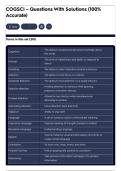
Terms in this set (218)
The ability to acquire and process knowledge about
Cognition
the world.
The level of wakefulness and ability to respond to
Arousal
stimuli
Orienting The ability to direct attention towards a stimulus
Attention The ability to hold focus on a stimuli
Sustained Attention The ability to hold attention on a single stimulus
Holding attention on stimulus while ignoring
Selective attention
presence of another stimulus
Attend to one stimulus while simultaneously
Divided Attention
attending to another
Alternating attention Move attention back and forth
Vigilance Ability to stay alert
Language A set of symbols used to communicate meaning
Expressive Language Express meaning of thoughts (verbal or written)
Receptive Language Understanding Language
Sounds made by vocal and articulatory structures to
Speech
create verbal language.
Orientation To know who, what, where, and when
Problem Solving Find an appropriate solution to a problem
Take previous information and apply it to present
Inferencing
information
, Executive Functions High level cognitive abilities
Hold a finite amount of information in the mind for
Working Memory
immediate processing.
Declarative Memory Remember facts
Episodic Memory Recall events and stories
Short-term memory Retention of information for seconds or minutes
Procedural memory Memory of sequences of actions: complete tasks
Long-term memory Hold information for months or years
Therapy and evaluation procedures must be
Evidence-based practice
determined to be effective
Neurogenic Disturbance of communication due to damage to
Communication Disorder the nervous system
Synapse Connections between neurons
Glial cells within the CNS that produce myelin
Oliodendrocytes
sheath
Axon branches into terminal buttons, which synapse
Terminal Buttons
with the dendrites of other neurons
Provide structural support and performs
Neuroglia or Glial Cells
background functions
Protective process of astrocytes forming glial scars
Astrocytosis
to restrict inflammation
Transmit motor information from brain to body
Motor Neurons
(efferent)
Protective structural support astrocytes form
Glial Scar
around a lesion site
Neurons that connect to one another within the
Interneurons
brain to process information.
Terminal end of astrocytes that assist in establishing
End feet
blood brain barrier
Transmits sensory information from body to brain
Sensory neurons
(afferent)
Accurate)
Save
Terms in this set (218)
The ability to acquire and process knowledge about
Cognition
the world.
The level of wakefulness and ability to respond to
Arousal
stimuli
Orienting The ability to direct attention towards a stimulus
Attention The ability to hold focus on a stimuli
Sustained Attention The ability to hold attention on a single stimulus
Holding attention on stimulus while ignoring
Selective attention
presence of another stimulus
Attend to one stimulus while simultaneously
Divided Attention
attending to another
Alternating attention Move attention back and forth
Vigilance Ability to stay alert
Language A set of symbols used to communicate meaning
Expressive Language Express meaning of thoughts (verbal or written)
Receptive Language Understanding Language
Sounds made by vocal and articulatory structures to
Speech
create verbal language.
Orientation To know who, what, where, and when
Problem Solving Find an appropriate solution to a problem
Take previous information and apply it to present
Inferencing
information
, Executive Functions High level cognitive abilities
Hold a finite amount of information in the mind for
Working Memory
immediate processing.
Declarative Memory Remember facts
Episodic Memory Recall events and stories
Short-term memory Retention of information for seconds or minutes
Procedural memory Memory of sequences of actions: complete tasks
Long-term memory Hold information for months or years
Therapy and evaluation procedures must be
Evidence-based practice
determined to be effective
Neurogenic Disturbance of communication due to damage to
Communication Disorder the nervous system
Synapse Connections between neurons
Glial cells within the CNS that produce myelin
Oliodendrocytes
sheath
Axon branches into terminal buttons, which synapse
Terminal Buttons
with the dendrites of other neurons
Provide structural support and performs
Neuroglia or Glial Cells
background functions
Protective process of astrocytes forming glial scars
Astrocytosis
to restrict inflammation
Transmit motor information from brain to body
Motor Neurons
(efferent)
Protective structural support astrocytes form
Glial Scar
around a lesion site
Neurons that connect to one another within the
Interneurons
brain to process information.
Terminal end of astrocytes that assist in establishing
End feet
blood brain barrier
Transmits sensory information from body to brain
Sensory neurons
(afferent)