
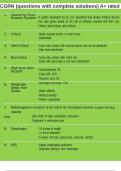
CGRN (questions with complete solutions) A+ rated
1. Spaulding Classi-
fication System A system developed by Dr. E.H. Spaulding that divides medical devices
into cate- gories based on the risk of infection involved with their use.
Critical, Semi-critical, non-critical
2. Critical -Break mucosal barrier or enter tissue
-Sterilized
3. Semi-Critical -Come into contact with mucosal barrier but do not penetrate
-High level disinfected
4. Non-critical -Come into contact with intact skin
-Clean with germicide or low level disinfectant
5. High-level disin- -Glutaraldehyde 2%
fectant
-Cidex OPA .55%
-Peracetic Acid .2%
6. Moderate -Hydrogen Peroxide 7.5%
Seda- tion
Goals -Intact reflexes
-Reduce anxiety
-Patient cooperation
7. Methemoglobine--Oxidation of iron within the hemoglobin prevents oxygen carrying
capacity
mia -Side ettect of topic anesthetics (lidocaine)
-Treatment is methylene blue
8. Esophagus -10 inches in length
-1 inch in diameter
-4 layers (mucosa, submucosa, muscular, serosa)
9. UES -Upper esophageal sphincter
-Separates pharynx from esophagus
1/
22
,CGRN (questions with complete solutions) A+ rated
-Striated muscle
2/
22
,CGRN (questions with complete solutions) A+ rated
10. LES -Lower esophageal sphincter
-Separates esophagus from stomach
-Smooth muscle
-VIP and nitric oxide relax sphincter
11. Pyrosis -Heartburn
12. Dyspepsia -Epigastric pain
13. Odynophagia -Painful swallowing
14. Esophageal -Zenker's
Di- verticuli
-Traction
-Epiphrenic
15. Achalasia -Absence of peristalsis and increased LES pressure
-Bird beak appearance
-Can be treated with CCBs or dilation or botox or surgery (Heller's myotom
16. Nutcracke -Condition characterized by high pressure (>175 mmHg) propulsive
r
Esophagu contractions that are often of prolonged duration
s
17. DES -Dittuse esophageal spasm
-Uncoordinated/ simultaneous contractions d/t damaged nerves
3/
22
1. Spaulding Classi-
fication System A system developed by Dr. E.H. Spaulding that divides medical devices
into cate- gories based on the risk of infection involved with their use.
Critical, Semi-critical, non-critical
2. Critical -Break mucosal barrier or enter tissue
-Sterilized
3. Semi-Critical -Come into contact with mucosal barrier but do not penetrate
-High level disinfected
4. Non-critical -Come into contact with intact skin
-Clean with germicide or low level disinfectant
5. High-level disin- -Glutaraldehyde 2%
fectant
-Cidex OPA .55%
-Peracetic Acid .2%
6. Moderate -Hydrogen Peroxide 7.5%
Seda- tion
Goals -Intact reflexes
-Reduce anxiety
-Patient cooperation
7. Methemoglobine--Oxidation of iron within the hemoglobin prevents oxygen carrying
capacity
mia -Side ettect of topic anesthetics (lidocaine)
-Treatment is methylene blue
8. Esophagus -10 inches in length
-1 inch in diameter
-4 layers (mucosa, submucosa, muscular, serosa)
9. UES -Upper esophageal sphincter
-Separates pharynx from esophagus
1/
22
,CGRN (questions with complete solutions) A+ rated
-Striated muscle
2/
22
,CGRN (questions with complete solutions) A+ rated
10. LES -Lower esophageal sphincter
-Separates esophagus from stomach
-Smooth muscle
-VIP and nitric oxide relax sphincter
11. Pyrosis -Heartburn
12. Dyspepsia -Epigastric pain
13. Odynophagia -Painful swallowing
14. Esophageal -Zenker's
Di- verticuli
-Traction
-Epiphrenic
15. Achalasia -Absence of peristalsis and increased LES pressure
-Bird beak appearance
-Can be treated with CCBs or dilation or botox or surgery (Heller's myotom
16. Nutcracke -Condition characterized by high pressure (>175 mmHg) propulsive
r
Esophagu contractions that are often of prolonged duration
s
17. DES -Dittuse esophageal spasm
-Uncoordinated/ simultaneous contractions d/t damaged nerves
3/
22


