

Written by students who passed Immediately available after payment Read online or as PDF Wrong document? Swap it for free 4.6 TrustPilot
logo-home
Document preview thumbnail
Preview 3 out of 30 pages
Exam (elaborations)

Physical Examination and Health Assessment 9th Edition by Carolyn Jarvis, Ann Eckhardt Test Bank / All Chapters 1-32 / Full Complete 2025/2026 EXAM QUESTIONS WITH CORRECT ANSWERS

Document preview thumbnail
Preview 3 out of 30 pages

Physical Examination and Health Assessment 9th Edition by Carolyn Jarvis, Ann Eckhardt Test Bank / All Chapters 1-32 / Full Complete 2025/2026 EXAM QUESTIONS WITH CORRECT ANSWERS Physical Examination and Health Assessment 9th Edition by Carolyn Jarvis, Ann Eckhardt Test Bank / All Chapters 1-32 / Full Complete 2025/2026 Test Bank for Physical Examination and Health Assessment, 9th Edition, Carolyn Jarvis, ISBN: 9780323510806 Latest Update Chapter 01: Evidence-Based Assessment MULTIPLE CHOICE 1. After completing an initial assessment of a patient, the nurse has charted that his respirations are eupneic and his pulse is 58 beats per minute. These types of data would be: a. Objective. b. Reflective. c. Subjective. d. Introspective. ANS: A Objective data are what the health professional observes by inspecting, percussing, palpating, and auscultating during the physical examination. Subjective data is what the person says about him or herself during history taking. The terms reflective and introspective are not used to describe data. DIF: Cognitive Level: Understanding (Comprehension) MSC: Client Needs: Safe and Effective Care Environment: Management of Care 2. A patient tells the nurse that he is very nervNouUsR, SisINnGauTsBea.CteOdM, and feels hot. These types of data would be: a. Objective. b. Reflective. c. Subjective. d. Introspective. ANS: C Subjective data are what the person says about him or herself during history taking. Objective data are what the health professional observes by inspecting, percussing, palpating, and auscultating during the physical examination. The terms reflective and introspective are not used to describe data. DIF: Cognitive Level: Understanding (Comprehension) MSC: Client Needs: Safe and Effective Care Environment: Management of Care 3. The patients record, laboratory studies, objective data, and subjective data combine to form the: a. Data base. b. Admitting data. c. Financial statement. d. Discharge summary. ANS: A Together with the patients record and laboratory studies, the objective and subjective data form the data base. The other items are not part of the patients record, laboratory studies, or data. DIF: Cognitive Level: Remembering (Knowledge) MSC: Client Needs: Safe and Effective Care Environment: Management of Care 4. When listening to a patients breath sounds, the nurse is unsure of a sound that is heard. The nurses next action should be to: a. Immediately notify the patients physician. b. Document the sound exactly as it was heard. c. Validate the data by asking a coworker to listen to the breath sounds. d. Assess again in 20 minutes to note whether the sound is still present. NURSINGTB.COM ANS: C When unsure of a sound heard while listening to a patients breath sounds, the nurse validates the data to ensure accuracy. If the nurse has less experience in an area, then he or she asks an expert to listen. DIF: Cognitive Level: Analyzing (Analysis) MSC: Client Needs: Safe and Effective Care Environment: Management of Care 5. The nurse is conducting a class for new graduate nurses. During the teaching session, the nurse should keep in mind that novice nurses, without a background of skills and experience from which to draw, are more likely to make their decisions using: a. Intuition. b. A set of rules. c. Articles in journals. d. Advice from supervisors. ANS: B Novice nurses operate from a set of defined, structured rules. The expert practitioner uses intuitive links. DIF: Cognitive Level: Understanding (Comprehension) MSC: Client Needs: General 6. The nurse is reviewing information about evidence-based practice (EBP). Which statement best reflects EBP? a. EBP relies on tradition for supportNoUf RbeSsINt pGrTacBt.iCceOsM. b. EBP is simply the use of best practice techniques for the treatment of patients. c. EBP emphasizes the use of best evidence with the clinicians experience. d. The patients own preferences are not important with EBP. ANS: C EBP is a systematic approach to practice that emphasizes the use of best evidence in combination with the clinicians experience, as well as patient preferences and values, when making decisions about care and treatment. EBP is more than simply using the best practice techniques to treat patients, and questioning tradition is important when no compelling and supportive research evidence exists. DIF: Cognitive Level: Applying (Application) MSC: Client Needs: Safe and Effective Care Environment: Management of Care 7. Expert nurses learn to attend to a pattern of assessment data and act without consciously labeling it. These responses are referred to as: a. Intuition. b. The nursing process. c. Clinical knowledge. d. Diagnostic reasoning. ANS: A Intuition is characterized by pattern recognitionexpert nurses learn to attend to a pattern of assessment data and act without consciously labeling it. The other options are not correct. DIF: Cognitive Level: Understanding (Comprehension) MSC: Client Needs: General 8. The nurse is conducting a class on priority setting for a group of new graduate nurses. Which is an example of a first-level priority problem? a. Patient with postoperative pain b. Newly diagnosed patient with diabetes who needs diabetic teaching STUVIA.COM c. Individual with a small laceration on the sole of the foot

Content preview

lOMoAR c PSD| 832240


7


TO GET ALL CHAPTERS EMAIL ME AT>>>

TO GET ALL CHAPTERS EMAIL ME AT>>>


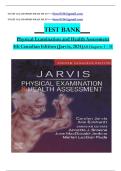
TEST BANK
Physical Examination and Health Assessment
4th Canadian Edition (Jarvis, 2024)All Chapters 1 - 31

, lOMoAR c PSD| 8322407


TABLE OF CONTENTS

, lOMoAR c PSD| 8322407


Chapter 1;
Critical Thinking and Evidence-Informed Assessment


MULTIPLE CHOICE

1. Which type of data is collected by obtaining vital signs?

a. Objective
b. Reflecting
c. Subjective
d. Introspective

ANSWER: a
Objective data are what the health professional observes by inspecting,
percussing, palpating, and auscultating during the physical examination.
Subjective data are what the person says about themselves during history
taking.
The terms reflective and introspective are not used to describe data.
PTS: 1
DIF: Cognitive Level: Understanding (Comprehension)
MSC: Client Needs: Safe and Effective Care Environment: Management of Care

2.During an assessment, a patient describes feeling warm,
nauseated, and nervous. Which type of data is collected?

a. Objective
b. Reflective
c. Subjective
d. Introspective

ANSWER: c

Connected book
 image
Publisher: Unknown ISBN: 9780323510806 Edition: Unknown

Document information

Uploaded on
October 15, 2025
Number of pages
30
Written in
2025/2026
Type
Exam (elaborations)
Contains
Questions & answers
$13.49

Wrong document? Swap it for free Within 14 days of purchase and before downloading, you can choose a different document. You can simply spend the amount again.
Written by students who passed
Immediately available after payment
Read online or as PDF

Seller avatar
Reputation scores are based on the amount of documents a seller has sold for a fee and the reviews they have received for those documents. There are three levels: Bronze, Silver and Gold. The better the reputation, the more your can rely on the quality of the sellers work.
GradeAchiver
2.7
(3)
Sold
35
Followers
2
Items
2771
Last sold
2 months ago


Why students choose Stuvia

Created by fellow students, verified by reviews

Quality you can trust: written by students who passed their tests and reviewed by others who've used these notes.

Didn't get what you expected? Choose another document

No worries! You can instantly pick a different document that better fits what you're looking for.

Pay as you like, start learning right away

No subscription, no commitments. Pay the way you're used to via credit card and download your PDF document instantly.

Student with book image

“Bought, downloaded, and aced it. It really can be that simple.”

Alisha Student

Working on your references?

Create accurate citations in APA, MLA and Harvard with our free citation generator.

Working on your references?

Frequently asked questions

