

Working Memory Model - Baddeley and Hitch (1974)
Baddeley and Hitch argued that the Short Term Memory (STM) from Atkinson and Shiffrin’s 1968
Multi-Store Model (MSM) was too simple. According to MSM, STM holds limited amounts of in-
formation for short periods of time with relatively little processing.
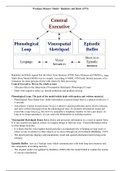
Central Executive: Drives the whole system
- Allocates data to the subsystems (Visuospatial Sketchpad, Phonological Loop)
- Deals with cognitive tasks e.g. mental arithmetic and problem solving
Phonological Loop: The part of the model which deals with spoken and written material.
- Phonological Store (Inner Ear): holds information in speech based form (i.e spoken words) for 1-
2 seconds
- Articulatory Control System (Inner Voice): Linked to speech production and is used to rehearse
and store verbal information from the phonological store. It circulates information round and
round like a tape loop (e.g. like how we remember a telephone number we have just heard. As
long as we keep repeating it, we can retain the information in working memory.
Visuospatial Sketchpad (Inner Eye): Stores and processes information in a visual or spatial form.
It is also used for navigation (where we imagine things to find our way). Visual information refers
to what things look like.
- It is likely that the visuo-spatial sketch pad plays an important role in helping us keep track of
where we are in relation to other objects as we move through our environment (Baddeley, 1997).
- The sketch pad also displays and manipulates visual and spatial information held in long-term
memory.
Episodic Buffer: Acts as a 'backup' store which communicates with both long term memory and
the components of working memory.
- The original model was updated by Baddeley (2000) after the model failed to explain the results
of various experiments.
Baddeley and Hitch argued that the Short Term Memory (STM) from Atkinson and Shiffrin’s 1968
Multi-Store Model (MSM) was too simple. According to MSM, STM holds limited amounts of in-
formation for short periods of time with relatively little processing.
Central Executive: Drives the whole system
- Allocates data to the subsystems (Visuospatial Sketchpad, Phonological Loop)
- Deals with cognitive tasks e.g. mental arithmetic and problem solving
Phonological Loop: The part of the model which deals with spoken and written material.
- Phonological Store (Inner Ear): holds information in speech based form (i.e spoken words) for 1-
2 seconds
- Articulatory Control System (Inner Voice): Linked to speech production and is used to rehearse
and store verbal information from the phonological store. It circulates information round and
round like a tape loop (e.g. like how we remember a telephone number we have just heard. As
long as we keep repeating it, we can retain the information in working memory.
Visuospatial Sketchpad (Inner Eye): Stores and processes information in a visual or spatial form.
It is also used for navigation (where we imagine things to find our way). Visual information refers
to what things look like.
- It is likely that the visuo-spatial sketch pad plays an important role in helping us keep track of
where we are in relation to other objects as we move through our environment (Baddeley, 1997).
- The sketch pad also displays and manipulates visual and spatial information held in long-term
memory.
Episodic Buffer: Acts as a 'backup' store which communicates with both long term memory and
the components of working memory.
- The original model was updated by Baddeley (2000) after the model failed to explain the results
of various experiments.


