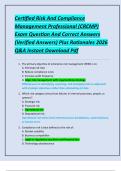
Certified Business Continuity Professional
(CBCP) Practice Exam Questions And
Correct Answers (Verified Answers) Plus
Rationales 2025|2026 Q&A | Instant
Download Pdf
1. What is the primary goal of business continuity management?
a) Reduce insurance costs
b) Ensure critical business operations continue during disruptions
c) Improve customer satisfaction
d) Eliminate all risks
The goal of BCM is to maintain essential functions during and after a
disruption, not eliminate all risk.
2. Which phase of the BCM lifecycle involves identifying critical
functions?
a) Testing
b) Business Impact Analysis
c) Recovery
, d) Risk assessment
The Business Impact Analysis (BIA) identifies critical functions and their
dependencies.
3. Which document defines the scope and objectives of the business
continuity program?
a) Risk assessment report
b) Recovery plan
c) Business continuity policy
d) Crisis communication plan
The BC policy provides strategic direction, scope, and objectives for the
program.
4. The maximum tolerable downtime (MTD) is defined as:
a) The maximum time a company can take to recover financial losses
b) The maximum time a process can be disrupted before
unacceptable impact occurs
c) The time it takes to notify stakeholders
d) The expected recovery time for IT systems
MTD indicates how long a business can withstand a disruption before
it becomes critical.
5. The Recovery Time Objective (RTO) is best described as:
a) The time it takes to restore all services
b) The target time to restore a function after disruption
c) The maximum time for data loss
, d) The time it takes to conduct a BIA
RTO specifies the acceptable downtime before recovery must be
completed.
6. What is the first step in developing a business continuity plan?
a) Create training materials
b) Develop testing strategies
c) Conduct a Business Impact Analysis
d) Draft recovery procedures
The BIA is foundational and determines priorities for continuity
planning.
7. Which of the following best defines Recovery Point Objective (RPO)?
a) The time by which normal operations must resume
b) The acceptable amount of data loss measured in time
c) The duration of system downtime
d) The cost of recovery
RPO determines how much data loss is acceptable in terms of time
(e.g., last 4 hours of data).
8. What is a key purpose of the risk assessment process in BCM?
a) Determine communication protocols
b) Identify and evaluate threats and vulnerabilities
c) Estimate the company’s insurance needs
d) Prepare test schedules
(CBCP) Practice Exam Questions And
Correct Answers (Verified Answers) Plus
Rationales 2025|2026 Q&A | Instant
Download Pdf
1. What is the primary goal of business continuity management?
a) Reduce insurance costs
b) Ensure critical business operations continue during disruptions
c) Improve customer satisfaction
d) Eliminate all risks
The goal of BCM is to maintain essential functions during and after a
disruption, not eliminate all risk.
2. Which phase of the BCM lifecycle involves identifying critical
functions?
a) Testing
b) Business Impact Analysis
c) Recovery
, d) Risk assessment
The Business Impact Analysis (BIA) identifies critical functions and their
dependencies.
3. Which document defines the scope and objectives of the business
continuity program?
a) Risk assessment report
b) Recovery plan
c) Business continuity policy
d) Crisis communication plan
The BC policy provides strategic direction, scope, and objectives for the
program.
4. The maximum tolerable downtime (MTD) is defined as:
a) The maximum time a company can take to recover financial losses
b) The maximum time a process can be disrupted before
unacceptable impact occurs
c) The time it takes to notify stakeholders
d) The expected recovery time for IT systems
MTD indicates how long a business can withstand a disruption before
it becomes critical.
5. The Recovery Time Objective (RTO) is best described as:
a) The time it takes to restore all services
b) The target time to restore a function after disruption
c) The maximum time for data loss
, d) The time it takes to conduct a BIA
RTO specifies the acceptable downtime before recovery must be
completed.
6. What is the first step in developing a business continuity plan?
a) Create training materials
b) Develop testing strategies
c) Conduct a Business Impact Analysis
d) Draft recovery procedures
The BIA is foundational and determines priorities for continuity
planning.
7. Which of the following best defines Recovery Point Objective (RPO)?
a) The time by which normal operations must resume
b) The acceptable amount of data loss measured in time
c) The duration of system downtime
d) The cost of recovery
RPO determines how much data loss is acceptable in terms of time
(e.g., last 4 hours of data).
8. What is a key purpose of the risk assessment process in BCM?
a) Determine communication protocols
b) Identify and evaluate threats and vulnerabilities
c) Estimate the company’s insurance needs
d) Prepare test schedules