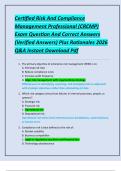
CERTIFIED WEALTH STRATEGIST (CWS)
EXAM QUESTION AND CORRECT
ANSWERS (VERIFIED ANSWERS) PLUS
RATIONALES 2026 Q&A INSTANT
DOWNLOAD PDF
1. The primary objective of wealth management is to
A. Maximize short-term returns
B. Minimize taxes at all costs
C. Speculate on market movements
D. Align financial resources with a client’s long-term goals
Rationale: Wealth management integrates investments, tax, estate, and
risk planning to meet long-term objectives.
2. A high-net-worth individual is most commonly defined as a client with
investable assets of
A. $100,000 or more
B. $250,000 or more
C. $1 million or more
D. $10 million or more
Rationale: The widely accepted threshold for HNWI status is $1 million in
investable assets.
3. Which document outlines a client’s risk tolerance, objectives, and
constraints?
A. Trust deed
B. Prospectus
C. Investment Policy Statement (IPS)
, D. Asset allocation report
Rationale: The IPS is the foundational document guiding portfolio
decisions.
4. Risk tolerance refers to a client’s
A. Ability to take risk
B. Time horizon
C. Willingness to accept volatility and potential loss
D. Liquidity preference
Rationale: Risk tolerance measures emotional and psychological comfort
with risk.
5. Risk capacity is best described as a client’s
A. Emotional response to losses
B. Investment knowledge
C. Financial ability to withstand losses
D. Tax bracket
Rationale: Risk capacity is objective and based on financial circumstances.
6. Which asset class typically provides the greatest inflation protection?
A. Cash
B. Bonds
C. Real assets (e.g., real estate, commodities)
D. Money market instruments
Rationale: Real assets tend to rise with inflation.
7. Diversification primarily aims to
A. Eliminate all risk
B. Increase systematic risk
C. Reduce unsystematic risk
D. Guarantee returns
Rationale: Diversification lowers asset-specific (unsystematic) risk.
8. Systematic risk is best described as risk that
A. Can be diversified away
, B. Is unique to a company
C. Affects the entire market
D. Arises from poor management
Rationale: Market-wide factors drive systematic risk.
9. The modern portfolio theory emphasizes
A. Market timing
B. Security selection only
C. Risk-return tradeoff through diversification
D. Guaranteed income
Rationale: MPT focuses on optimizing portfolios based on risk and return.
10.Which metric measures volatility?
A. Alpha
B. Beta
C. Standard deviation
D. Sharpe ratio
Rationale: Standard deviation measures dispersion of returns.
11.Beta measures a portfolio’s
A. Absolute risk
B. Credit risk
C. Sensitivity to market movements
D. Liquidity
Rationale: Beta compares portfolio volatility to the market.
12.Alpha represents
A. Market risk
B. Volatility
C. Excess return over a benchmark
D. Tracking error
Rationale: Alpha measures value added by active management.
EXAM QUESTION AND CORRECT
ANSWERS (VERIFIED ANSWERS) PLUS
RATIONALES 2026 Q&A INSTANT
DOWNLOAD PDF
1. The primary objective of wealth management is to
A. Maximize short-term returns
B. Minimize taxes at all costs
C. Speculate on market movements
D. Align financial resources with a client’s long-term goals
Rationale: Wealth management integrates investments, tax, estate, and
risk planning to meet long-term objectives.
2. A high-net-worth individual is most commonly defined as a client with
investable assets of
A. $100,000 or more
B. $250,000 or more
C. $1 million or more
D. $10 million or more
Rationale: The widely accepted threshold for HNWI status is $1 million in
investable assets.
3. Which document outlines a client’s risk tolerance, objectives, and
constraints?
A. Trust deed
B. Prospectus
C. Investment Policy Statement (IPS)
, D. Asset allocation report
Rationale: The IPS is the foundational document guiding portfolio
decisions.
4. Risk tolerance refers to a client’s
A. Ability to take risk
B. Time horizon
C. Willingness to accept volatility and potential loss
D. Liquidity preference
Rationale: Risk tolerance measures emotional and psychological comfort
with risk.
5. Risk capacity is best described as a client’s
A. Emotional response to losses
B. Investment knowledge
C. Financial ability to withstand losses
D. Tax bracket
Rationale: Risk capacity is objective and based on financial circumstances.
6. Which asset class typically provides the greatest inflation protection?
A. Cash
B. Bonds
C. Real assets (e.g., real estate, commodities)
D. Money market instruments
Rationale: Real assets tend to rise with inflation.
7. Diversification primarily aims to
A. Eliminate all risk
B. Increase systematic risk
C. Reduce unsystematic risk
D. Guarantee returns
Rationale: Diversification lowers asset-specific (unsystematic) risk.
8. Systematic risk is best described as risk that
A. Can be diversified away
, B. Is unique to a company
C. Affects the entire market
D. Arises from poor management
Rationale: Market-wide factors drive systematic risk.
9. The modern portfolio theory emphasizes
A. Market timing
B. Security selection only
C. Risk-return tradeoff through diversification
D. Guaranteed income
Rationale: MPT focuses on optimizing portfolios based on risk and return.
10.Which metric measures volatility?
A. Alpha
B. Beta
C. Standard deviation
D. Sharpe ratio
Rationale: Standard deviation measures dispersion of returns.
11.Beta measures a portfolio’s
A. Absolute risk
B. Credit risk
C. Sensitivity to market movements
D. Liquidity
Rationale: Beta compares portfolio volatility to the market.
12.Alpha represents
A. Market risk
B. Volatility
C. Excess return over a benchmark
D. Tracking error
Rationale: Alpha measures value added by active management.