CSAMS psychopharmacology Review UPDATED ACTUAL Questions and
CORRECT Answers
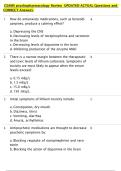
1. How do antianxiety medications, such as benzodi- a
azepines, produce a calming effect?
a. Depressing the CNS
b. Decreasing levels of norepinephrine and serotonin
in the brain
c. Decreasing levels of dopamine in the brain
d. Inhibiting production of the enzyme MAO
2. There is a narrow margin between the therapeutic b
and toxic levels of lithium carbonate. Symptoms of
toxicity are most likely to appear when the serum
levels exceed:
a. 0.15 mEq/L
b. 1.5 mEq/L
c. 15.0 mEq/L
d. 150 mEq/L
3. Initial symptoms of lithium toxicity include: c
a. Constipation, dry mouth
b. Dizziness, thirst
c. Vomiting, diarrhea
d. Anuria, arrhythmias
4. Antipsychotic medications are thought to decrease b
psychotic symptoms by:
a. Blocking reuptake of norepinephrine and sero-
tonin
b. Blocking the action of dopamine in the brain
, c. Inhibiting production of the enzyme MAO
d. Depressing the CNS
5. Part of the nurse's ongoing assessment of the client a
taking antipsychotic medications is to observe for ex-
trapyramidal symptoms. Which of the following are
examples of extrapyramidal symptoms?
a. Muscular weakness, rigidity, tremors, facial
spasms
b. Dry mouth, blurred vision, urinary retention, or-
thostatic hypotension
c. Amenorrhea, gynecomastia, retrograde ejacula-
tion
d. Elevated blood pressure, severe occipital
headache, stiff neck
6. A client who is prescribed haloperidol is observed to b
be staring at the ceiling and says he cannot move
his eyes. The nurse notices that he also appears to
have muscle spasms in his legs and hands. What is
the most appropriate action for the nurse to take at
this point?
a. Conduct an AIMS test.
b. Administer prn benztropine (Cogentin).
c. Withhold the next dose of antipsychotic medica-
tion.
d. Contact the physician.
7. A client reports to the nurse that she has been on her a
antidepressant medication (fluoxetine) for almost 2
, weeks and does not feel much better. Which of these
actions by the nurse demonstrates the best clinical
judgment?
a. Educate the client that this medication may not be
fully effective for up to 4 weeks.
b. Hold the next dose and contact the physician to
recommend an alternative antidepressant.
c. Check the client's vital signs and check labs for
therapeutic blood levels.
d. Assess whether the client is aware of mood swings
or history of bipolar disorder in her family.
8. A client who was recently prescribed an MAOI tells b
the nurse that he drinks 3 to 4 cups of coffee with
each meal. Which of these actions by the nurse
demonstrates the best clinical judgment?
a. Instruct the client that he only needs to avoid foods
high in tyramine; coffee consumption is not an issue
with this medication.
b. Inform the client that foods or beverages with high
caffeine content increase the risk for serious hyper-
tension and arrhythmias.
c. Inform the client that caffeine interferes with the
effectiveness of this medication.
d. Instruct the client that red wines are a better bev-
erage choice because they do not contain tyramine.
9. A young adult client has been prescribed an SSRI an- d
tidepressant, which she has been taking for 1 week.
She reports that she feels like she is getting worse
CORRECT Answers
1. How do antianxiety medications, such as benzodi- a
azepines, produce a calming effect?
a. Depressing the CNS
b. Decreasing levels of norepinephrine and serotonin
in the brain
c. Decreasing levels of dopamine in the brain
d. Inhibiting production of the enzyme MAO
2. There is a narrow margin between the therapeutic b
and toxic levels of lithium carbonate. Symptoms of
toxicity are most likely to appear when the serum
levels exceed:
a. 0.15 mEq/L
b. 1.5 mEq/L
c. 15.0 mEq/L
d. 150 mEq/L
3. Initial symptoms of lithium toxicity include: c
a. Constipation, dry mouth
b. Dizziness, thirst
c. Vomiting, diarrhea
d. Anuria, arrhythmias
4. Antipsychotic medications are thought to decrease b
psychotic symptoms by:
a. Blocking reuptake of norepinephrine and sero-
tonin
b. Blocking the action of dopamine in the brain
, c. Inhibiting production of the enzyme MAO
d. Depressing the CNS
5. Part of the nurse's ongoing assessment of the client a
taking antipsychotic medications is to observe for ex-
trapyramidal symptoms. Which of the following are
examples of extrapyramidal symptoms?
a. Muscular weakness, rigidity, tremors, facial
spasms
b. Dry mouth, blurred vision, urinary retention, or-
thostatic hypotension
c. Amenorrhea, gynecomastia, retrograde ejacula-
tion
d. Elevated blood pressure, severe occipital
headache, stiff neck
6. A client who is prescribed haloperidol is observed to b
be staring at the ceiling and says he cannot move
his eyes. The nurse notices that he also appears to
have muscle spasms in his legs and hands. What is
the most appropriate action for the nurse to take at
this point?
a. Conduct an AIMS test.
b. Administer prn benztropine (Cogentin).
c. Withhold the next dose of antipsychotic medica-
tion.
d. Contact the physician.
7. A client reports to the nurse that she has been on her a
antidepressant medication (fluoxetine) for almost 2
, weeks and does not feel much better. Which of these
actions by the nurse demonstrates the best clinical
judgment?
a. Educate the client that this medication may not be
fully effective for up to 4 weeks.
b. Hold the next dose and contact the physician to
recommend an alternative antidepressant.
c. Check the client's vital signs and check labs for
therapeutic blood levels.
d. Assess whether the client is aware of mood swings
or history of bipolar disorder in her family.
8. A client who was recently prescribed an MAOI tells b
the nurse that he drinks 3 to 4 cups of coffee with
each meal. Which of these actions by the nurse
demonstrates the best clinical judgment?
a. Instruct the client that he only needs to avoid foods
high in tyramine; coffee consumption is not an issue
with this medication.
b. Inform the client that foods or beverages with high
caffeine content increase the risk for serious hyper-
tension and arrhythmias.
c. Inform the client that caffeine interferes with the
effectiveness of this medication.
d. Instruct the client that red wines are a better bev-
erage choice because they do not contain tyramine.
9. A young adult client has been prescribed an SSRI an- d
tidepressant, which she has been taking for 1 week.
She reports that she feels like she is getting worse