
HESI Practice test
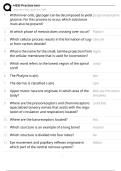
Study online at https://quizlet.com/_7swk4
1. Within liver cells, glycogen can be decomposed to yield glucagon and epinephrine
glucose. For this process to occur, which substance
must also be present?
2. At which phase of meiosis does crossing over occur? Prophase 1
3. Which cellular process results in the formation of sug- Calvin cycle
ar from carbon dioxide?
4. What is the name for the small, tail-like projection from Flagella
the cellular membrane that is used for locomotion?
5. Which word refers to the lowest region of the spinal Lumbar
cord?
6. The Phalynx is a(n) bone
7. The dermis is classified s a(n) organ
8. Upper motor neurons originate in which area of the Motor area of the cerebral
body? hemispheres
9. Where are the pressoreceptors and chemoreceptors Carotid Body
(specialized sensory nerves that assist with the regu-
lation of circulation and respiration) located?
10. Where are the baroreceptors located? Aorta
11. Which sturcture is an example of a long bone? metatarsal
12. Which structure is divided into four lobes? liver
13. Eye movement and papillary reflexes originate in Midbrain
which part of the central nervous system?
1/5
, HESI Practice test
Study online at https://quizlet.com/_7swk4
14. Which vessel transports blood from the lung to the Pulmonary vein
heart?
15. What does the word 'pulmonary' mean? lungs
16. Venous refers to which part of the body system? Circulation
17. What is the primary sympathetic neurohormone? norepinephrine
18. An improper balance between calcium and which sub- phosphorus
stance can adversely affect the growth of healthy bone
tissue?
19. The function of the pulmonary veins is to carry oxygenated blood to the
________________? left atrium
20. What substance causes extreme dilation of arterioles Histamine
and capillaries, stagnating blood flow within the tis-
sues and leading to profound shock?
21. What is the expected pH of the stomach? 0.90 to 1.50
22. What mineral is responsible for muscle contraction? Calcium
23. Bile is secreted into which organ? Small intestines
24. What is the function of glucocorticoids that are secret- carbohydrate, protein, and
ed from the adrenal cortex? fat metabolism
25. What does parathyroid hormone regulate? Calcium
26. What is the function of aldosterone? Conserves sodium in the
body
27. What is the function of the baroreceptors? Decrease heart rate
2/5
Study online at https://quizlet.com/_7swk4
1. Within liver cells, glycogen can be decomposed to yield glucagon and epinephrine
glucose. For this process to occur, which substance
must also be present?
2. At which phase of meiosis does crossing over occur? Prophase 1
3. Which cellular process results in the formation of sug- Calvin cycle
ar from carbon dioxide?
4. What is the name for the small, tail-like projection from Flagella
the cellular membrane that is used for locomotion?
5. Which word refers to the lowest region of the spinal Lumbar
cord?
6. The Phalynx is a(n) bone
7. The dermis is classified s a(n) organ
8. Upper motor neurons originate in which area of the Motor area of the cerebral
body? hemispheres
9. Where are the pressoreceptors and chemoreceptors Carotid Body
(specialized sensory nerves that assist with the regu-
lation of circulation and respiration) located?
10. Where are the baroreceptors located? Aorta
11. Which sturcture is an example of a long bone? metatarsal
12. Which structure is divided into four lobes? liver
13. Eye movement and papillary reflexes originate in Midbrain
which part of the central nervous system?
1/5
, HESI Practice test
Study online at https://quizlet.com/_7swk4
14. Which vessel transports blood from the lung to the Pulmonary vein
heart?
15. What does the word 'pulmonary' mean? lungs
16. Venous refers to which part of the body system? Circulation
17. What is the primary sympathetic neurohormone? norepinephrine
18. An improper balance between calcium and which sub- phosphorus
stance can adversely affect the growth of healthy bone
tissue?
19. The function of the pulmonary veins is to carry oxygenated blood to the
________________? left atrium
20. What substance causes extreme dilation of arterioles Histamine
and capillaries, stagnating blood flow within the tis-
sues and leading to profound shock?
21. What is the expected pH of the stomach? 0.90 to 1.50
22. What mineral is responsible for muscle contraction? Calcium
23. Bile is secreted into which organ? Small intestines
24. What is the function of glucocorticoids that are secret- carbohydrate, protein, and
ed from the adrenal cortex? fat metabolism
25. What does parathyroid hormone regulate? Calcium
26. What is the function of aldosterone? Conserves sodium in the
body
27. What is the function of the baroreceptors? Decrease heart rate
2/5


