

C.A.L.T EXAM STUDY GUIDE| ACCURATE CURRENTLY TESTING EXAM VERSION WIT
AN ACCURATE EXPERT VERIFIED STUDY GUIDE FOR GUARANTEED PASS | LATEST
UPDATE
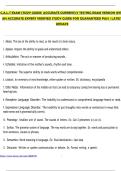
1. Alexia: The loss of the ability to read, as the result of a brain injury.
2. Apasia: Impairs the ability to speak and understand others.
3. Articulation: The act or manner of producing sounds.
4. Echolalia: Imitation of the mother's sounds, rhythm and tone.
5. Hyperlexia: The superior ability to reads words without comprehension.
6. Lexicon: An inventory of word knowledge, either spoken or written. EX: dictionary, encyclopedia
7. Otitis Media: Inflammation of the middle ear that can lead to temporary conductive hearing loss or permanent
hearing loss.
8. Receptive Language Disorder: The inability to understand or comprehend language heard or read.
9. Expressive Language Disorder: The inability to put thoughts into words or sentences in ways that
make sense and is grammatically correct.
10. Phonology: Smallest unit of sound. The sounds of letters. Ex: Cat=3 phonemes (c) (a) (t).
11. Syntax: The grammar system of language. The way words are strung together. Ex: words and punctuation to
form sentences, clauses or phrases.
12. Semantics: Word meaning in language. Ex: final destination = last stop
13. Discourse: Written or spoken communication or debate. Ex: Formal writing, a speech.
https://www.stuvia.com/user/MBOFFIN 1/
15
, 14. Morphology: The smallest unit of language that convey meaning. Ex: Root words
15. Pragmatics: Incapable of understanding the speakers intent (requests and tones) Ex: Can't you turn down
the T.V.? = means no; not yes.
16. Alphabetic Language: A language in which letters are used systematically to represent speech sounds.
17. Alphabetic Principle: The use of letters and letter clusters to represent phonemes in an orthography.
(spelling)
18. Anglo Saxon: The language of the Germanic peoples (Angles, Saxons and Jutes) who settles in Britain in the
5th and 6th centuries. It was the dominant language in Britain until the Norman Conquest in 1066.
19. Analytic Instruction: Instruction that separates the whole into its parts to reveal its relationships. (Whole
to Part) (Top Down) (Concept driven)
20. Analytic Phonics: Students hear the whole word and segment into phonemes or sounds in order to spell.
(whole to part) Ex: Pit = (p) (i) (t)
21. Antonyms: Words that are opposite in meaning. (semantics)
22. Arbitrary Learning: New learning that has no logical connection to already acquired knowledge or
practical relationships.
23. Auditory: relating to or experienced through hearing.
https://www.stuvia.com/user/MBOFFIN 2/
15
AN ACCURATE EXPERT VERIFIED STUDY GUIDE FOR GUARANTEED PASS | LATEST
UPDATE
1. Alexia: The loss of the ability to read, as the result of a brain injury.
2. Apasia: Impairs the ability to speak and understand others.
3. Articulation: The act or manner of producing sounds.
4. Echolalia: Imitation of the mother's sounds, rhythm and tone.
5. Hyperlexia: The superior ability to reads words without comprehension.
6. Lexicon: An inventory of word knowledge, either spoken or written. EX: dictionary, encyclopedia
7. Otitis Media: Inflammation of the middle ear that can lead to temporary conductive hearing loss or permanent
hearing loss.
8. Receptive Language Disorder: The inability to understand or comprehend language heard or read.
9. Expressive Language Disorder: The inability to put thoughts into words or sentences in ways that
make sense and is grammatically correct.
10. Phonology: Smallest unit of sound. The sounds of letters. Ex: Cat=3 phonemes (c) (a) (t).
11. Syntax: The grammar system of language. The way words are strung together. Ex: words and punctuation to
form sentences, clauses or phrases.
12. Semantics: Word meaning in language. Ex: final destination = last stop
13. Discourse: Written or spoken communication or debate. Ex: Formal writing, a speech.
https://www.stuvia.com/user/MBOFFIN 1/
15
, 14. Morphology: The smallest unit of language that convey meaning. Ex: Root words
15. Pragmatics: Incapable of understanding the speakers intent (requests and tones) Ex: Can't you turn down
the T.V.? = means no; not yes.
16. Alphabetic Language: A language in which letters are used systematically to represent speech sounds.
17. Alphabetic Principle: The use of letters and letter clusters to represent phonemes in an orthography.
(spelling)
18. Anglo Saxon: The language of the Germanic peoples (Angles, Saxons and Jutes) who settles in Britain in the
5th and 6th centuries. It was the dominant language in Britain until the Norman Conquest in 1066.
19. Analytic Instruction: Instruction that separates the whole into its parts to reveal its relationships. (Whole
to Part) (Top Down) (Concept driven)
20. Analytic Phonics: Students hear the whole word and segment into phonemes or sounds in order to spell.
(whole to part) Ex: Pit = (p) (i) (t)
21. Antonyms: Words that are opposite in meaning. (semantics)
22. Arbitrary Learning: New learning that has no logical connection to already acquired knowledge or
practical relationships.
23. Auditory: relating to or experienced through hearing.
https://www.stuvia.com/user/MBOFFIN 2/
15


