RNC Antepartum Exam Questions
100% Complete Answers Latest
Update(Straight A'S)
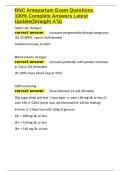
Heart rate changes -
correct answer ✅increases progressively through pregnancy
(10-20 BPM), max in 3rd trimester
Greatest increase in labor
Blood volume changes -
correct answer ✅increases gradually, with greater increases
in 2nd & 3rd trimesters
20-100% more blood (avg of 45%)
GDM screening -
correct answer ✅Done between 24 and 28 weeks
50g sugar drink and test 1 hour later ⇒ want 140 mg/dL or less; if
over 190 ⇒ GDM (some may use threshold of 130 for testing)
If more ⇒ 3 hour test with 100g of glucose
1hr = 180mg/dL or less
2hr = 155mg/dL or less
3hr = 140 mg/dL or less
,RNC Antepartum Exam Questions
100% Complete Answers Latest
Update(Straight A'S)
Hepatitis in pregnancy -
correct answer ✅Hep B is highly contagious to baby if baby
is not given treatment post-delivery (HBIG)
Can get hep B & A vaccines in pregnancy
Hep B can still have vaginal delivery and breastfeed
Hep C = can still breastfeed
Chorionic villus sampling -
correct answer ✅gets small tissue sample from placenta to
look for genetic abnormalities (Down syndrome, edwards, pataus)
Risk of miscarriage
Transabdominal, transcervical
Weeks 11-14 is typically when it's done
Amniocentesis -
correct answer ✅Sample of amniotic fluid
Genetic disorders (CF, Downs, Edwards), look at lung maturity, sex
of baby, diagnose fetal infection
, RNC Antepartum Exam Questions
100% Complete Answers Latest
Update(Straight A'S)
Risk for infection, miscarriage, and leaking fluid
Typically weeks 15-20
Quad screen -
correct answer ✅Alpha-fetoprotein, hCG, unconjugated
estriol (uE3), inhibin A
Typically 15-22 weeks gestation (most accurate at 16-18 weeks)
Used to look at risk of Down syndrome, nueral tube defects
High AFP ⇒ neural tube defects, abdominal wall anomaly (low
levels ⇒ down syndrome)
Low uE3 ⇒ down syndrome
High hCG ⇒ down syndrome
High inhibin-A ⇒ down syndrome
Fetal arrhythmias -
correct answer ✅Sudden increases or decreases, sounds of
dropped beats, sudden changes in variability
PACs are most common; a-flutter ⇒ sawtooth pattern, SVT
Artifact will be random spikes, while arrhythmia will be more
consistent
100% Complete Answers Latest
Update(Straight A'S)
Heart rate changes -
correct answer ✅increases progressively through pregnancy
(10-20 BPM), max in 3rd trimester
Greatest increase in labor
Blood volume changes -
correct answer ✅increases gradually, with greater increases
in 2nd & 3rd trimesters
20-100% more blood (avg of 45%)
GDM screening -
correct answer ✅Done between 24 and 28 weeks
50g sugar drink and test 1 hour later ⇒ want 140 mg/dL or less; if
over 190 ⇒ GDM (some may use threshold of 130 for testing)
If more ⇒ 3 hour test with 100g of glucose
1hr = 180mg/dL or less
2hr = 155mg/dL or less
3hr = 140 mg/dL or less
,RNC Antepartum Exam Questions
100% Complete Answers Latest
Update(Straight A'S)
Hepatitis in pregnancy -
correct answer ✅Hep B is highly contagious to baby if baby
is not given treatment post-delivery (HBIG)
Can get hep B & A vaccines in pregnancy
Hep B can still have vaginal delivery and breastfeed
Hep C = can still breastfeed
Chorionic villus sampling -
correct answer ✅gets small tissue sample from placenta to
look for genetic abnormalities (Down syndrome, edwards, pataus)
Risk of miscarriage
Transabdominal, transcervical
Weeks 11-14 is typically when it's done
Amniocentesis -
correct answer ✅Sample of amniotic fluid
Genetic disorders (CF, Downs, Edwards), look at lung maturity, sex
of baby, diagnose fetal infection
, RNC Antepartum Exam Questions
100% Complete Answers Latest
Update(Straight A'S)
Risk for infection, miscarriage, and leaking fluid
Typically weeks 15-20
Quad screen -
correct answer ✅Alpha-fetoprotein, hCG, unconjugated
estriol (uE3), inhibin A
Typically 15-22 weeks gestation (most accurate at 16-18 weeks)
Used to look at risk of Down syndrome, nueral tube defects
High AFP ⇒ neural tube defects, abdominal wall anomaly (low
levels ⇒ down syndrome)
Low uE3 ⇒ down syndrome
High hCG ⇒ down syndrome
High inhibin-A ⇒ down syndrome
Fetal arrhythmias -
correct answer ✅Sudden increases or decreases, sounds of
dropped beats, sudden changes in variability
PACs are most common; a-flutter ⇒ sawtooth pattern, SVT
Artifact will be random spikes, while arrhythmia will be more
consistent