
NSG 316 Exam 1
Study online at https://quizlet.com/_8puw2d
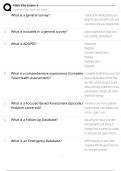
1. What is a general survey? a study of the whole person, cov-
ering the general health state and
any obvious physical characteristics
2. What is included in a general survey? physical appearance, body struc-
ture, mobility, and behavior
3. What is ADOPIE? Assessment
Diagnosis
Outcome/ Identification
Planning
Implementation
Evaluation
4. What is a comprehensive assessment (Complete a complete health history and a full
Total Health Assessment)? physical examination where they
describe current and past health
states and form a baseline to mea-
sure all future changes (ex. home
healthcare setting)
5. What is a Focused Based Assessment (Episodic/ a limited or short-term problem
Problem-centered)? concerned with one problem, one
cue (ex. urgent care)
6. What is a Follow-Up Database? evaluating the status of all iden-
tified problems and noting if
changes have occurred (ex. prima-
ry care physician appointment)
7. What is an Emergency Database? RAPID collection of data, often
compiled with lifesaving measure
(ex. emergency room)
, NSG 316 Exam 1
Study online at https://quizlet.com/_8puw2d
8. How do you know the source of information they will give the same answer even
given is reliable? when the question is rephrased or
repeated 3 times with the same an-
swer
9. How do you know if the patient is actually ill just a sick patient will communicate
by how they communicate? poorly
10. What is PQRST Provocative/ Palliative
Quality/ Quantity
Region/ Radiation
Severity Scale 1-10
Timing/ Onset
11. What is a good way to depict gender, relation- GENOGRAM (family tree)
ships, and age of immediate blood relatives in at - identifies increased disease or ill-
least three generations such as parents, grand- ness they might be prone to
parents, and siblings?
12. What affects health promotion and disease pre- Age
vention throughout the life span? Smoking/ Drinking
Weight
Genetics
13. What are ADL's? Bathing, dressing, eating, transfer-
ring, walking, and toileting
14. What are IADL's? independent living situations like
housekeeping, shopping, cooking,
doing laundry, using the tele-
phone, managing finances
15. What are AADL's?
, NSG 316 Exam 1
Study online at https://quizlet.com/_8puw2d
their social relationships and re-
sources such as nutrition, self-con-
cept and coping, as well as their
home environment
16. What is the Katz Index of Independence in ADL? the concept of physical disability
and measures physical function in
older adults and the chronically ill
17. What is the Lawton Instrumental Activities of measures functional abilities nec-
Daily Living (IADL's)? essary for independent community
living
18. What are examples of AADL's occupational and recreational ac-
tivities such as occupational ther-
apists, the Up-and-Go Test, phys-
ical performance test, and perfor-
mance activities of daily living
19. How does the Health History Sequence go? Biographical Data
Source of History
Reason for Seeking Care
Present Health or History of present
illness
Past Health
Family History
Review of Systems (ROS)
Functional Assessment (IADL's)
20. What is a pneumonic to remember the Health Bill Sat Right Past Pete For Raw Fish
History Sequence?
21. Biographical Data
Study online at https://quizlet.com/_8puw2d
1. What is a general survey? a study of the whole person, cov-
ering the general health state and
any obvious physical characteristics
2. What is included in a general survey? physical appearance, body struc-
ture, mobility, and behavior
3. What is ADOPIE? Assessment
Diagnosis
Outcome/ Identification
Planning
Implementation
Evaluation
4. What is a comprehensive assessment (Complete a complete health history and a full
Total Health Assessment)? physical examination where they
describe current and past health
states and form a baseline to mea-
sure all future changes (ex. home
healthcare setting)
5. What is a Focused Based Assessment (Episodic/ a limited or short-term problem
Problem-centered)? concerned with one problem, one
cue (ex. urgent care)
6. What is a Follow-Up Database? evaluating the status of all iden-
tified problems and noting if
changes have occurred (ex. prima-
ry care physician appointment)
7. What is an Emergency Database? RAPID collection of data, often
compiled with lifesaving measure
(ex. emergency room)
, NSG 316 Exam 1
Study online at https://quizlet.com/_8puw2d
8. How do you know the source of information they will give the same answer even
given is reliable? when the question is rephrased or
repeated 3 times with the same an-
swer
9. How do you know if the patient is actually ill just a sick patient will communicate
by how they communicate? poorly
10. What is PQRST Provocative/ Palliative
Quality/ Quantity
Region/ Radiation
Severity Scale 1-10
Timing/ Onset
11. What is a good way to depict gender, relation- GENOGRAM (family tree)
ships, and age of immediate blood relatives in at - identifies increased disease or ill-
least three generations such as parents, grand- ness they might be prone to
parents, and siblings?
12. What affects health promotion and disease pre- Age
vention throughout the life span? Smoking/ Drinking
Weight
Genetics
13. What are ADL's? Bathing, dressing, eating, transfer-
ring, walking, and toileting
14. What are IADL's? independent living situations like
housekeeping, shopping, cooking,
doing laundry, using the tele-
phone, managing finances
15. What are AADL's?
, NSG 316 Exam 1
Study online at https://quizlet.com/_8puw2d
their social relationships and re-
sources such as nutrition, self-con-
cept and coping, as well as their
home environment
16. What is the Katz Index of Independence in ADL? the concept of physical disability
and measures physical function in
older adults and the chronically ill
17. What is the Lawton Instrumental Activities of measures functional abilities nec-
Daily Living (IADL's)? essary for independent community
living
18. What are examples of AADL's occupational and recreational ac-
tivities such as occupational ther-
apists, the Up-and-Go Test, phys-
ical performance test, and perfor-
mance activities of daily living
19. How does the Health History Sequence go? Biographical Data
Source of History
Reason for Seeking Care
Present Health or History of present
illness
Past Health
Family History
Review of Systems (ROS)
Functional Assessment (IADL's)
20. What is a pneumonic to remember the Health Bill Sat Right Past Pete For Raw Fish
History Sequence?
21. Biographical Data


