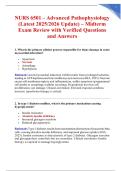
NURS 6501 – Advanced Pathophysiology
(Walden University) | Quizzes 2025/2026 – 150
Verified Questions with 100% Correct Answers
Comprehensive Assessment
Student ID: _________________ Date: _________________
Instructor: [Instructor Name] Course Mentor: [Mentor Name]
Time Limit: 150 minutes Total Points: 150 points
Section 1: Cellular Physiology (Questions 1–30)
What is the primary source of energy for cellular metabolism?
A. Glucose
B. Amino acids
C. Fatty acids
D. Adenosine triphosphate (ATP)
E. Creatine phosphate
D
1. Rationale: ATP is the primary energy currency of cells, generated through
glycolysis, the citric acid cycle, and oxidative phosphorylation. Glucose and
fatty acids are substrates, but ATP directly powers cellular processes
(Alberts et al., Molecular Biology of the Cell, 6th ed.).
Which cellular structure is primarily responsible for protein synthesis?
A. Mitochondria
B. Ribosomes
C. Golgi apparatus
D. Endoplasmic reticulum
,E. Lysosomes
B
2. Rationale: Ribosomes, located in the cytoplasm or on the rough endoplasmic
reticulum, translate mRNA into proteins. The endoplasmic reticulum aids in
folding, but ribosomes perform synthesis (Robbins and Cotran Pathologic
Basis of Disease, 10th ed.).
What is the primary mechanism of apoptosis?
A. Necrosis due to ATP depletion
B. Activation of caspase enzymes
C. Oxidative stress from free radicals
D. Cellular swelling and rupture
E. Mitochondrial membrane rupture
B
3. Rationale: Apoptosis is a programmed cell death process mediated by
caspase activation, triggered by intrinsic (mitochondrial) or extrinsic (death
receptor) pathways. Necrosis is unprogrammed and involves cell rupture
(Kumar et al., 2020).
What is the primary cause of cellular injury in hypoxia?
A. Increased ATP production
B. Mitochondrial dysfunction
C. Enhanced protein synthesis
D. Reduced oxidative stress
E. Increased membrane permeability
B
4. Rationale: Hypoxia impairs mitochondrial oxidative phosphorylation,
reducing ATP production and leading to cellular injury. This disrupts ion
, pumps and metabolic processes (Robbins and Cotran, 10th ed.).
Which ion is most critical for maintaining resting membrane potential?
A. Sodium (Na⁺)
B. Potassium (K⁺)
C. Calcium (Ca²⁺)
D. Chloride (Cl⁻)
E. Magnesium (Mg²⁺)
B
5. Rationale: Potassium ions maintain the resting membrane potential via the
Na⁺/K⁺-ATPase pump, creating a negative intracellular charge relative to the
extracellular environment (Guyton and Hall, Textbook of Medical
Physiology, 14th ed.).
What is the hallmark of reversible cell injury?
A. Cell membrane rupture
B. Cellular swelling
C. Nuclear fragmentation
D. Mitochondrial calcification
E. Loss of organelles
B
6. Rationale: Cellular swelling, due to impaired Na⁺/K⁺-ATPase function and
water influx, is a reversible change in early cell injury. Irreversible changes
include membrane rupture and nuclear fragmentation (Robbins and Cotran,
10th ed.).
What is the role of cytochrome c in apoptosis?
A. Inhibits caspase activation
B. Triggers mitochondrial membrane repair
, C. Activates the intrinsic apoptotic pathway
D. Enhances ATP production
E. Stabilizes the cell membrane
C
7. Rationale: Cytochrome c, released from mitochondria, binds Apaf-1 to form
the apoptosome, activating caspases in the intrinsic pathway of apoptosis
(Kumar et al., 2020).
Which process describes the movement of water across a semipermeable
membrane due to solute concentration differences?
A. Diffusion
B. Osmosis
C. Active transport
D. Facilitated diffusion
E. Endocytosis
B
8. Rationale: Osmosis is the passive movement of water across a
semipermeable membrane from a region of lower to higher solute
concentration, critical in cellular homeostasis (Alberts et al., 6th ed.).
What is the primary effect of oxidative stress on cells?
A. Increased protein synthesis
B. Damage to lipids, proteins, and DNA
C. Enhanced mitochondrial function
D. Stabilization of cell membranes
E. Reduced caspase activation
B
(Walden University) | Quizzes 2025/2026 – 150
Verified Questions with 100% Correct Answers
Comprehensive Assessment
Student ID: _________________ Date: _________________
Instructor: [Instructor Name] Course Mentor: [Mentor Name]
Time Limit: 150 minutes Total Points: 150 points
Section 1: Cellular Physiology (Questions 1–30)
What is the primary source of energy for cellular metabolism?
A. Glucose
B. Amino acids
C. Fatty acids
D. Adenosine triphosphate (ATP)
E. Creatine phosphate
D
1. Rationale: ATP is the primary energy currency of cells, generated through
glycolysis, the citric acid cycle, and oxidative phosphorylation. Glucose and
fatty acids are substrates, but ATP directly powers cellular processes
(Alberts et al., Molecular Biology of the Cell, 6th ed.).
Which cellular structure is primarily responsible for protein synthesis?
A. Mitochondria
B. Ribosomes
C. Golgi apparatus
D. Endoplasmic reticulum
,E. Lysosomes
B
2. Rationale: Ribosomes, located in the cytoplasm or on the rough endoplasmic
reticulum, translate mRNA into proteins. The endoplasmic reticulum aids in
folding, but ribosomes perform synthesis (Robbins and Cotran Pathologic
Basis of Disease, 10th ed.).
What is the primary mechanism of apoptosis?
A. Necrosis due to ATP depletion
B. Activation of caspase enzymes
C. Oxidative stress from free radicals
D. Cellular swelling and rupture
E. Mitochondrial membrane rupture
B
3. Rationale: Apoptosis is a programmed cell death process mediated by
caspase activation, triggered by intrinsic (mitochondrial) or extrinsic (death
receptor) pathways. Necrosis is unprogrammed and involves cell rupture
(Kumar et al., 2020).
What is the primary cause of cellular injury in hypoxia?
A. Increased ATP production
B. Mitochondrial dysfunction
C. Enhanced protein synthesis
D. Reduced oxidative stress
E. Increased membrane permeability
B
4. Rationale: Hypoxia impairs mitochondrial oxidative phosphorylation,
reducing ATP production and leading to cellular injury. This disrupts ion
, pumps and metabolic processes (Robbins and Cotran, 10th ed.).
Which ion is most critical for maintaining resting membrane potential?
A. Sodium (Na⁺)
B. Potassium (K⁺)
C. Calcium (Ca²⁺)
D. Chloride (Cl⁻)
E. Magnesium (Mg²⁺)
B
5. Rationale: Potassium ions maintain the resting membrane potential via the
Na⁺/K⁺-ATPase pump, creating a negative intracellular charge relative to the
extracellular environment (Guyton and Hall, Textbook of Medical
Physiology, 14th ed.).
What is the hallmark of reversible cell injury?
A. Cell membrane rupture
B. Cellular swelling
C. Nuclear fragmentation
D. Mitochondrial calcification
E. Loss of organelles
B
6. Rationale: Cellular swelling, due to impaired Na⁺/K⁺-ATPase function and
water influx, is a reversible change in early cell injury. Irreversible changes
include membrane rupture and nuclear fragmentation (Robbins and Cotran,
10th ed.).
What is the role of cytochrome c in apoptosis?
A. Inhibits caspase activation
B. Triggers mitochondrial membrane repair
, C. Activates the intrinsic apoptotic pathway
D. Enhances ATP production
E. Stabilizes the cell membrane
C
7. Rationale: Cytochrome c, released from mitochondria, binds Apaf-1 to form
the apoptosome, activating caspases in the intrinsic pathway of apoptosis
(Kumar et al., 2020).
Which process describes the movement of water across a semipermeable
membrane due to solute concentration differences?
A. Diffusion
B. Osmosis
C. Active transport
D. Facilitated diffusion
E. Endocytosis
B
8. Rationale: Osmosis is the passive movement of water across a
semipermeable membrane from a region of lower to higher solute
concentration, critical in cellular homeostasis (Alberts et al., 6th ed.).
What is the primary effect of oxidative stress on cells?
A. Increased protein synthesis
B. Damage to lipids, proteins, and DNA
C. Enhanced mitochondrial function
D. Stabilization of cell membranes
E. Reduced caspase activation
B