

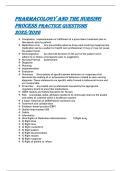
Pharmacology and the Nursing
Process PRACTICE QUESTIONS
2025/2026
❖ Compliance Implementation or fulfillment of a prescribers treatment plan or
therapeutic plan by patient.
❖ Medication error Any preventable adverse drug event involving inappropriate
medication use by a patient or health care professional; it may or may not cause
the patient harm.
❖ Noncompliance An informed decision on the part of the patient not to
adhere to or follow a therapeutic plan or suggestion.
❖ Nursing Process Assessment
❖ Diagnosis
❖ Planning
❖ Implementation
❖ Evaluation
❖ Outcomes Descriptions of specific patient behaviors or responses that
demonstrate meeting of or achievement of behaviors related to each nursing
diagnosis. These statements are specific while framed in behavioral terms and
are measurable.
❖ Prescriber Any health care professional licensed by the appropriate
regulatory board to prescribe medications.
❖ QSEN Quality and Safety Education for Nurses
❖ KSA knowledge, skills, attitudes needed to to continually improve the quality
and safety of a patient within a healthcare system
❖ 6 major initiatives of QSEN Patient-centered care
❖ Teamwork and collaboration
❖ Evidence-based practice (EBP)
❖ Quality improvement (QI)
❖ Safety
❖ Informatics
❖ Nine Rights of Medication Administration 1) Right drug
❖ 2) Right dose
❖ 3) Right time
❖ 4) Right route/form
❖ 5) Right patient
❖ 6) Right documentation
❖ 7) Right reason
❖ 8) Right response
❖ 9) Right of patient to refuse
,❖ Right drug Must be checked against the medication label or profile 3x b4
giving
❖ Right Dose always check the dose and confirm that is appropriate for patient's
age and size
❖ check prescribed dose against available drug stock and against normal drug
range
❖ recheck all math calculations
❖ REMEMBER NO LEADING ZERO's 0.2 is allowed, but NEVER 2.0
❖ Right Time Include in your 3 check the frequency of the ordered medication,
the time administered and the last time the med was given.
❖ ***For routine med orders the standard of care is within the half hour it was
prescribed.
❖ PNR as needed
❖ analgesic pain reliever
❖ Never use abbreviations It is crucial to patient safety to never use any
abbreviations for any component of the drug order
❖ Right Route and Form Never assume the route of admission
❖ Right Patient requires confirmation of a patient's identity with two forms of
identification before drug administration
❖ Right Documentation requires the nurse to record immediately the
appropriate information about the drug administered
❖ ** DOCUMENT ONLY AFTER med was given
❖ Right Reason Is it appropriate to give the med
❖ Right response refers to the drug and it's desired response
❖ continually assess and evaluate the achievement of the desired response as
well as any undesired response
❖ right to refuse clients have right but need to clarify reason and notify
prescriber
❖ When can you NEVER return a med When it has been unwrapped, or
opened.
❖ Medication errors any preventable event or activity that can cause
inappropriate medication use or patient harm
❖ Case study on Page 7
❖ 1) What questions does the nurse need to ask during the assessment phase
Use of home or folk remedies
❖ Intake of caffeine
❖ Use of over-the-counter medications
, ❖ Past and present health history, in addition to her anemia
❖ Pertinent family history
❖ Cultural differences/issues
❖ Responses to medications taken in the past
❖ Case Study on Page 7
❖ What nursing diagnosis is appropriate at the time? Deficient knowledge about
therapy with iron supplements
❖ Self-health management, readiness for enhanced
❖ Case study on page 7
❖ 3) What is missing, what should be done? Think about the "Nine Rights"!
Assuming the prescription has her name on it (right patient), and the licensed
prescriber's signature (right documentation), the prescription has the drug
name (right drug), 325 mg (right dose), PO (right route), and right reason (for
anemia), but something is missing! The right TIME. How often does this
medication need to be taken? Should it be taken with meals or on an empty
stomach? The pharmacist will need to contact the licensed prescriber to clarify
the prescription. The frequency of the medication will certainly affect the dosage
she ultimately receives each day.
❖ Case study page 7
❖ How should the nurse Handle this? Dollie has the right to refuse to take the
medication. However, the nurse needs to identify Dollie's reasons for refusing
the medication. If the "cause" of refusal is known, then the nursing care plan
may be revised and further actions implemented, such as education about the
purpose of the drug and how to manage side effects, as well as other concerns
raised by the patient. In addition, the licensed prescriber should be notified of
Dollie's concerns, and the data should be documented, including information
about the nurse's response to Dollie's concerns.
❖ Overview of the Nursing Process • The nursing process is an ongoing, constantly
changing,
❖ and evolving organizational framework for the practice of
❖ nursing, encompassing all steps taken by the nurse in caring
❖ for a patient.
• The phases of the nursing process include assessment; development of
nursing diagnoses; planning, with establishment
❖ of goals and outcome criteria; implementation, including
❖ patient education; and evaluation.
• Safe, therapeutic, and effective medication administration is
❖ a major responsibility of professional nurses as they apply
❖ the nursing process to the care of their patients.
• Critical thinking is a major part of the nursing process and
❖ involves the use of the mind and thought processes to gather
❖ information and then develop conclusions, make decisions,
❖ draw inferences, and reflect on all aspects of patient care.
Process PRACTICE QUESTIONS
2025/2026
❖ Compliance Implementation or fulfillment of a prescribers treatment plan or
therapeutic plan by patient.
❖ Medication error Any preventable adverse drug event involving inappropriate
medication use by a patient or health care professional; it may or may not cause
the patient harm.
❖ Noncompliance An informed decision on the part of the patient not to
adhere to or follow a therapeutic plan or suggestion.
❖ Nursing Process Assessment
❖ Diagnosis
❖ Planning
❖ Implementation
❖ Evaluation
❖ Outcomes Descriptions of specific patient behaviors or responses that
demonstrate meeting of or achievement of behaviors related to each nursing
diagnosis. These statements are specific while framed in behavioral terms and
are measurable.
❖ Prescriber Any health care professional licensed by the appropriate
regulatory board to prescribe medications.
❖ QSEN Quality and Safety Education for Nurses
❖ KSA knowledge, skills, attitudes needed to to continually improve the quality
and safety of a patient within a healthcare system
❖ 6 major initiatives of QSEN Patient-centered care
❖ Teamwork and collaboration
❖ Evidence-based practice (EBP)
❖ Quality improvement (QI)
❖ Safety
❖ Informatics
❖ Nine Rights of Medication Administration 1) Right drug
❖ 2) Right dose
❖ 3) Right time
❖ 4) Right route/form
❖ 5) Right patient
❖ 6) Right documentation
❖ 7) Right reason
❖ 8) Right response
❖ 9) Right of patient to refuse
,❖ Right drug Must be checked against the medication label or profile 3x b4
giving
❖ Right Dose always check the dose and confirm that is appropriate for patient's
age and size
❖ check prescribed dose against available drug stock and against normal drug
range
❖ recheck all math calculations
❖ REMEMBER NO LEADING ZERO's 0.2 is allowed, but NEVER 2.0
❖ Right Time Include in your 3 check the frequency of the ordered medication,
the time administered and the last time the med was given.
❖ ***For routine med orders the standard of care is within the half hour it was
prescribed.
❖ PNR as needed
❖ analgesic pain reliever
❖ Never use abbreviations It is crucial to patient safety to never use any
abbreviations for any component of the drug order
❖ Right Route and Form Never assume the route of admission
❖ Right Patient requires confirmation of a patient's identity with two forms of
identification before drug administration
❖ Right Documentation requires the nurse to record immediately the
appropriate information about the drug administered
❖ ** DOCUMENT ONLY AFTER med was given
❖ Right Reason Is it appropriate to give the med
❖ Right response refers to the drug and it's desired response
❖ continually assess and evaluate the achievement of the desired response as
well as any undesired response
❖ right to refuse clients have right but need to clarify reason and notify
prescriber
❖ When can you NEVER return a med When it has been unwrapped, or
opened.
❖ Medication errors any preventable event or activity that can cause
inappropriate medication use or patient harm
❖ Case study on Page 7
❖ 1) What questions does the nurse need to ask during the assessment phase
Use of home or folk remedies
❖ Intake of caffeine
❖ Use of over-the-counter medications
, ❖ Past and present health history, in addition to her anemia
❖ Pertinent family history
❖ Cultural differences/issues
❖ Responses to medications taken in the past
❖ Case Study on Page 7
❖ What nursing diagnosis is appropriate at the time? Deficient knowledge about
therapy with iron supplements
❖ Self-health management, readiness for enhanced
❖ Case study on page 7
❖ 3) What is missing, what should be done? Think about the "Nine Rights"!
Assuming the prescription has her name on it (right patient), and the licensed
prescriber's signature (right documentation), the prescription has the drug
name (right drug), 325 mg (right dose), PO (right route), and right reason (for
anemia), but something is missing! The right TIME. How often does this
medication need to be taken? Should it be taken with meals or on an empty
stomach? The pharmacist will need to contact the licensed prescriber to clarify
the prescription. The frequency of the medication will certainly affect the dosage
she ultimately receives each day.
❖ Case study page 7
❖ How should the nurse Handle this? Dollie has the right to refuse to take the
medication. However, the nurse needs to identify Dollie's reasons for refusing
the medication. If the "cause" of refusal is known, then the nursing care plan
may be revised and further actions implemented, such as education about the
purpose of the drug and how to manage side effects, as well as other concerns
raised by the patient. In addition, the licensed prescriber should be notified of
Dollie's concerns, and the data should be documented, including information
about the nurse's response to Dollie's concerns.
❖ Overview of the Nursing Process • The nursing process is an ongoing, constantly
changing,
❖ and evolving organizational framework for the practice of
❖ nursing, encompassing all steps taken by the nurse in caring
❖ for a patient.
• The phases of the nursing process include assessment; development of
nursing diagnoses; planning, with establishment
❖ of goals and outcome criteria; implementation, including
❖ patient education; and evaluation.
• Safe, therapeutic, and effective medication administration is
❖ a major responsibility of professional nurses as they apply
❖ the nursing process to the care of their patients.
• Critical thinking is a major part of the nursing process and
❖ involves the use of the mind and thought processes to gather
❖ information and then develop conclusions, make decisions,
❖ draw inferences, and reflect on all aspects of patient care.


