NU 435 Exam 1
Study online at https://quizlet.com/_fov8br
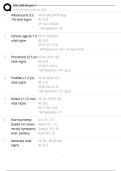
1. Adolescent (12- HR: 60-100 [50-90 if sleep]
15) vital signs RR: 12-20
BP: 110-131/64-83
* SBP hypotension < 90
2. School age (6-11) HR: 75-118 [58-90]
vital signs RR: 18-25
BP: 97--80
* SBP hypotension < 90 [< 70+ age x2 if 6-9]
3. Preschool (3-5 yr) HR: 80-120 [65-100]
vital signs RR: 20-28
BP: 89-112/ 46-72
*SBP hypotension < 70 + age x2
4. Toddler (1-2 yr) HR: 98-140 [80-120]
vital signs RR: 22-37
BP: 86-- 63
*SBP Hypotension < 70 + age x2
5. Infant (1-12 mo) HR: 100- 190 [90-160]
vital signs RR: 30-53
BP: 72-104/ 37-56
*SBP hypotension < 70
6. Normal temp oral: 35.5 - 37.5
based on route - Axillary: 36.5 - 37.5
rectal, tympanic, Tympanic: 35.8 - 38
oral, axillary Rectal: 36.6 - 38
7. Neonate vital HR: 100 - 205 [90-160]
signs RR: 30-53
, NU 435 Exam 1
Study online at https://quizlet.com/_fov8br
BP: 67 - 84/ 35 - 53
*SBP Hypotension < 60
8. What are the 1) promote development
three child 2) improve childhood nutrtion
health promo- 3) Improve oral health
tion goals?
9. What are some -obesity (most common nutritional issue)
childhood health - type 2 diabetes
problems? [7] - childhood injuries (leading cause of death/ disability),
- violence
- vaping epidemic
- covid 19
- mental health problems
*Injuries leading cause in kids > 1
10. infant Mortality - African American race
risk factors [6] - male gender
- short or long gestation
- low birth weight
- maternal age (younger or older)
- maternal education.
11. Causes of infant - congenital anomalies,
death - disorders related to short gestation,
- maternal complications of pregnancy,
- sudden infant death syndrome (SIDS).
12. Family centered family is always the constant in a child's life.
care --> Enabling - enable to provide opportunities to care for the child.
--> Empowerment - empower to maintain control over the situation.
, NU 435 Exam 1
Study online at https://quizlet.com/_fov8br
13. Atraumatic care minimize stress of the healthcare system.
[what is it? goal? --> The provision of therapeutic care in settings, by personnel, and through the
3 principles?] use of interventions that eliminate or minimize the psychological and physical
distress experienced by children and their families in the health care system.
Three principles: (1) prevent or minimize the child's separation from the family, (2)
promote a sense of control, and (3) prevent or minimize bodily injury and pain.
*foster parent child relationship, control pain, prepare the child before proce-
dures, provide play & choices, respect culture.
14. Cultural Humility openness, self-awareness, egolessness, supportive interactions, self-reflection &
critique.
--> teach providers to be more engaged in understanding the social determinants
of health, their impact and roots, and how to counteract their negative effects.
’"culture" is not only race/ ethnicity, but also social class, age, sexual orientation,
sexuality, gender, ability, and professional discipline, among other things.
*understand what health beliefs are important to the family
15. Growth vs devel- 1) Growth = an increase in the number and size of cells, results in increased size
opment and weight
2) Development = Gradual emerging and expanding of an individual's capacity
through growth, maturation, and learning; advancing complexity.
*G&D encompass changes that take place over the lifetime of an individual.
Growth can be viewed as quantitative change and development as qualitative
change.
16. Patterns of 1.) Directional Trends = cephalocaudal (head to tail), proximodistal (from midline
growth and de- to periphery), and differentiation (from simple to complex activities and func-
velopment tions).
2.) Sequential trends = definite, predictable sequence (crawl before walking).
*Patterns or trends can vary among individuals AND over time in one individual.
17. Infancy = MOST RAPID period of growth
*then puberty; growth slow during early child to puberty.
Study online at https://quizlet.com/_fov8br
1. Adolescent (12- HR: 60-100 [50-90 if sleep]
15) vital signs RR: 12-20
BP: 110-131/64-83
* SBP hypotension < 90
2. School age (6-11) HR: 75-118 [58-90]
vital signs RR: 18-25
BP: 97--80
* SBP hypotension < 90 [< 70+ age x2 if 6-9]
3. Preschool (3-5 yr) HR: 80-120 [65-100]
vital signs RR: 20-28
BP: 89-112/ 46-72
*SBP hypotension < 70 + age x2
4. Toddler (1-2 yr) HR: 98-140 [80-120]
vital signs RR: 22-37
BP: 86-- 63
*SBP Hypotension < 70 + age x2
5. Infant (1-12 mo) HR: 100- 190 [90-160]
vital signs RR: 30-53
BP: 72-104/ 37-56
*SBP hypotension < 70
6. Normal temp oral: 35.5 - 37.5
based on route - Axillary: 36.5 - 37.5
rectal, tympanic, Tympanic: 35.8 - 38
oral, axillary Rectal: 36.6 - 38
7. Neonate vital HR: 100 - 205 [90-160]
signs RR: 30-53
, NU 435 Exam 1
Study online at https://quizlet.com/_fov8br
BP: 67 - 84/ 35 - 53
*SBP Hypotension < 60
8. What are the 1) promote development
three child 2) improve childhood nutrtion
health promo- 3) Improve oral health
tion goals?
9. What are some -obesity (most common nutritional issue)
childhood health - type 2 diabetes
problems? [7] - childhood injuries (leading cause of death/ disability),
- violence
- vaping epidemic
- covid 19
- mental health problems
*Injuries leading cause in kids > 1
10. infant Mortality - African American race
risk factors [6] - male gender
- short or long gestation
- low birth weight
- maternal age (younger or older)
- maternal education.
11. Causes of infant - congenital anomalies,
death - disorders related to short gestation,
- maternal complications of pregnancy,
- sudden infant death syndrome (SIDS).
12. Family centered family is always the constant in a child's life.
care --> Enabling - enable to provide opportunities to care for the child.
--> Empowerment - empower to maintain control over the situation.
, NU 435 Exam 1
Study online at https://quizlet.com/_fov8br
13. Atraumatic care minimize stress of the healthcare system.
[what is it? goal? --> The provision of therapeutic care in settings, by personnel, and through the
3 principles?] use of interventions that eliminate or minimize the psychological and physical
distress experienced by children and their families in the health care system.
Three principles: (1) prevent or minimize the child's separation from the family, (2)
promote a sense of control, and (3) prevent or minimize bodily injury and pain.
*foster parent child relationship, control pain, prepare the child before proce-
dures, provide play & choices, respect culture.
14. Cultural Humility openness, self-awareness, egolessness, supportive interactions, self-reflection &
critique.
--> teach providers to be more engaged in understanding the social determinants
of health, their impact and roots, and how to counteract their negative effects.
’"culture" is not only race/ ethnicity, but also social class, age, sexual orientation,
sexuality, gender, ability, and professional discipline, among other things.
*understand what health beliefs are important to the family
15. Growth vs devel- 1) Growth = an increase in the number and size of cells, results in increased size
opment and weight
2) Development = Gradual emerging and expanding of an individual's capacity
through growth, maturation, and learning; advancing complexity.
*G&D encompass changes that take place over the lifetime of an individual.
Growth can be viewed as quantitative change and development as qualitative
change.
16. Patterns of 1.) Directional Trends = cephalocaudal (head to tail), proximodistal (from midline
growth and de- to periphery), and differentiation (from simple to complex activities and func-
velopment tions).
2.) Sequential trends = definite, predictable sequence (crawl before walking).
*Patterns or trends can vary among individuals AND over time in one individual.
17. Infancy = MOST RAPID period of growth
*then puberty; growth slow during early child to puberty.