

CORRECT ANSWERS|LATEST
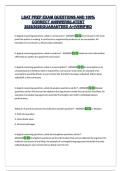
In logical reasoning questions, what is a conclusion? - ANSWER A conclusion is the main
point the author is making. A conclusion is supported by evidence or an assumption. An
example of a conclusion is, Allison plays volleyball.
In logical reasoning questions, what is evidence? - ANSWER Evidence is the information
offered by an author to support the conclusion.
In logical reasoning questions, what is an assumption? - ANSWER An assumption is an
unstated piece of evidence that is required for a conclusion to be valid. An example of an
assumption would be Allison is over six feet tall, therefore she plays volleyball. Allison plays
volleyball, is the conclusion.
In logical reasoning questions, what do weaken questions ask for? - ANSWER Weaken
questions ask for info that can be added to the argument to make the conclusion less likely. An
example of a weakening argument would be that height can hinder a volleyball players
performance.
What are 4 words or phrases that indicate a weaken question? - ANSWER 1. Weaken
2. Calls into question
3. Casts doubt upon
4. Seriously damages
In logical reasoning questions, what do strengthen questions ask for? -
ANSWER Strengthen questions ask for information that can be added to the argument to
make the conclusion more likely. An example of a strengthening argument would be that only
volleyball players over six feet tall can block over the net.
, What are 2 words or phrases that indicate a strengthen question? - ANSWER 1.
Strengthen
2. Support
In logical reasoning questions, what do flaw questions ask for? - ANSWER Flaw questions
want you to determine the error the author makes in going from the evidence to the
conclusion. There are numerous different common flaws that appear on the LSAT.
What are the 8 common flaws in logical reasoning questions on the LSAT? - ANSWER 1.
Unwarranted Assumption, 2. Necessity versus sufficiency,
3. Representativeness, 4. Scope Shift, 5. Alternative possibilities, 6. Causation versus
correlation, 7. Opinion versus fact, 8. Number versus percentage
Unwarranted Assumption - Logical Reasoning Flaw - ANSWER Assumptions based on
insufficient evidence. An example is her battery works; therefore her battery is charged. The
unwarranted assumption is that the battery working is the only thing needed to ensure the
phone is charged.
Necessity versus Sufficiency - Logical Reasoning Flaw - ANSWER A flaw of deeming a
sufficient action as necessary. An example would be saying if we break up, I will unfriend him on
Facebook. Breaking up might be sufficient reasoning to unfriend someone, but breaking up is
not required to unfriend him.
Representativesness - Logical Reasoning Flaw - ANSWER Assuming something as
representative of a dissimilar population. An example would be saying when I was a child, mint
ice cream was my favorite flavor; therefore I will serve that at your birthday. However, your
preference is not representative of everyone.
Scope Shift - Logical Reasoning Flaw - ANSWER When a conclusion presents information
not present in the evidence. An example would be saying only 10 percent of children have been
to Washington D.C.; therefore kids don't know a lot about government. This conclusion
presents a shift in scope.
In logical reasoning questions, what is a conclusion? - ANSWER A conclusion is the main
point the author is making. A conclusion is supported by evidence or an assumption. An
example of a conclusion is, Allison plays volleyball.
In logical reasoning questions, what is evidence? - ANSWER Evidence is the information
offered by an author to support the conclusion.
In logical reasoning questions, what is an assumption? - ANSWER An assumption is an
unstated piece of evidence that is required for a conclusion to be valid. An example of an
assumption would be Allison is over six feet tall, therefore she plays volleyball. Allison plays
volleyball, is the conclusion.
In logical reasoning questions, what do weaken questions ask for? - ANSWER Weaken
questions ask for info that can be added to the argument to make the conclusion less likely. An
example of a weakening argument would be that height can hinder a volleyball players
performance.
What are 4 words or phrases that indicate a weaken question? - ANSWER 1. Weaken
2. Calls into question
3. Casts doubt upon
4. Seriously damages
In logical reasoning questions, what do strengthen questions ask for? -
ANSWER Strengthen questions ask for information that can be added to the argument to
make the conclusion more likely. An example of a strengthening argument would be that only
volleyball players over six feet tall can block over the net.
, What are 2 words or phrases that indicate a strengthen question? - ANSWER 1.
Strengthen
2. Support
In logical reasoning questions, what do flaw questions ask for? - ANSWER Flaw questions
want you to determine the error the author makes in going from the evidence to the
conclusion. There are numerous different common flaws that appear on the LSAT.
What are the 8 common flaws in logical reasoning questions on the LSAT? - ANSWER 1.
Unwarranted Assumption, 2. Necessity versus sufficiency,
3. Representativeness, 4. Scope Shift, 5. Alternative possibilities, 6. Causation versus
correlation, 7. Opinion versus fact, 8. Number versus percentage
Unwarranted Assumption - Logical Reasoning Flaw - ANSWER Assumptions based on
insufficient evidence. An example is her battery works; therefore her battery is charged. The
unwarranted assumption is that the battery working is the only thing needed to ensure the
phone is charged.
Necessity versus Sufficiency - Logical Reasoning Flaw - ANSWER A flaw of deeming a
sufficient action as necessary. An example would be saying if we break up, I will unfriend him on
Facebook. Breaking up might be sufficient reasoning to unfriend someone, but breaking up is
not required to unfriend him.
Representativesness - Logical Reasoning Flaw - ANSWER Assuming something as
representative of a dissimilar population. An example would be saying when I was a child, mint
ice cream was my favorite flavor; therefore I will serve that at your birthday. However, your
preference is not representative of everyone.
Scope Shift - Logical Reasoning Flaw - ANSWER When a conclusion presents information
not present in the evidence. An example would be saying only 10 percent of children have been
to Washington D.C.; therefore kids don't know a lot about government. This conclusion
presents a shift in scope.


