

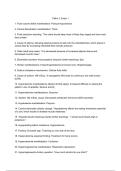
Patho 2: Exam 1
1. Fluid volume deficit manifestation: Postural hypotension
2. Clinical dehydration manifestation: Thirst
3. Fluid restriction teaching: “The client should keep track of fluids they ingest and how much
they urinate.”
4. Cause of edema: Allowing plasma proteins to leak into the interstitial fluid, which draws in
excess fluid by increasing interstitial fluid osmotic pressure.
5. Older adult body water: “It is decreased because of increased adipose tissue and
decreased muscle mass.”
6. Electrolyte excretion misconception (requires further teaching): Spit
7. Similar manifestations of hypo/hyperkalemia (incorrect one): Hepatomegaly
8. Sodium imbalance mechanism: Cellular fluid shifts
9. Cause of sodium 128 mEq/L: A nasogastric (NG) tube to continuous low wall suction
(LWS)
10. Hyponatremia manifestations (Select all that apply): Increased difficulty in waking the
patient, Loss of appetite, Seizure activity
11. Hypernatremia manifestations: Seizures
12. Sodium 162 mEq/L cause: Decreased antidiuretic hormone (ADH) secretion
13. Hypokalemia manifestation: Polyuria
14. Correct electrolyte cellular change: “Hypokalemia affects the resting membrane potential
of a cell, which results in skeletal muscle weakness.”
15. Thiazide diuretic teaching (needs further teaching): “I should avoid foods high in
potassium.”
16. Hypoparathyroidism imbalance: Hypocalcemia
17. Positive Chvostek sign: Twitching on one side of the face
18. Hypercalcemia expected finding: Treatment for bone tumors
19. Hypercalcemia manifestation: Confusion
20. Hypermagnesemia manifestation: Respiratory depression
21. Hypomagnesemia history question: “How much alcohol do you drink?”
1. Fluid volume deficit manifestation: Postural hypotension
2. Clinical dehydration manifestation: Thirst
3. Fluid restriction teaching: “The client should keep track of fluids they ingest and how much
they urinate.”
4. Cause of edema: Allowing plasma proteins to leak into the interstitial fluid, which draws in
excess fluid by increasing interstitial fluid osmotic pressure.
5. Older adult body water: “It is decreased because of increased adipose tissue and
decreased muscle mass.”
6. Electrolyte excretion misconception (requires further teaching): Spit
7. Similar manifestations of hypo/hyperkalemia (incorrect one): Hepatomegaly
8. Sodium imbalance mechanism: Cellular fluid shifts
9. Cause of sodium 128 mEq/L: A nasogastric (NG) tube to continuous low wall suction
(LWS)
10. Hyponatremia manifestations (Select all that apply): Increased difficulty in waking the
patient, Loss of appetite, Seizure activity
11. Hypernatremia manifestations: Seizures
12. Sodium 162 mEq/L cause: Decreased antidiuretic hormone (ADH) secretion
13. Hypokalemia manifestation: Polyuria
14. Correct electrolyte cellular change: “Hypokalemia affects the resting membrane potential
of a cell, which results in skeletal muscle weakness.”
15. Thiazide diuretic teaching (needs further teaching): “I should avoid foods high in
potassium.”
16. Hypoparathyroidism imbalance: Hypocalcemia
17. Positive Chvostek sign: Twitching on one side of the face
18. Hypercalcemia expected finding: Treatment for bone tumors
19. Hypercalcemia manifestation: Confusion
20. Hypermagnesemia manifestation: Respiratory depression
21. Hypomagnesemia history question: “How much alcohol do you drink?”


