
WALLSTREET PREP- ULTIMATE GUIDE TO
TECHNICAL FINANCE INTERVIEW QUESTIONS &
A+ ALREADY GRADED ANSWERS
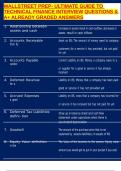
1. Relationship between
Increases in assets result in cash outflow, decreases in
assets and cash
assets result in cash inflows
2. Accounts Receivable Asset on BS; The amount of money owed to company
from its
customers for a service it has provided, but not paid
for yet
3. Accounts Payable Current Liability on BS; Money a company owes to a
vendor
or supplier for a good or service it has already
received
4. Deferred Revenue Liability on BS; Money that a company has been paid
for a
good or service it has not provided yet
5. Accrued Expenses Liability on BS; costs that a company has incurred for
a good
or service it has received but has not paid for yet
6. Deferred Tax Liabilities show up in balance sheet and cash flow
defini- tion statement under operations when there is
accelerated depreciation
7. Goodwill The amount of the purchase price that is not
explained by assets-liabilities; In assets of BS
8. Equity Value definition The Value of the business to the owners. Equity value
is the
amount you would get to put in your pocket if you sold
1/
20
,WALLSTREET PREP- ULTIMATE GUIDE TO
TECHNICAL FINANCE INTERVIEW QUESTIONS &
A+ ALREADY GRADED ANSWERS
the business
9. Enterprise Value definition The value of the operations, the entire firm, operating
as-
sets-operating liabilities
10. Operating assets All assets except for cash and other investment assets
11. Operating liabilities All liabilities except for debt and debt-like liabilities
12. Direct way of getting Equity Val- Operating assets-liabilities->Enterprise value,
Enterprise Val-
ue ue-net debt->Equity Value
2/
20
, WALLSTREET PREP- ULTIMATE GUIDE TO
TECHNICAL FINANCE INTERVIEW QUESTIONS &
A+ ALREADY GRADED ANSWERS
13. Indirect way of getting Equity value from SE on balance sheet->Equity
Equity Value value net debt=Enterprise Value
14. Do finance professionals Yes, when valuing financial institutions. This is
ever rely on book value because the balance sheet values of bank assets-
liabilities tends to not be too far from the FMV. Also,
when you are conducting a liquidation analysis
15. Comparable Company Analysis Valuing a company by finding a similar company
in the same
industry and deriving a price from there
16. Comparable Looking at the amount buyers have paid for
Transactions Analysis acquiring similar companies in the past
17. DCF Value a company by looking at the future cash flows it
can generate and discount them to the present to
arrive at a present value of your business
18. Leveraged buyout A specific type of valuation approach that looks at the
value
of a company to new acquirers under a highly
leveraged scenario
19. Liquidation analysis Value a company under a worst case liquidation
scenario
20. Unlevered DCF Approach Forecast and discount the operating cash flows to get
enter-
prise value. Then add cash and subtract debt to get
Equity value
3/
20
TECHNICAL FINANCE INTERVIEW QUESTIONS &
A+ ALREADY GRADED ANSWERS
1. Relationship between
Increases in assets result in cash outflow, decreases in
assets and cash
assets result in cash inflows
2. Accounts Receivable Asset on BS; The amount of money owed to company
from its
customers for a service it has provided, but not paid
for yet
3. Accounts Payable Current Liability on BS; Money a company owes to a
vendor
or supplier for a good or service it has already
received
4. Deferred Revenue Liability on BS; Money that a company has been paid
for a
good or service it has not provided yet
5. Accrued Expenses Liability on BS; costs that a company has incurred for
a good
or service it has received but has not paid for yet
6. Deferred Tax Liabilities show up in balance sheet and cash flow
defini- tion statement under operations when there is
accelerated depreciation
7. Goodwill The amount of the purchase price that is not
explained by assets-liabilities; In assets of BS
8. Equity Value definition The Value of the business to the owners. Equity value
is the
amount you would get to put in your pocket if you sold
1/
20
,WALLSTREET PREP- ULTIMATE GUIDE TO
TECHNICAL FINANCE INTERVIEW QUESTIONS &
A+ ALREADY GRADED ANSWERS
the business
9. Enterprise Value definition The value of the operations, the entire firm, operating
as-
sets-operating liabilities
10. Operating assets All assets except for cash and other investment assets
11. Operating liabilities All liabilities except for debt and debt-like liabilities
12. Direct way of getting Equity Val- Operating assets-liabilities->Enterprise value,
Enterprise Val-
ue ue-net debt->Equity Value
2/
20
, WALLSTREET PREP- ULTIMATE GUIDE TO
TECHNICAL FINANCE INTERVIEW QUESTIONS &
A+ ALREADY GRADED ANSWERS
13. Indirect way of getting Equity value from SE on balance sheet->Equity
Equity Value value net debt=Enterprise Value
14. Do finance professionals Yes, when valuing financial institutions. This is
ever rely on book value because the balance sheet values of bank assets-
liabilities tends to not be too far from the FMV. Also,
when you are conducting a liquidation analysis
15. Comparable Company Analysis Valuing a company by finding a similar company
in the same
industry and deriving a price from there
16. Comparable Looking at the amount buyers have paid for
Transactions Analysis acquiring similar companies in the past
17. DCF Value a company by looking at the future cash flows it
can generate and discount them to the present to
arrive at a present value of your business
18. Leveraged buyout A specific type of valuation approach that looks at the
value
of a company to new acquirers under a highly
leveraged scenario
19. Liquidation analysis Value a company under a worst case liquidation
scenario
20. Unlevered DCF Approach Forecast and discount the operating cash flows to get
enter-
prise value. Then add cash and subtract debt to get
Equity value
3/
20


