

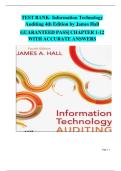
TEST BANK- Information Technology
Auditing 4th Edition by James Hall
GUARANTEED PASS| CHAPTER 1-12
WITH ACCURATE ANSWERS
Ar
ch
Do
c
Page | 1
, Chapter 1—Auditing and Internal Control
TRUE/FALSE
1. Corporate management (including the CEO) must certify monthly and annually their
organization‘s internal controls over financial reporting.
ACCURATE ANSWER: F PTS: 1
2. Both the SEC and the PCAOB require management to use the COBIT framework for assessing
internal control adequacy.
ACCURATE ANSWER: F PTS: 1
3. Both the SEC and the PCAOB require management to use the COSO framework for assessing
internal control adequacy.
ACCURATE ANSWER: F PTS: 1
Ar
4. A qualified opinion on management‘s assessment of internal controls over the financial reporting
ch
system necessitates a qualified opinion on the financial statements?
ACCURATE ANSWER: F PTS: 1
Do
c
5. The same internal control objectives apply to manual and computer-based information systems.
ACCURATE ANSWER: T PTS: 1
6. The external auditor is responsible for establishing and maintaining the internal control system.
ACCURATE ANSWER: F PTS: 1
7. Segregation of duties is an example of an internal control procedure.
ACCURATE ANSWER: T PTS: 1
8. Preventive controls are passive techniques designed to reduce fraud.
ACCURATE ANSWER: T PTS: 1
Page | 2
,9. The Sarbanes-Oxley Act requires only that a firm keep good records.
ACCURATE ANSWER: F PTS: 1
10. A key modifying assumption in internal control is that the internal control system is the
responsibility of management.
ACCURATE ANSWER: T PTS: 1
11. While the Sarbanes-Oxley Act prohibits auditors from providing non-accounting services to their
audit clients, they are not prohibited from performing such services for non-audit clients or privately
held companies.
ACCURATE ANSWER: T PTS: 1
12. The Sarbanes-Oxley Act requires the audit committee to hire and oversee the external auditors.
Ar
ACCURATE ANSWER: T PTS: 1
ch
13. Section 404 requires that corporate management (including the CEO) certify their organization‘s
internal controls on a quarterly and annual basis.
Do
ACCURATE ANSWER: F PTS: 1
c
14. Section 302 requires the management of public companies to assess and formally report on the
effectiveness of their organization‘s internal controls.
ACCURATE ANSWER: F PTS: 1
15. Application controls apply to a wide range of exposures that threaten the integrity of all programs
processed within the computer environment.
ACCURATE ANSWER: F PTS: 1
16. IT auditing is a small part of most external and internal audits.
ACCURATE ANSWER: F PTS: 1
Page | 3
, 17. Advisory services is an emerging field that goes beyond the auditor‘s traditional attestation
function.
ACCURATE ANSWER: T PTS: 1
18. An IT auditor expresses an opinion on the fairness of the financial statements.
ACCURATE ANSWER: F PTS: 1
19. External auditing is an independent appraisal function established within an organization to
examine and evaluate its activities as a service to the organization.
ACCURATE ANSWER: F PTS: 1
20. External auditors can cooperate with and use evidence gathered by internal audit departments that
are organizationally independent and that report to the Audit Committee of the Board of Directors.
Ar
ACCURATE ANSWER: T PTS: 1
ch
21. Tests of controls determine whether the database contents fairly reflect the organization's
transactions.
Do
ACCURATE ANSWER: F PTS: 1
c
22. Audit risk is the probability that the auditor will render an unqualified opinion on financial
statements that are materially misstated.
ACCURATE ANSWER: T PTS: 1
23. A strong internal control system will reduce the amount of substantive testing that must be
performed.
ACCURATE ANSWER: T PTS: 1
24. Substantive testing techniques provide information about the accuracy and completeness of an
application's processes.
ACCURATE ANSWER: F PTS: 1
Page | 4
Auditing 4th Edition by James Hall
GUARANTEED PASS| CHAPTER 1-12
WITH ACCURATE ANSWERS
Ar
ch
Do
c
Page | 1
, Chapter 1—Auditing and Internal Control
TRUE/FALSE
1. Corporate management (including the CEO) must certify monthly and annually their
organization‘s internal controls over financial reporting.
ACCURATE ANSWER: F PTS: 1
2. Both the SEC and the PCAOB require management to use the COBIT framework for assessing
internal control adequacy.
ACCURATE ANSWER: F PTS: 1
3. Both the SEC and the PCAOB require management to use the COSO framework for assessing
internal control adequacy.
ACCURATE ANSWER: F PTS: 1
Ar
4. A qualified opinion on management‘s assessment of internal controls over the financial reporting
ch
system necessitates a qualified opinion on the financial statements?
ACCURATE ANSWER: F PTS: 1
Do
c
5. The same internal control objectives apply to manual and computer-based information systems.
ACCURATE ANSWER: T PTS: 1
6. The external auditor is responsible for establishing and maintaining the internal control system.
ACCURATE ANSWER: F PTS: 1
7. Segregation of duties is an example of an internal control procedure.
ACCURATE ANSWER: T PTS: 1
8. Preventive controls are passive techniques designed to reduce fraud.
ACCURATE ANSWER: T PTS: 1
Page | 2
,9. The Sarbanes-Oxley Act requires only that a firm keep good records.
ACCURATE ANSWER: F PTS: 1
10. A key modifying assumption in internal control is that the internal control system is the
responsibility of management.
ACCURATE ANSWER: T PTS: 1
11. While the Sarbanes-Oxley Act prohibits auditors from providing non-accounting services to their
audit clients, they are not prohibited from performing such services for non-audit clients or privately
held companies.
ACCURATE ANSWER: T PTS: 1
12. The Sarbanes-Oxley Act requires the audit committee to hire and oversee the external auditors.
Ar
ACCURATE ANSWER: T PTS: 1
ch
13. Section 404 requires that corporate management (including the CEO) certify their organization‘s
internal controls on a quarterly and annual basis.
Do
ACCURATE ANSWER: F PTS: 1
c
14. Section 302 requires the management of public companies to assess and formally report on the
effectiveness of their organization‘s internal controls.
ACCURATE ANSWER: F PTS: 1
15. Application controls apply to a wide range of exposures that threaten the integrity of all programs
processed within the computer environment.
ACCURATE ANSWER: F PTS: 1
16. IT auditing is a small part of most external and internal audits.
ACCURATE ANSWER: F PTS: 1
Page | 3
, 17. Advisory services is an emerging field that goes beyond the auditor‘s traditional attestation
function.
ACCURATE ANSWER: T PTS: 1
18. An IT auditor expresses an opinion on the fairness of the financial statements.
ACCURATE ANSWER: F PTS: 1
19. External auditing is an independent appraisal function established within an organization to
examine and evaluate its activities as a service to the organization.
ACCURATE ANSWER: F PTS: 1
20. External auditors can cooperate with and use evidence gathered by internal audit departments that
are organizationally independent and that report to the Audit Committee of the Board of Directors.
Ar
ACCURATE ANSWER: T PTS: 1
ch
21. Tests of controls determine whether the database contents fairly reflect the organization's
transactions.
Do
ACCURATE ANSWER: F PTS: 1
c
22. Audit risk is the probability that the auditor will render an unqualified opinion on financial
statements that are materially misstated.
ACCURATE ANSWER: T PTS: 1
23. A strong internal control system will reduce the amount of substantive testing that must be
performed.
ACCURATE ANSWER: T PTS: 1
24. Substantive testing techniques provide information about the accuracy and completeness of an
application's processes.
ACCURATE ANSWER: F PTS: 1
Page | 4


