
Lecture 1
Research = creative and systematic work undertaken to increase the stock of knowledge. It involves
the collection, organization and analysis of information to increase understanding of a topic or issue.
Good research questions are:
Interesting doubt, unknown answer (to important problem)
Relevant theoretical and practical
Feasible
Important criteria for a good research question:
Generalizability
o Broader relationships
o If specific situation is different, why?
Managerial/societal relevance
o Will someone act differently (target different customers, different campaigns etc.
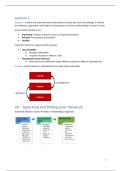
Concept = quality, feature or characteristic that makes topic measurable.
2A – Searching and finding prior literature
Systematic literature search follow a methodological approach:
1
,Process of searching for sources:
1. Decide on your literature search topic refine the ideas into a reasonably clear and specific
topic of what you wish to search for in the literature.
Example:
Financial management versus the impact of the recession narrow down to:
The impact of the recession on financial management narrow down to:
The impact of the recession on financial management budgeting
Search words: recession, financial management, budget
2. Identify search terms and phrases you will use search term = a word or phrase that
describes your research topic, question(s) or objectives.
3. Choose your (online) databases see examples of databases in the slides of week 2.
4. Undertake your search searching for sources.
Type in the search term for the online database.
Use Boolean operators (‘and’, ‘or, ‘not’) to link two or more search terms.
If you have found a paper, trace backwards and forward.
Read abstract/introduction to determine its relevance to your research.
Check bibliographies for more sources.
Note recurring citations.
5. Obtain articles
Types of literature:
Textbooks use to get an overview of your research topic and find out who are the
recognized experts.
o For specific audience (students, professionals)
o Material usually presented in ordered and relatively accessible form
o Draws on wide range of sources, including peer-reviewed academic journal articles
Peer-reviewed (refereed) academic journal articles most useful for your literature review.
o Detailed reports of research
o Written by experts in the field, evaluated by other academics (quality and suitability)
o Rigorous attention to detail and verification of information
o Extensive list of references
Non-refereed academic journal articles may have bias.
o May provide detailed reports of research
o Articles selected by an editor or editorial board with subject knowledge
2
, Professional and trade journal articles can provide useful insights into practice (may be
biased, so use with caution).
o For members of professional trade organizations
o Mix of news items and more detailed accounts of a practical nature
o Rarely based on research, although some provide summaries of research
Newspaper articles good for topical events and developments (may contain bias in
reporting and coverage).
o For members of public, addressing a particular market segment
o Filtered dependent on events, priority on headline-grabbing stories appealing to
readers
Conference proceedings useful if theme of the conference matches your research.
o Articles of selected papers presented at a conference, often published as a book or
special edition of a journal
o Usually peer-reviewed
Reports may be difficult to access or expensive to purchase, but can be useful when the
topic matches your research.
o Reports on specific topics by academics and various organizations.
o May have bias, may not have gone through peer-review process
o Some have high quality (be critical)
There are three types of sources:
Primary sources original materials providing raw data or evidence yet to be developed
and tested to justify your hypothesis or claim.
Secondary sources books, articles or reports that are based on primary sources and are
intended for scholarly or professional audiences.
Tertiary sources books and articles that synthesize and report on secondary sources for
general readers.
Evaluating the usefulness of literature to your research:
Relevance
Value
Reliability
When a literature source meets these criteria:
- Make quotes or summarize of key points.
- Note source information (author, title and journal name, year of publication, page numbers).
- Note things such as findings that are common/contested, two or three important trends in
the research, and the most influential theories.
3



