

Paper 1 Revision:
Topics:
Social Influence
Attachment
Memory
Memory:
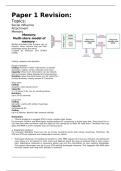
Multi-store model of
memory -
Mental processes that humans use to
acquire, store, retrieve and use their
knowledge about the world.
Created by Atkinson and Shiffrin
(1968)
Coding, capacity and duration:
Sensory Register -
Coding (Format in which information is stored)
Gustatory, haptic, echoic, olfactory and iconic.
Capacity (How much information can be stored)
Very processed, highly detailed and unprocessed.
Duration (How long information can be stored for)
Limited duration, usually around 0.5 seconds.
Short term -
Coding
Acoustic; main sensory form.
Capacity
7 +/-2 items (5-9), can try chunking items.
Duration
Up to 18-30 seconds.
Long term
Coding
Semantic; words with similar meanings.
Capacity
Unlimited.18-30
Coding
Up to a lifetime, Bahrick high external validity.
Evaluation:
- Clinical evidence to suggest STM is more complex than shown.
For example, Shallice and Warrington studied patient KF conducting a digital span test. They found his re -
call was poor when someone read the digits to him compared to when he read them. Therefore this sug-
gests the MMM is more complex than one utinary store.
+ Supporting evidence.
For example, Baddeley found we mix up similar sounding words with similar meanings. Therefore, the
STM and LTM are separate and independent memory stores.
- Prolonged rehearsal not needed for transfer to LTM. MSM argues the more you rehearse something the
more likely it is to transfer to LTM. Craik and Watkins found the type of rehersal that is more impor-
tant; elaborative rehearsal is necessary where you link the information to your existing knowledge.
This means information can go to your LTM without prolonged rehearsal. This suggests that MSM does
not fully explain how long term storage is achieved.
————————————
,Types of long term memory
-
Tulving stated there are 3 types of
long term memory; this criticised
the multi-store model of memory.
Episodic memory:
Autobiographical record of their
personal experiences; these are
time stamped. The strength of the memory is often down to the emotions
experienced when coded. Traumatic events are often well recalled. A sin-
gle memory can contain various different components - visual, auditory,
smell. You have to make a conscious effort to recall the events.
Semantic memory - Explicit memory and contains all knowledge an in-
dividual has learned; meaning of words. Tend to be linked to episodic
memories, however they are not time stamped. Less personal, more
about facts we have learnt; immense amount of information and is con-
stantly being added to.
Procedural memory - Memory for actions, skills and everything we do
(Muscle memory). Not open for conscious inspection (can’t explain
them).
Evaluation:
+Clinical supporting evidence.
For example, (HM) could remember what the term ‘dog’ meant but
couldn’t remember having a dog or petting a dog, this means his seman-
tic memories were fine. Therefore this supports Tulvin’s memory of he
idea that there are multiple types of long term memory.
+Supported by scientific studies.
For example, Tulving conducted a study known as Tulving’s gold memory
study where he asked participants to recall memories in their life; when
they were recalling episodes in their life during the PET scan the right
pre-frontal cortex was signalling whereas when he asked them to recall
general facts the left pre-frontal cortex was signalling. Therefore, this in-
creases the validity of the theory.
+Real life application. For example Belleville trained older people how
had minor cognitive impairments to improve episodic memories. Re-
sults showed the trained participants performed better in memory
tasks than the control group. Therefore, because Belleville used train-
ing techniques based upon Tulving’s theory it could potentially help the
health system with treatments for things such as Alzheimers.
, Working Memory
Created by Baddeley and Hitch
(1974), focuses on the short term
memory.
Central executive - Most impor-
tant part of the model, controls the
slave systems. Has a limited capac-
ity; can process information from
any sensory modality. Monitors in-
coming information, has an atten-
tional process.
Slave systems - Two systems; visio spatial scratchpad and phono-
logical loop. Phonological loop has acoustic coding. Split into two
parts, phonological store and articulatory loop. Phonological store is
external sound whereas the articulatory loop is internal. To do with
maintenance rehearsal. Limited capacity, articulatory loop is any-
thing you can rehearse in 2 seconds. Word length effect - Words
which are short are easier to remember as it takes less then 2 sec-
onds to recall. Visuo-spatial scratchpad is the inner eye, has vis-
ual coding. Has a limited capacity (3-4 items); manipulates images
within our head. Episodic buffer added in 2000 by Baddeley as he
suggested the working memory needed more store. Information
from any sensory modality; manipulates material, limited capacity
(4 chunks). Integrates info from LTM.
Evaluation:
+ Supporting clinical research. For example, Braver; made par-
ticipants complete various different tasks which were associated
with the working memory model. They found the prefrontal cortex
showed activity during planning tasks, occipital lobe during visual
tasks, Wernick’s area during speech perception and Broca’s area
during speech production.
+ Scientific support. For example (KF) could remember words he
stated in his head whereas he couldn’t remember words someone
else told him. This shows there are multiple components within
the working memory model and that it is not just a singular store.
+ Dual task research. Participants asked to do two tasks at the
same time. For example, participants could be doing a visual and
acoustic task at the same time. Found participants who completed
two tasks within the same store suffered with articulatory sup-
pression (trying to compete in the same component). Therefore
this supports the working memory model and suggests it is not
one unitary store.
, - Lack of knowledge and understanding of the central executive.
For example, could be over or underestimating its importance
within the model.
Forgetting (Interference)
Occurs when two pieces of information conflict with each other, re-
sulting in forgetting one of or both or in some distortion of the
memory. Normally associated with long term memory and happens
with similar information.
Two types:
Proactive interference - Earlier learning interferes with what you are
trying to learn at present i.e. learning two languages.
Retroactive interference - More recent learning interferes with the
recall of earlier material.
McGeoch and McDonald (1931)
Studied retroactive interference by changing the amount of similar-
ity between two sets of materials. Participants had to learn a list of
10 words until they could remember them 100%. They then learned
a new list; six groups had to learn different types of new lists.
Findings - Participants had to recall original list of words, the most
similar material (synonyms) produced the worst recall. Shows inter-
ference is strongest when the memories are similar.
Evaluation:
+ Supporting research. For example, McGeoch and McDonald
found interference is stronger when the two materials/memories
are similar. Therefore the research supports the theory’s idea that
memories interfere with one another and lead us to forget. In ad-
dition, the supporting research holds high validity as lab experi-
ments control for extraneous variables, which in return gives us
confidence that interference is a valid explanation for forgetting.
- Research is potentially flawed. For example the majority of stud-
ies asked participants to learn list of words when in real life we try
learn more complex things such as birthdays or ingredients; artifi-
cial tasks in lab experiments does not mirror everyday life tasks.
Therefore, interference cannot be generalised as there is a
greater chance it will be displayed in lab settings rather than in
real life situations.
Topics:
Social Influence
Attachment
Memory
Memory:
Multi-store model of
memory -
Mental processes that humans use to
acquire, store, retrieve and use their
knowledge about the world.
Created by Atkinson and Shiffrin
(1968)
Coding, capacity and duration:
Sensory Register -
Coding (Format in which information is stored)
Gustatory, haptic, echoic, olfactory and iconic.
Capacity (How much information can be stored)
Very processed, highly detailed and unprocessed.
Duration (How long information can be stored for)
Limited duration, usually around 0.5 seconds.
Short term -
Coding
Acoustic; main sensory form.
Capacity
7 +/-2 items (5-9), can try chunking items.
Duration
Up to 18-30 seconds.
Long term
Coding
Semantic; words with similar meanings.
Capacity
Unlimited.18-30
Coding
Up to a lifetime, Bahrick high external validity.
Evaluation:
- Clinical evidence to suggest STM is more complex than shown.
For example, Shallice and Warrington studied patient KF conducting a digital span test. They found his re -
call was poor when someone read the digits to him compared to when he read them. Therefore this sug-
gests the MMM is more complex than one utinary store.
+ Supporting evidence.
For example, Baddeley found we mix up similar sounding words with similar meanings. Therefore, the
STM and LTM are separate and independent memory stores.
- Prolonged rehearsal not needed for transfer to LTM. MSM argues the more you rehearse something the
more likely it is to transfer to LTM. Craik and Watkins found the type of rehersal that is more impor-
tant; elaborative rehearsal is necessary where you link the information to your existing knowledge.
This means information can go to your LTM without prolonged rehearsal. This suggests that MSM does
not fully explain how long term storage is achieved.
————————————
,Types of long term memory
-
Tulving stated there are 3 types of
long term memory; this criticised
the multi-store model of memory.
Episodic memory:
Autobiographical record of their
personal experiences; these are
time stamped. The strength of the memory is often down to the emotions
experienced when coded. Traumatic events are often well recalled. A sin-
gle memory can contain various different components - visual, auditory,
smell. You have to make a conscious effort to recall the events.
Semantic memory - Explicit memory and contains all knowledge an in-
dividual has learned; meaning of words. Tend to be linked to episodic
memories, however they are not time stamped. Less personal, more
about facts we have learnt; immense amount of information and is con-
stantly being added to.
Procedural memory - Memory for actions, skills and everything we do
(Muscle memory). Not open for conscious inspection (can’t explain
them).
Evaluation:
+Clinical supporting evidence.
For example, (HM) could remember what the term ‘dog’ meant but
couldn’t remember having a dog or petting a dog, this means his seman-
tic memories were fine. Therefore this supports Tulvin’s memory of he
idea that there are multiple types of long term memory.
+Supported by scientific studies.
For example, Tulving conducted a study known as Tulving’s gold memory
study where he asked participants to recall memories in their life; when
they were recalling episodes in their life during the PET scan the right
pre-frontal cortex was signalling whereas when he asked them to recall
general facts the left pre-frontal cortex was signalling. Therefore, this in-
creases the validity of the theory.
+Real life application. For example Belleville trained older people how
had minor cognitive impairments to improve episodic memories. Re-
sults showed the trained participants performed better in memory
tasks than the control group. Therefore, because Belleville used train-
ing techniques based upon Tulving’s theory it could potentially help the
health system with treatments for things such as Alzheimers.
, Working Memory
Created by Baddeley and Hitch
(1974), focuses on the short term
memory.
Central executive - Most impor-
tant part of the model, controls the
slave systems. Has a limited capac-
ity; can process information from
any sensory modality. Monitors in-
coming information, has an atten-
tional process.
Slave systems - Two systems; visio spatial scratchpad and phono-
logical loop. Phonological loop has acoustic coding. Split into two
parts, phonological store and articulatory loop. Phonological store is
external sound whereas the articulatory loop is internal. To do with
maintenance rehearsal. Limited capacity, articulatory loop is any-
thing you can rehearse in 2 seconds. Word length effect - Words
which are short are easier to remember as it takes less then 2 sec-
onds to recall. Visuo-spatial scratchpad is the inner eye, has vis-
ual coding. Has a limited capacity (3-4 items); manipulates images
within our head. Episodic buffer added in 2000 by Baddeley as he
suggested the working memory needed more store. Information
from any sensory modality; manipulates material, limited capacity
(4 chunks). Integrates info from LTM.
Evaluation:
+ Supporting clinical research. For example, Braver; made par-
ticipants complete various different tasks which were associated
with the working memory model. They found the prefrontal cortex
showed activity during planning tasks, occipital lobe during visual
tasks, Wernick’s area during speech perception and Broca’s area
during speech production.
+ Scientific support. For example (KF) could remember words he
stated in his head whereas he couldn’t remember words someone
else told him. This shows there are multiple components within
the working memory model and that it is not just a singular store.
+ Dual task research. Participants asked to do two tasks at the
same time. For example, participants could be doing a visual and
acoustic task at the same time. Found participants who completed
two tasks within the same store suffered with articulatory sup-
pression (trying to compete in the same component). Therefore
this supports the working memory model and suggests it is not
one unitary store.
, - Lack of knowledge and understanding of the central executive.
For example, could be over or underestimating its importance
within the model.
Forgetting (Interference)
Occurs when two pieces of information conflict with each other, re-
sulting in forgetting one of or both or in some distortion of the
memory. Normally associated with long term memory and happens
with similar information.
Two types:
Proactive interference - Earlier learning interferes with what you are
trying to learn at present i.e. learning two languages.
Retroactive interference - More recent learning interferes with the
recall of earlier material.
McGeoch and McDonald (1931)
Studied retroactive interference by changing the amount of similar-
ity between two sets of materials. Participants had to learn a list of
10 words until they could remember them 100%. They then learned
a new list; six groups had to learn different types of new lists.
Findings - Participants had to recall original list of words, the most
similar material (synonyms) produced the worst recall. Shows inter-
ference is strongest when the memories are similar.
Evaluation:
+ Supporting research. For example, McGeoch and McDonald
found interference is stronger when the two materials/memories
are similar. Therefore the research supports the theory’s idea that
memories interfere with one another and lead us to forget. In ad-
dition, the supporting research holds high validity as lab experi-
ments control for extraneous variables, which in return gives us
confidence that interference is a valid explanation for forgetting.
- Research is potentially flawed. For example the majority of stud-
ies asked participants to learn list of words when in real life we try
learn more complex things such as birthdays or ingredients; artifi-
cial tasks in lab experiments does not mirror everyday life tasks.
Therefore, interference cannot be generalised as there is a
greater chance it will be displayed in lab settings rather than in
real life situations.


