
Physiology Of Motor Control & Learning Exam Questions With Correct Verified Answers | Latest
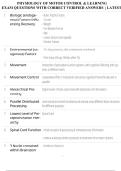
1. Biologic (endogenous) Factors Influencing Recovery - Brain Trophic Factors - Gender - Weight - Pre-Morbid Factors - Age - Lesion Factors (size/speed) - Genetic Factors 2. Environmental (exogenous) Factors - Pre-Injury (exercise, diet, environment enrichment) - Post-Injury (Drugs, Rehab, other Tx) 3. Movement interaction of perception & action systems, with cognition affecting both systems at different levels 4. Movement Control cooperative effort of many brain structures organized hierarchically and in parallel 5. Hierarchical Processing higher levels of brain concerned with abstraction of information 6. Parallel Distributed Processing same signal processed simultaneously among many different brain structures for different purposes 7. Lowest Level of Perception/ Action Hierarchy Spinal Cord 8. Spinal Cord Function - initial reception & processing of somatosensory information - reflex & voluntary control of posture & movement thru motor neurons 9. 3 Nuclei contained within Brainstem - Vestibular (balance) 1 / 14 Physiology of Motor Control & Learning - Red Nucleus - Reticular Nucleus (large role in motor activation) 10. Brainstem Function contains ascending & descending pathways transmitting sensory & motor info to CNS 11. Cerebellum Location behind brainstem; connected by Peduncles 12. Cerebellum Function - coordination & error detection for voluntary movements and balance - "conductor" of timing for movement 13. Where does the Cerebellum receive inputs from? - Spinal Cord - Cerebral Cortex 14. Diencephalon contains thalamus and hypothalamus 15. Thalamus - Main relay center for sensory info of the brain - conducts impulses between the spinal cord and the cerebrum 16. Hypothalamus important for maintaining Homeostasis 17. Basal Ganglia - higher order cognitive aspects of motor control (planning of motor strategies) - helps initiate & plan movement, makes them smooth 18. Pathophysiology of Basal Ganglia can lead to... - Parkinson's (not enough movement) - Huntington's (too much movement) 19. Ce
Document information
- Uploaded on
- September 30, 2025
- Number of pages
- 14
- Written in
- 2025/2026
- Type
- Exam (elaborations)
- Contains
- Questions & answers


