
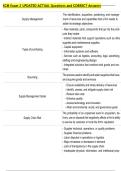
SCM Exam 2 UPDATED ACTUAL Questions and CORRECT Answers
The identification, acquisition, positioning, and manage-
Supply Management ment of resources and capabilities that a firm needs to
attain its strategic objectives
- Raw materials, parts, components that go into the prod-
ucts they make
- Indirect materials that support operations such as oflce
supplies and maintenance supplies
- Capital equipment
Types of purchasing
- Information systems and software
- Services such as logistics, accounting, legal, advertising,
staflng and engineering design
- Integrated solutions that combine both goods and ser-
vices
The process used to identify and select suppliers that have,
Sourcing
and acquire goods and services
- Ensure availability and timely delivery of resources
- Identify, assess, and mitigate supply chain risk
- Reduce total costs
Supply Management Goals
- Enhance quality
- Access technology and innovation
- Attain environmental, social, and governance goals
The probability of an unplanned event in acquisition, de-
Supply Chain Risk livery, use or disposal that negatively affects a firm's ability
to service its customer or hurts the firm's reputation
- Supplier technical, operations, or quality problems
- Supplier financial problems
- Labor disputes in operations or logistics
- Major increases or decreases in demand
- Lack of transparency in the supply chain
- Inadequate physical, information, and intellectual prop-
, erty security
- Natural disasters
- Political stability, terrorism, and war
Factors contributing to risk - Changes in government regulations
- Concentration of suppliers within the same geographical
region
- Labor shortages
- Lean manufacturing
- Just-in-time deliveries
Increase supply chain risk - Reliance on a single supplier for each component
- Global sourcing
- Concentrating suppliers in a single location
Practices identify, assess, and reduce risk exposure and
Supply Chain Risk Management
speed recovery if a disruption occurs
The capability to resist and recover from supply chain
Supply Chain Resilience
disruptions
- Holding higher inventory levels of critical materials to
allow more time to react if a disruption occurs
- Using multiple suppliers for purchases reducing depen-
dence on a single company
- Working closely with suppliers to improve their capabil-
Increase supply chain resilience
ities
- Requiring suppliers to have geographically dispersed
operations
- Investing in technical solutions such as blockchain to
increase visibility throughout the supply chain
All the costs incurred before, during, and after a purchase
Total Cost of Ownership (sourcing costs, purchase price, transportation, handling,
inspection, quality, rework, maintenance, and disposal)
, Time spent and costs of searching for, visiting, evaluating,
Before the transaction
and certifying suppliers
Purchase price and costs of ordering, transporting, expe-
During the transaction
diting, receiving, inspecting, and following up
Costs of inventory, supply risk, production downtime, de-
fects in finished goods, warranties, safety recalls, replace-
After the transaction
ments, repairs, lost sales, liability, and damaged reputa-
tion
- Support and provide value to the community
- Increase social diversity
- Encourage environmental responsibility
Sustainability and ESG Goals - Display ethical behavior
- Practice and promote financial responsibility
- Respect human rights
- Ensure a safe working environment
Resources and capabilities that should be provided by the
Insourcing
firm
Resources and capabilities that should be provided by its
Outsourcing
suppliers
Considers insourcing and outsourcing the production of
Make or buy decision
parts and components
- Capital is not needed for equipment and facilities
- Easier to add or remove capacity if demand changes
- Lower costs because suppliers gain economies of scale
Outsourcing advantages
and suppliers often pay lower wages
- Increased flexibility to change technology or suppliers
- Better access to supply market information
Outsourcing disadvantages
The identification, acquisition, positioning, and manage-
Supply Management ment of resources and capabilities that a firm needs to
attain its strategic objectives
- Raw materials, parts, components that go into the prod-
ucts they make
- Indirect materials that support operations such as oflce
supplies and maintenance supplies
- Capital equipment
Types of purchasing
- Information systems and software
- Services such as logistics, accounting, legal, advertising,
staflng and engineering design
- Integrated solutions that combine both goods and ser-
vices
The process used to identify and select suppliers that have,
Sourcing
and acquire goods and services
- Ensure availability and timely delivery of resources
- Identify, assess, and mitigate supply chain risk
- Reduce total costs
Supply Management Goals
- Enhance quality
- Access technology and innovation
- Attain environmental, social, and governance goals
The probability of an unplanned event in acquisition, de-
Supply Chain Risk livery, use or disposal that negatively affects a firm's ability
to service its customer or hurts the firm's reputation
- Supplier technical, operations, or quality problems
- Supplier financial problems
- Labor disputes in operations or logistics
- Major increases or decreases in demand
- Lack of transparency in the supply chain
- Inadequate physical, information, and intellectual prop-
, erty security
- Natural disasters
- Political stability, terrorism, and war
Factors contributing to risk - Changes in government regulations
- Concentration of suppliers within the same geographical
region
- Labor shortages
- Lean manufacturing
- Just-in-time deliveries
Increase supply chain risk - Reliance on a single supplier for each component
- Global sourcing
- Concentrating suppliers in a single location
Practices identify, assess, and reduce risk exposure and
Supply Chain Risk Management
speed recovery if a disruption occurs
The capability to resist and recover from supply chain
Supply Chain Resilience
disruptions
- Holding higher inventory levels of critical materials to
allow more time to react if a disruption occurs
- Using multiple suppliers for purchases reducing depen-
dence on a single company
- Working closely with suppliers to improve their capabil-
Increase supply chain resilience
ities
- Requiring suppliers to have geographically dispersed
operations
- Investing in technical solutions such as blockchain to
increase visibility throughout the supply chain
All the costs incurred before, during, and after a purchase
Total Cost of Ownership (sourcing costs, purchase price, transportation, handling,
inspection, quality, rework, maintenance, and disposal)
, Time spent and costs of searching for, visiting, evaluating,
Before the transaction
and certifying suppliers
Purchase price and costs of ordering, transporting, expe-
During the transaction
diting, receiving, inspecting, and following up
Costs of inventory, supply risk, production downtime, de-
fects in finished goods, warranties, safety recalls, replace-
After the transaction
ments, repairs, lost sales, liability, and damaged reputa-
tion
- Support and provide value to the community
- Increase social diversity
- Encourage environmental responsibility
Sustainability and ESG Goals - Display ethical behavior
- Practice and promote financial responsibility
- Respect human rights
- Ensure a safe working environment
Resources and capabilities that should be provided by the
Insourcing
firm
Resources and capabilities that should be provided by its
Outsourcing
suppliers
Considers insourcing and outsourcing the production of
Make or buy decision
parts and components
- Capital is not needed for equipment and facilities
- Easier to add or remove capacity if demand changes
- Lower costs because suppliers gain economies of scale
Outsourcing advantages
and suppliers often pay lower wages
- Increased flexibility to change technology or suppliers
- Better access to supply market information
Outsourcing disadvantages


