
Nr507 Review Midterm Exam Questions With Correct Verified Answers | 100% Pass (A+ Certified)
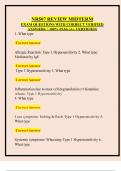
NR507 REVIEW MIDTERM EXAM QUESTIONS WITH CORRECT VERIFIED ANSWERS | 100% PASS (A+ CERTIFIED) 1. What type Correct Answer Allergic Reaction: Type 1 Hypersensitivity 2. What type: Mediated by IgE Correct Answer Type 1 Hypersensitivity 3. What type Correct Answer Inflammation due to mast cell degranulation r/t histamine release: Type 1 Hypersensitivity 4. What type Correct Answer Loca symptoms- Itching & Rash: Type 1 Hypersensitivity 5. What type Correct Answer Systemic symptoms- Wheezing: Type 1 Hypersensitivity 6. What type Correct Answer Most dangerous form is an anaphylatic reaction systemic response, hypotension, severe bronchoconstriction: Type 1 Hypersensitivity 7. What type Correct Answer Treatment: Epinephrine reverses its effects (hypotension and bronchoconstriciton): Type 1 Hypersensitivity 8. What type Correct Answer Cytotoxic reaction (toxic to living cells) & tissue specific i. e.- thyroid tissue- breaks down of thyroid cells: Type 2 Hypersensitivity 9. What type Correct Answer Macrophages are the primary effectors cells involved: Type 2 Hypersensitivity 10. What type Correct Answer Can cause tissue damage and alter its function. i.e. thryiod damage, alters the thryoids function-- Graves Disease is a autoimmune form of hyperthyroidism where it alters the thyroids function (doesnt destroy the tissue though) Correct Answer Type 2 Hypersensitivity 11. Graves disease: an autoimmune disorder that is caused by hyperthyroidism and is characterized by goiter and/or exophthalmos Type 2 Hypersensitivity 12. What type: Incompatible blood type example of cell/tissue damage that occurs. Severe transfusion reaction occurs and the transfused erythrocytes (antigens that is going into the body has a different blood type) are destroyed by aggultination or complement-mediated lysis Correct Answer Type 2 Hypersensitivity 13. What type: Organ specific- the antibody is going to bind to the antigen on the cell surgace of a sepcific organ Correct Answer Type 2 Hypersensitivity 14. What type: The antibody binds to soluble antigen outside of the cell surface that was relased into the blood or body fluids, and the complex is then deposited in the tissues. You have a antigen (anti-complex) that circulates outside of the cell surface so its a antigen/antibody complex released to the blood and then depositis in joints, tissues, and organs and causes damage to that particular system Correct Answer Type 3 Hypersensitivity 15. What type: Not organ specific: Type 3 Hypersensitivity 16. What type: Lupus: Type 2 and type 3 Hypersensitivity 17. What type: Lupus: a chronic autoimmune disease characterized by inflammation of various parts of the body 18. What type: Rheumatoid Arthritis: Antigen/antibodies are depoisted in the joints. Lupus: antibody/antigens deposit in the organs: Type 3 Hypersensitivity 19. Type 3 and Type Reaction antibodies most involved Correct Answer IGG & IGM 20. With lupus no one presents the same why Correct Answer Because the antibody complexes circulat to a lot of areas in the body. Individualized diagnosis and treatment based on how the individual is presenting. 21. Symptoms of Lupus (Type 3 auto-immune response) -Facial rash- -Discoid Rah- -Oral or nasohargyngeal u_______ -Hem___________ disorders (hemolytic anemia, leuopenia lymphonia, or thrombocytopenia) -Im______________ disorders -Non-eorisve ar__________ of at least 2 peripheral joints -Serositis -R________ Disorder -Neurological disorders- se________ or ps_____________ -Presence of anti-n_________ antibody Correct Answer Facial rash- Malar rash -Discoid Rah- rasied patches devleoped as a result of sunlight -Oral or nasohargyngeal ulcers -Hemtaologic disorders (hemolytic anemia, leuopenia
Document information
- Uploaded on
- September 30, 2025
- Number of pages
- 45
- Written in
- 2025/2026
- Type
- Exam (elaborations)
- Contains
- Questions & answers


